Hemiarthroplasty or internal fixation for intracapsular displaced femoral neck fractures: randomised controlled trial
- PMID: 18056740
- PMCID: PMC2137068
- DOI: 10.1136/bmj.39399.456551.25
Hemiarthroplasty or internal fixation for intracapsular displaced femoral neck fractures: randomised controlled trial
Abstract
Objective: To compare the functional results after displaced fractures of the femoral neck treated with internal fixation or hemiarthroplasty.
Design: Randomised trial with blinding of assessments of functional results.
Setting: University hospital.
Participants: 222 patients; 165 (74%) women, mean age 83 years. Inclusion criteria were age above 60, ability to walk before the fracture, and no major hip pathology, regardless of cognitive function.
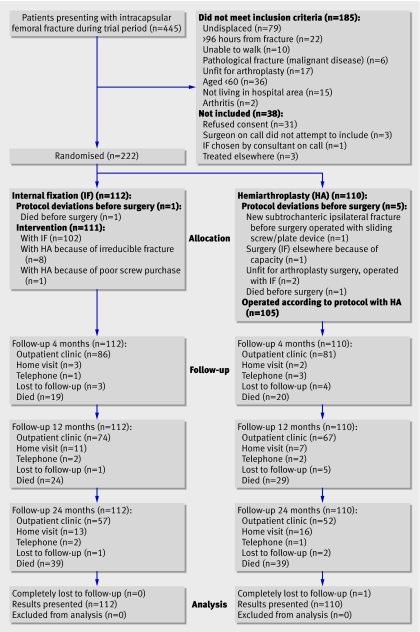
Interventions: Closed reduction and two parallel screws (112 patients) and bipolar cemented hemiarthroplasty (110 patients). Follow-up at 4, 12, and 24 months.
Main outcome measures: Hip function (Harris hip score), health related quality of life (Eq-5d), activities of daily living (Barthel index). In all cases high scores indicate better function.
Results: Mean Harris hip score in the hemiarthroplasty group was 8.2 points higher (95% confidence interval 2.8 to 13.5 points, P=0.003) at four months and 6.7 points (1.5 to 11.9 points, P=0.01) higher at 12 months. Mean Eq-5d index score at 24 months was 0.13 higher in the hemiarthroplasty group (0.01 to 0.25, P=0.03). The Eq-5d visual analogue scale was 8.7 points higher in the hemiarthroplasty group after 4 months (1.9 to 15.6, P=0.01). After 12 and 24 months the percentage scoring 95 or 100 on the Barthel index was higher in the hemiarthroplasty group (relative risk 0.67, 0.47 to 0.95, P=0.02. and 0.63, 0.42 to 0.94, P=0.02, respectively). Complications occurred in 56 (50%) patients in the internal fixation group and 16 (15%) in the hemiarthroplasty group (3.44, 2.11 to 5.60, P<0.001). In each group 39 patients (35%) died within 24 months (0.98, 0.69 to 1.40, P=0.92)
Conclusions: Hemiarthroplasty is associated with better functional outcome than internal fixation in treatment of displaced fractures of the femoral neck in elderly patients.
Trial registration: NCT00464230.
Conflict of interest statement
Competing interests: FF has received lecture fees from OrtoMedic, who market orthopaedic implants; LN has received consulting and lecture fees from DePuy, Biomet, OrtoMedic, and SCP, who all manufacture and market orthopaedic implants.
Figures
Comment in
-
Treatment of displaced intracapsular hip fractures in elderly patients.BMJ. 2007 Dec 15;335(7632):1220-1. doi: 10.1136/bmj.39392.353090.80. Epub 2007 Dec 4. BMJ. 2007. PMID: 18056744 Free PMC article.
References
-
- Johnell O, Kanis JA. An estimate of the worldwide prevalence and disability associated with osteoporotic fractures. Osteoporos Int 2006;17:1726-33. - PubMed
-
- Johnell O, Kanis JA. An estimate of the worldwide prevalence, mortality and disability associated with hip fracture. Osteoporos Int 2004;15:897-902. - PubMed
-
- Van Balen R, Steyerberg EW, Polder JJ, Ribbers TL, Habbema JD, Cools HJ. Hip fracture in elderly patients: outcomes for function, quality of life, and type of residence. Clin Orthop Relat Res 2001;390:232-43. - PubMed
-
- Osnes EK, Lofthus CM, Meyer HE, Falch JA, Nordsletten L, Cappelen I, et al. Consequences of hip fracture on activities of daily life and residential needs. Osteoporos Int 2004;15:567-74. - PubMed
-
- Lofthus CM, Osnes EK, Falch JA, Kaastad TS, Kristiansen IS, Nordsletten L, et al. Epidemiology of hip fractures in Oslo, Norway. Bone 2001;29:413-8. - PubMed
Publication types
MeSH terms
Associated data
LinkOut - more resources
Full Text Sources
Medical