An immortalized human cell line bearing a PRKAR1A-inactivating mutation: effects of overexpression of the wild-type Allele and other protein kinase A subunits
- PMID: 18056771
- PMCID: PMC2243228
- DOI: 10.1210/jc.2007-1902
An immortalized human cell line bearing a PRKAR1A-inactivating mutation: effects of overexpression of the wild-type Allele and other protein kinase A subunits
Abstract
Context: Inactivating mutations of PRKAR1A, the regulatory subunit type 1A (RIalpha) of protein kinase A (PKA), are associated with tumor formation.
Objective: Our objective was to evaluate the role of PKA isozymes on proliferation and cell cycle.
Methods: A cell line with RIalpha haploinsufficiency due to an inactivating PRKAR1A mutation (IVS2+1 G-->A) was transfected with constructs encoding PKA subunits. Genetics, PKA subunit mRNA and protein expression and proliferation, aneuploidy, and cell cycle status were assessed. To identify factors that mediate PKA-associated cell cycle changes, we studied E2F and cyclins expression in transfected cells and E2F's role by small interfering RNA; we also assessed cAMP levels and baseline and stimulated cAMP signaling in transfected cells.
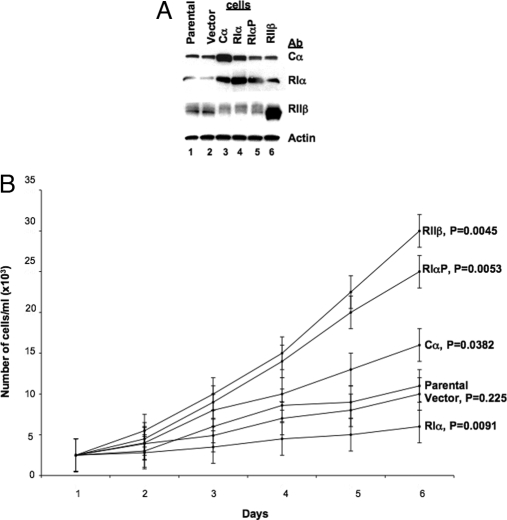
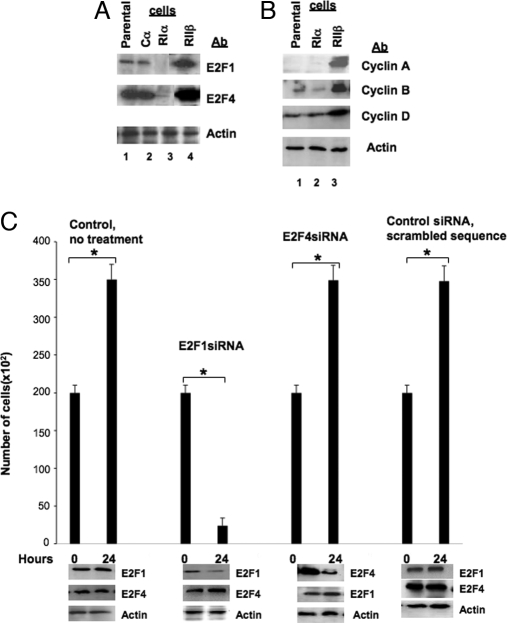
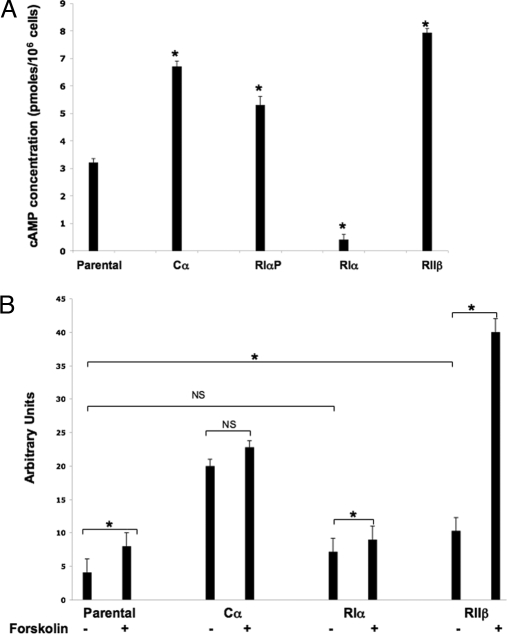
Results: Introduction of PKA subunits led to changes in proliferation and cell cycle: a decrease in aneuploidy and G(2)/M for the PRKAR1A-transfected cells and an increase in S phase and aneuploidy for cells transfected with PRKAR2B, a known PRKAR1A mutant (RIalphaP), and the PKA catalytic subunit. There were alterations in cAMP levels, PKA subunit expression, cyclins, and E2F factors; E2F1 was shown to possibly mediate PKA effects on cell cycle by small interfering RNA studies. cAMP levels and constitutive and stimulated cAMP signaling were altered in transfected cells.
Conclusion: This is the first immortalized cell line with a naturally occurring PRKAR1A-inactivating mutation that is associated in vivo with tumor formation. PKA isozyme balance is critical for the control of cAMP signaling and related cell cycle and proliferation changes. Finally, E2F1 may be a factor that mediates dysregulated PKA's effects on the cell cycle.
Figures
References
-
- Stratakis CA 2003 Genetics of adrenocortical tumors: gatekeepers, landscapers and conductors in symphony. Trends Endocrinol Metab 14:404–410 - PubMed
-
- Boston BA, Mandel S, LaFranchi S, Bliziotes M 1994 Activating mutation in the stimulatory guanine nucleotide-binding protein in an infant with Cushing’s syndrome and nodular adrenal hyperplasia. J Clin Endocrinol Metab 79:890–893 - PubMed
-
- Fragoso MC, Domenice S, Latronico AC, Martin RM, Pereira MA, Zerbini MC, Lucon AM, Mendonca BB 2003 Cushing’s syndrome secondary to adrenocorticotropin-independent macronodular adrenocortical hyperplasia due to activating mutations of GNAS1 gene. J Clin Endocrinol Metab 88:2147–2151 - PubMed
-
- Groussin L, Jullian E, Perlemoine K, Louvel A, Leheup B, Luton JP, Bertagna X, Bertherat J 2002 Mutations of the PRKAR1A gene in Cushing’s syndrome due to sporadic primary pigmented nodular adrenocortical disease. J Clin Endocrinol Metab 87:4324–4329 - PubMed
-
- Kirschner LS, Carney JA, Pack SD, Taymans SE, Giatzakis C, Cho YS, Cho-Chung YS, Stratakis CA 2000 Mutations of the gene encoding the protein kinase A type I-α regulatory subunit in patients with the Carney complex. Nat Genet 26:89–92 - PubMed
Publication types
MeSH terms
Substances
Grants and funding
LinkOut - more resources
Full Text Sources
Research Materials