. 2008 Feb;82(4):1688-700.
doi: 10.1128/JVI.01842-07. Epub 2007 Dec 5.

Hepatitis A virus mutant spectra under the selective pressure of monoclonal antibodies: codon usage constraints limit capsid variability

Affiliations

Hepatitis A virus mutant spectra under the selective pressure of monoclonal antibodies: codon usage constraints limit capsid variability

Lluís Aragonès et al. J Virol. 2008 Feb.

Abstract

Severe structural constraints in the hepatitis A virus (HAV) capsid have been suggested as the reason for the lack of emergence of new serotypes in spite of the occurrence of complex distributions of mutants or quasispecies. Analysis of the HAV mutant spectra under immune pressure by the monoclonal antibodies (MAbs) K34C8 (immunodominant site) and H7C27 (glycophorin binding site) has revealed different evolutionary dynamics. Populations composed of complex ensembles of mutants with very low fitness or single dominant mutants with high fitness permit the acquisition of resistance to each of the MAbs, respectively. Deletion mutants were detected as components of the mutant spectra: up to 61 residues, with an average of 19, and up to 83 residues, with an average of 45, in VP3 and VP1 proteins, respectively. A clear negative selection of those replacements affecting the residues encoded by rare codons of the capsid surface has been detected through the present quasispecies analysis, confirming a certain beneficial role of such clusters. Since these clusters are located near or at the epitope regions, the need to maintain such clusters might prevent the emergence of new serotypes.


Figures
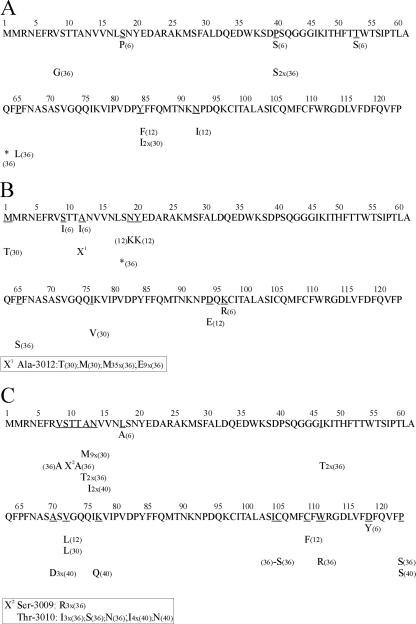
FIG. 1.
FIG. 1.
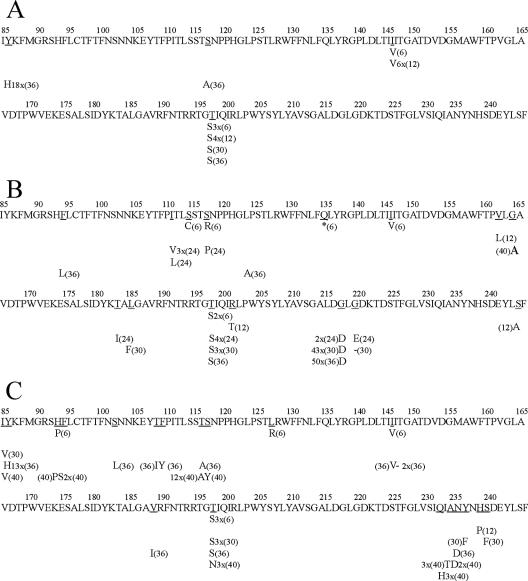
Amino acid replacements detected in a fragment of the VP3 protein through different passages of the HAV pHM175 43c strain under the selective pressure of the unrelated FCA antibody (A), H7C27 MAb (B), and K34C8 MAb (C). The replaced residues are underlined, with the new amino acid indicated below. The passage at which a given substitution occurred is indicated in parentheses. When a given substitution was present in more than one molecular clone is also indicated: i.e., “2x” means “two clones,” an asterisk represents generation of a stop codon, and “X” indicates when different replacements were detected for the same residue.
FIG. 2.
FIG. 2.
Amino acid replacements detected in a fragment of the VP1 protein through different passages of the HAV pHM175 43c strain under the selective pressure of the unrelated FCA antibody (A), H7C27 MAb (B), and K34C8 MAb (C). The replaced residues are underlined, with the new amino acid indicated below. The passage at which a given substitution occurred is indicated in parentheses. When a given substitution was present in more than one molecular clone is also indicated: i.e., “2x” indicates “two clones,” an asterisk represents generation of a stop codon, “−” represents generation of a deletion, and “X” indicates when different replacements were detected for the same residue.
FIG. 3.
FIG. 3.
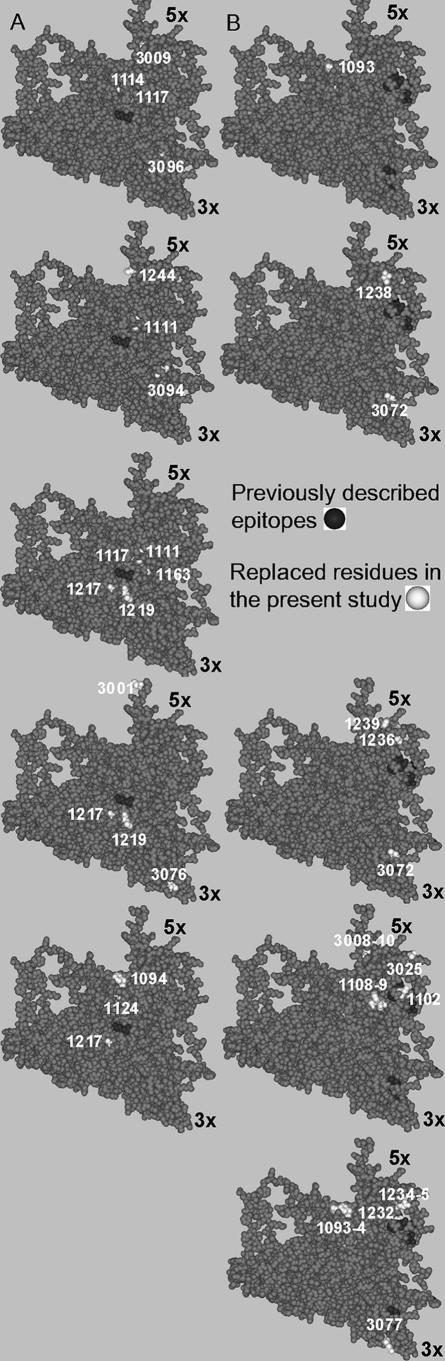
Location of the amino acid replacements detected during the passage of strain pHM175 43c under the selective pressure of the H7C27 MAb (A) or the K34C8 MAb (B) on an HAV protomer model (M. Luo, personal communication). The mutant spectrum was analyzed at P6, P12, P24, P30, and P36 (ordered vertically) in the case of the H7C27 MAb and P6, P12, P30, P36, and P40 (ordered vertically) in the case of the K34C8 MAb.
FIG. 4.
FIG. 4.
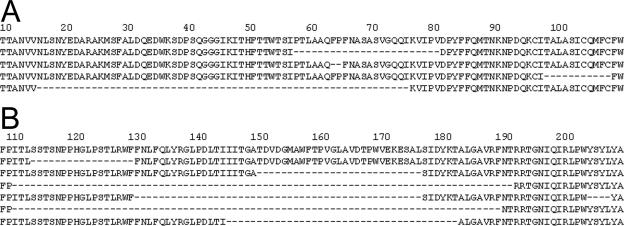
Genomes coding for deleted proteins among the different mutant spectra in VP3 (A) and VP1 (B).
FIG. 5.
FIG. 5.
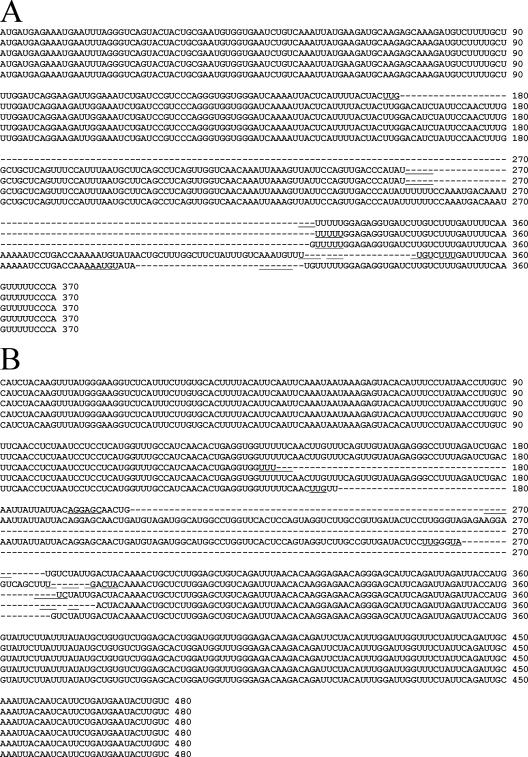
Genomes harboring nucleotide deletions detected among the different mutant spectra in VP3 (A) and VP1 (B). Direct repetitions of identical or very similar sequences at parting and anchoring sites are underlined.
FIG. 6.
FIG. 6.
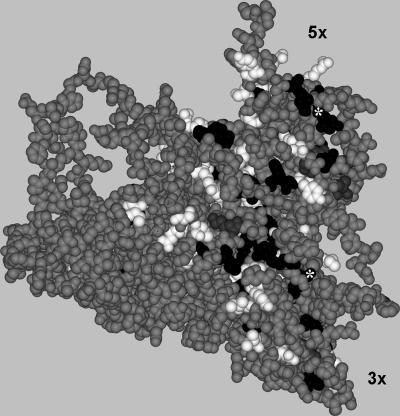
HAV protomer model (M. Luo, personal communication) in which is contained a merged image of the locations of all of the substituted residues detected through all of the passages with both antibodies (residues labeled in black) and the location of the residues encoded by rare codons (residues labeled in white). Those cases in which the replaced residue was encoded by a rare codon are labeled with asterisks. Previously identified residues associated either with the H7C27 or K34C8 MAb are labeled in gray.
FIG. 7.
FIG. 7.
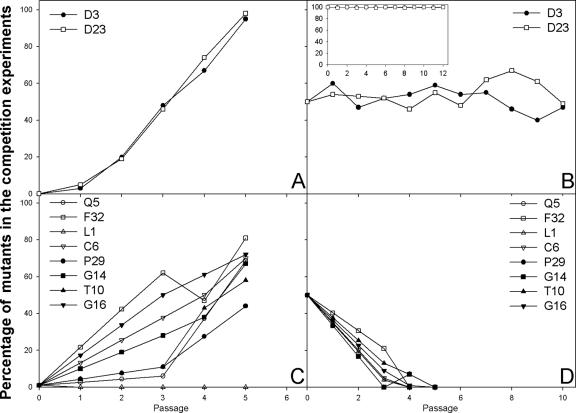
Growth competition experiments. Two H7C27 MAR mutants (A and B) and eight K34C8 MAR mutants (C and D) were grown in competition with the wild-type virus. In the presence of antibodies (A and C), the MAR/w+ ratios were 1:1,000 and 1:100 for the H7C27 and K34C8 MAbs, respectively. In the absence of antibodies (B and D), the ratio was 1:1, with the exception of the insert in panel B, which had a ratio of 1,000:1.

References

    1. Adzhubei, A. A., I. A. Adzhubei, I. A. Krasheninnikov, and S. Neidle. 1996. Non-radom usage of “degenerate” codons is related to protein three-dimensional structure. FEBS Lett. 39978-82. - PubMed
    1. Agol, V. I. 2002. Picornavirus genetics: an overview, p. 269-284. In B. L. Semler and E. Wimmer (ed.), Molecular biology of picornaviruses. ASM Press, Washington, DC.
    1. Airaksinen, A., N. Pariente, L. Menendez-Arias, and E. Domingo. 2003. Curing of foot-and-mouth disease virus from persistently infected cells by ribavirin involves enhanced mutagenesis. Virology 311339-349. - PubMed
    1. Arauz-Ruiz, P., L. Sundqvist, Z. García, L. Taylor, K. Visoná, H. Norder, and L. O. Magnius. 2001. Presumed common source outbreaks of hepatitis A in an endemic area confirmed by limited sequencing within the VP1 region. J. Med. Virol. 65449-456. - PubMed
    1. Arias, A., E. Lazaro, C. Escarmis, and E. Domingo. 2001. Molecular intermediates of fitness gain of an RNA virus: characterization of a mutant spectrum by biological and molecular cloning. J. Gen. Virol. 821049-1060. - PubMed

Publication types

MeSH terms

LinkOut - more resources