Sodium bicarbonate is associated with an increased incidence of contrast nephropathy: a retrospective cohort study of 7977 patients at mayo clinic
- PMID: 18057306
- PMCID: PMC2390990
- DOI: 10.2215/CJN.03100707
Sodium bicarbonate is associated with an increased incidence of contrast nephropathy: a retrospective cohort study of 7977 patients at mayo clinic
Abstract
Background and objectives: The role of sodium bicarbonate in preventing contrast nephropathy needs to be evaluated in clinical settings.
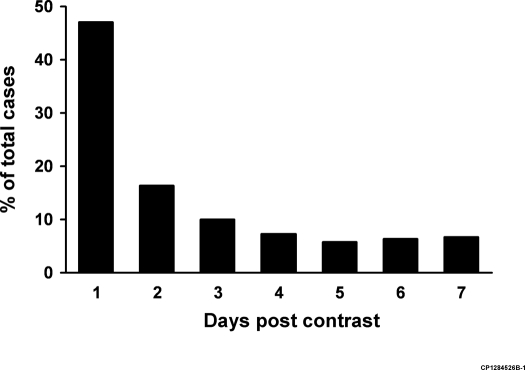
Design, setting, participants, & measurements: We performed a retrospective cohort study at Mayo Clinic in Rochester, Minnesota, to assess the risk of contrast nephropathy associated with the use of sodium bicarbonate, N-acetylcysteine, and the combination of sodium bicarbonate with N-acetylcysteine from April 2004 to May 2005. Contrast nephropathy was defined as postexposure creatinine elevation of > or =25% or >0.5 mg/dl within 7 d of contrast exposure.
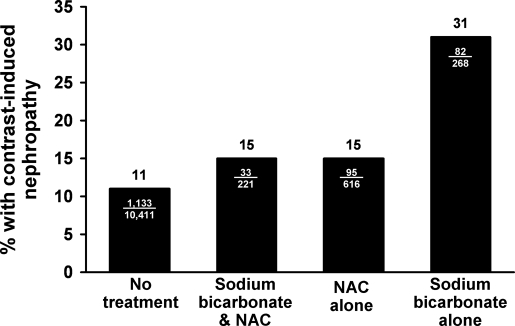
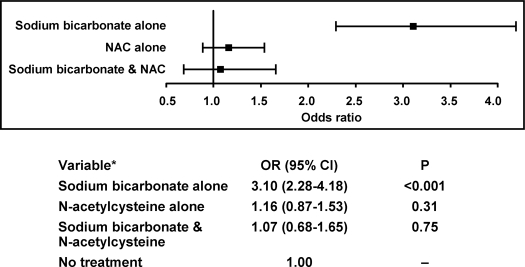
Results: A total of 11,516 contrast exposures in 7977 patients had creatinine values available for review before and after contrast exposure. More than 90% of exposures to agents prophylactic for contrast nephropathy were available for analysis. Sodium bicarbonate was used in 268 cases, N-acetylcysteine was used in 616 cases, and both agents were used in combination in 221 cases of contrast exposure. After adjustment for total volume of hydration, medications, age, gender, prior creatinine, contrast iodine load, prior exposure to contrast material, type of imaging study, heart failure, hypertension, renal failure, multiple myeloma, and diabetes mellitus, use of sodium bicarbonate alone was associated with an increased risk of contrast nephropathy compared with no treatment (odds ratio 3.10, 95% confidence interval 2.28 to 4.18; P < 0.001). N-acetylcysteine alone and in combination with sodium bicarbonate was not associated with any significant difference in the incidence of contrast nephropathy.
Conclusions: The use of intravenous sodium bicarbonate was associated with increased incidence of contrast nephropathy. Use of sodium bicarbonate to prevent contrast nephropathy should be evaluated further rather than adopted into clinical practice.
Figures
Comment in
-
Use of intravenous sodium bicarbonate might increase the risk of contrast nephropathy.Nat Clin Pract Nephrol. 2008 Jun;4(6):296-7. doi: 10.1038/ncpneph0805. Epub 2008 Apr 15. Nat Clin Pract Nephrol. 2008. PMID: 18414460 No abstract available.
References
-
- McCullough PA, Wolyn R, Rocher LL, Levin RN, O'Neill WW: Acute renal failure after coronary intervention: Incidence, risk factors, and relationship to mortality. Am J Med 103: 368–375, 1997 - PubMed
-
- Hou SH, Bushinsky DA, Wish JB, Cohen JJ, Harrington JT: Hospital-acquired renal insufficiency: A prospective study. Am J Med 74: 243–248, 1983 - PubMed
-
- Iakovou I, Dangas G, Mehran R, Lansky AJ, Ashby DT, Fahy M, Mintz GS, Kent KM, Pichard AD, Satler LF, Stone GW, Leon MB: Impact of gender on the incidence and outcome of contrast-induced nephropathy after percutaneous coronary intervention. J Invasive Cardiol 15: 18–22, 2003 - PubMed
-
- Rihal CS, Textor SC, Grill DE, Berger PB, Ting HH, Best PJ, Singh M, Bell MR, Barsness GW, Mathew V, Garratt KN, Holmes DR Jr: Incidence and prognostic importance of acute renal failure after percutaneous coronary intervention. Circulation 105: 2259–2264, 2002 - PubMed
-
- Levy EM, Viscoli CM, Horwitz RI: The effect of acute renal failure on mortality. A cohort analysis. JAMA 275: 1489–1494, 1996 - PubMed
Publication types
MeSH terms
Substances
LinkOut - more resources
Full Text Sources
Medical
Miscellaneous