Childhood body-mass index and the risk of coronary heart disease in adulthood
- PMID: 18057335
- PMCID: PMC3062903
- DOI: 10.1056/NEJMoa072515
Childhood body-mass index and the risk of coronary heart disease in adulthood
Abstract
Background: The worldwide epidemic of childhood obesity is progressing at an alarming rate. Risk factors for coronary heart disease (CHD) are already identifiable in overweight children. The severity of the long-term effects of excess childhood weight on CHD, however, remains unknown.
Methods: We investigated the association between body-mass index (BMI) in childhood (7 through 13 years of age) and CHD in adulthood (25 years of age or older), with and without adjustment for birth weight. The subjects were a cohort of 276,835 Danish schoolchildren for whom measurements of height and weight were available. CHD events were ascertained by linkage to national registers. Cox regression analyses were performed.
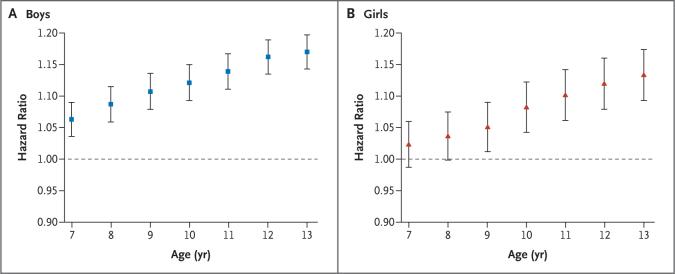
Results: In 5,063,622 person-years of follow-up, 10,235 men and 4318 women for whom childhood BMI data were available received a diagnosis of CHD or died of CHD as adults. The risk of any CHD event, a nonfatal event, and a fatal event among adults was positively associated with BMI at 7 to 13 years of age for boys and 10 to 13 years of age for girls. The associations were linear for each age, and the risk increased across the entire BMI distribution. Furthermore, the risk increased as the age of the child increased. Adjustment for birth weight strengthened the results.
Conclusions: Higher BMI during childhood is associated with an increased risk of CHD in adulthood. The associations are stronger in boys than in girls and increase with the age of the child in both sexes. Our findings suggest that as children are becoming heavier worldwide, greater numbers of them are at risk of having CHD in adulthood.
Copyright 2007 Massachusetts Medical Society.
Figures
Republished in
-
[Childhood body mass index and the risk of coronary heart disease in adulthood].Ugeskr Laeger. 2008 Aug 11;170(33):2434-7. Ugeskr Laeger. 2008. PMID: 18761824 Danish.
Comment in
-
Childhood obesity--the shape of things to come.N Engl J Med. 2007 Dec 6;357(23):2325-7. doi: 10.1056/NEJMp0706538. N Engl J Med. 2007. PMID: 18057334 No abstract available.
-
Pediatric obesity: an impending catastrophe.Arch Iran Med. 2008 Mar;11(2):242-5. Arch Iran Med. 2008. PMID: 18298310 No abstract available.
References
-
- Rössner S. Obesity: the disease of the twenty-first century. Int J Obes Relat Metab Disord. 2002;26(Suppl 4):S2–S4. - PubMed
-
- Ogden CL, Carroll MD, Curtin LR, McDowell MA, Tabak CJ, Flegal KM. Prevalence of overweight and obesity in the United States, 1999−2004. JAMA. 2006;295:1549–55. - PubMed
-
- Must A, Strauss RS. Risks and consequences of childhood and adolescent obesity. Int J Obes Relat Metab Disord. 1999;23(Suppl 2):S2–S11. - PubMed
-
- Weiss R, Dziura J, Burgert TS, et al. Obesity and the metabolic syndrome in children and adolescents. N Engl J Med. 2004;350:2362–74. - PubMed
Publication types
MeSH terms
Grants and funding
LinkOut - more resources
Full Text Sources
Other Literature Sources
Medical