


Comment
doi: 10.1172/JCI34250.
Staying awake puts pressure on brain arousal systems
Affiliations
- PMID: 18060024
- PMCID: PMC2096454
- DOI: 10.1172/JCI34250
Item in Clipboard
Comment
Staying awake puts pressure on brain arousal systems
J Clin Invest.
2007 Dec.
Abstract
Many brain centers are involved in keeping us awake. One example is the recently discovered hypocretin system located in the posterior hypothalamus. In this issue of the JCI, Rao et al. show that, in mice, synapses targeting hypocretin neurons become stronger when wakefulness is prolonged beyond its physiological duration (see the related article beginning on page 4022). This increase in synaptic strength may be one of the mechanisms that help us to stay awake when we are sleep deprived, but it may also represent one of the signals telling the brain that it is time to sleep.
Figures
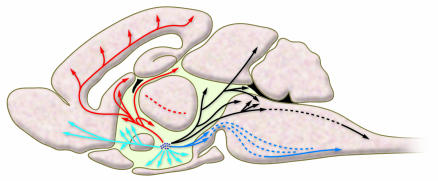
Hypocretin provides excitatory input to other wakefulness-promoting areas. Hypocretin-labeled neurons are shown in purple, the dorsal ascending pathway in red, the ventral ascending pathway in light blue, the dorsal descending pathway in black, and the ventral descending pathway in dark blue. Image reproduced with permission from Trends in Neurosciences (21).
Comment on
-
Prolonged wakefulness induces experience-dependent synaptic plasticity in mouse hypocretin/orexin neurons.J Clin Invest. 2007 Dec;117(12):4022-33. doi: 10.1172/JCI32829. J Clin Invest. 2007. PMID: 18060037 Free PMC article.
References
-
- Durmer J.S., Dinges D.F. Neurocognitive consequences of sleep deprivation. Semin. Neurol. 2005;25:117–129. - PubMed
-
- Jones B.E. From waking to sleeping: neuronal and chemical substrates. Trends Pharmacol. Sci. 2005;26:578–586. - PubMed
-
- Dahan L., et al. Prominent burst firing of dopaminergic neurons in the ventral tegmental area during paradoxical sleep. Neuropsychopharmacology. 2007;32:1232–1241. - PubMed
-
- Monti J.M., Monti D. The involvement of dopamine in the modulation of sleep and waking. Sleep Med. Rev. 2007;11:113–133. - PubMed
-
- Sakurai T. The neural circuit of orexin (hypocretin): maintaining sleep and wakefulness. Nat. Rev. Neurosci. 2007;8:171–181. - PubMed
