


Polymorphisms in the peroxisome proliferator activated receptor alpha gene are associated with levels of apolipoprotein CIII and triglyceride in African-Americans but not Caucasians
- PMID: 18061194
- PMCID: PMC2678963
- DOI: 10.1016/j.atherosclerosis.2007.10.004
Polymorphisms in the peroxisome proliferator activated receptor alpha gene are associated with levels of apolipoprotein CIII and triglyceride in African-Americans but not Caucasians
Abstract
Background: We tested whether single nucleotide polymorphisms (SNPs) in the PPARalpha gene (PPARA) are associated with variations in levels of plasma apolipoprotein CIII (apoCIII) levels, as well as other lipids and lipoproteins, in African-Americans and Caucasians.
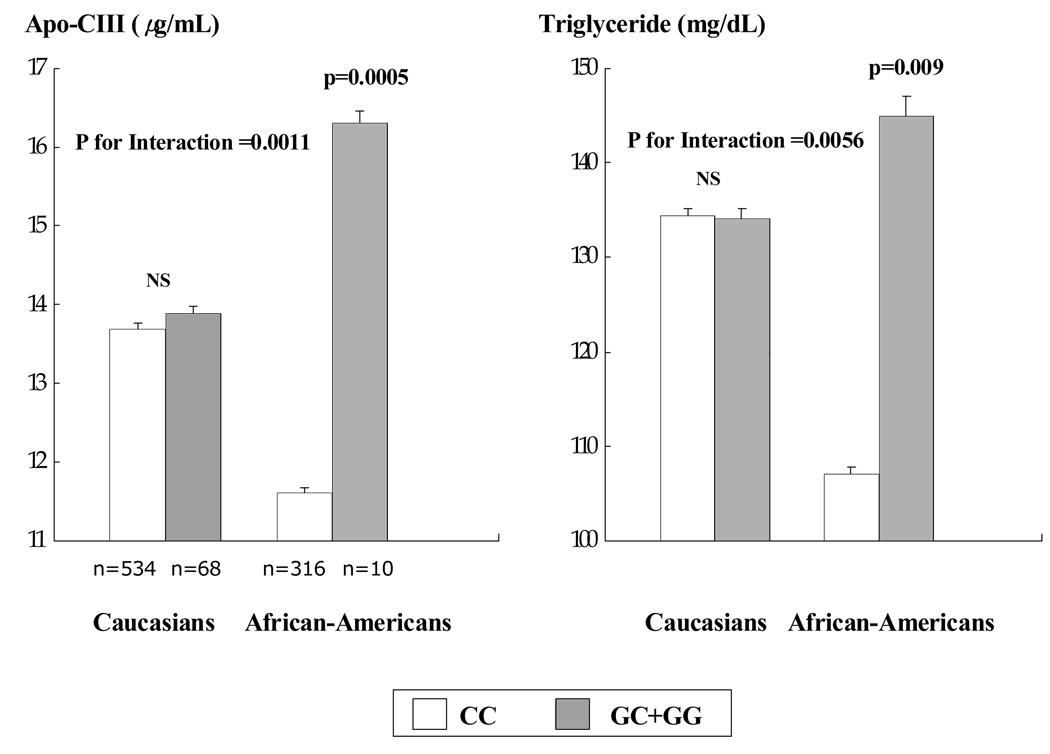
Methods and results: We initially identified an intronic SNP (rs4253728) in PPARA that was associated with plasma apoCIII level (p<0.05) in a subset of 435 individuals from the total study population (n=944; 335 African-Americans and 609 Caucasians). This SNP was then genotyped in a second subset of 476 individuals (total 911 subjects with available data), and a previously described PPARA coding SNP (L162V) which was shown to be in moderate linkage disequilibrium with the intronic SNP (r(2)=0.18) was genotyped in 928 subjects from the same study population. The minor allele frequencies for both SNPs were significantly lower in African-Americans compared with Caucasians (7.2% vs. 27.3% for rs4253728, 1.5% vs. 6.1% for L162V, both p<0.0001). African-Americans had significantly lower levels of TG and apoCIII compared with Caucasians after adjusting for age, sex, body mass index (BMI), waist circumference and other baseline characteristics. However, racial differences in TG levels were attenuated after adjusting for apoCIII levels. The minor alleles for both PPARA SNPs were associated with higher TG and apoCIII levels. Race modified the associations of L162V with TG (p for interaction=0.0056) and apoCIII (p for interaction=0.0011). Levels of both TG and apoCIII were lower in African-American but not Caucasian homozygotes for the major allele compared with carriers of the minor allele. Similar results were obtained for the intronic SNP, but the findings were no longer significant in a model that also contained L162V.
Conclusions: Two PPARA SNPs, L162V and rs4253728 (intronic), are less prevalent in African-Americans than in Caucasians and in African-Americans only are associated with higher apoCIII and TG levels.
Figures
Similar articles
-
Polyunsaturated fatty acids interact with the PPARA-L162V polymorphism to affect plasma triglyceride and apolipoprotein C-III concentrations in the Framingham Heart Study.J Nutr. 2005 Mar;135(3):397-403. doi: 10.1093/jn/135.3.397. J Nutr. 2005. PMID: 15735069
-
Racial or ethnic differences in allele frequencies of single-nucleotide polymorphisms in the methylenetetrahydrofolate reductase gene and their influence on response to methotrexate in rheumatoid arthritis.Ann Rheum Dis. 2006 Sep;65(9):1213-8. doi: 10.1136/ard.2005.046797. Epub 2006 Jan 26. Ann Rheum Dis. 2006. PMID: 16439441 Free PMC article.
-
Elevated Levels of Apolipoprotein CIII Increase the Risk of Postprandial Hypertriglyceridemia.Front Endocrinol (Lausanne). 2021 Apr 23;12:646185. doi: 10.3389/fendo.2021.646185. eCollection 2021. Front Endocrinol (Lausanne). 2021. PMID: 33967959 Free PMC article.
-
Response to micronized fenofibrate treatment is associated with the peroxisome-proliferator-activated receptors alpha G/C intron7 polymorphism in subjects with type 2 diabetes.Pharmacogenetics. 2004 Dec;14(12):823-9. doi: 10.1097/00008571-200412000-00005. Pharmacogenetics. 2004. PMID: 15608561
-
Peroxisome proliferator-activated receptor [alpha] genetic variation interacts with n-6 and long-chain n-3 fatty acid intake to affect total cholesterol and LDL-cholesterol concentrations in the Atherosclerosis Risk in Communities Study.Am J Clin Nutr. 2008 Jun;87(6):1926-31. doi: 10.1093/ajcn/87.6.1926. Am J Clin Nutr. 2008. PMID: 18541586 Free PMC article.
Cited by
-
Racial differences between African-American and white women in insulin resistance and visceral adiposity are associated with differences in apoCIII containing apoAI and apoB lipoproteins.Nutr Metab (Lond). 2014 Dec 17;11(1):56. doi: 10.1186/1743-7075-11-56. eCollection 2014. Nutr Metab (Lond). 2014. PMID: 25553059 Free PMC article.
-
Intraperitoneal fat and insulin resistance in obese adolescents.Obesity (Silver Spring). 2010 Feb;18(2):402-9. doi: 10.1038/oby.2009.261. Epub 2009 Aug 27. Obesity (Silver Spring). 2010. PMID: 19713950 Free PMC article. Clinical Trial.
-
Omega-3 fatty acids regulate gene expression levels differently in subjects carrying the PPARalpha L162V polymorphism.Genes Nutr. 2009 Sep;4(3):199-205. doi: 10.1007/s12263-009-0129-2. Epub 2009 Jul 8. Genes Nutr. 2009. PMID: 19585164 Free PMC article.
-
Novel genomic signals of recent selection in an Ethiopian population.Eur J Hum Genet. 2015 Aug;23(8):1085-92. doi: 10.1038/ejhg.2014.233. Epub 2014 Nov 5. Eur J Hum Genet. 2015. PMID: 25370040 Free PMC article.
-
Genetic variability of RXRB, PPARA, and PPARG in Wegener's granulomatosis.PPAR Res. 2009;2009:786781. doi: 10.1155/2009/786781. Epub 2009 Feb 11. PPAR Res. 2009. PMID: 19223982 Free PMC article.
References
-
- Fruchart JC, Duriez P, Staels B. Peroxisome proliferator-activated receptor-alpha activators regulate genes governing lipoprotein metabolism, vascular inflammation and atherosclerosis. Curr Opin Lipidol. 1999;10:245–257. - PubMed
-
- Schonfeld G. The effects of fibrates in lipoprotein and hemostatic coronary risk factors. Atherosclerosis. 1994;111:161–174. - PubMed
-
- Hertz R, Bishara-Shieban J. Mode of action of peroxisome proliferators as hypolipidemic drugs, suppression of apolipoprotein C-III. J Biol Chem. 1995;270:13470–13475. - PubMed
-
- Haubenwallner S, Essenburg AD, Barnet BC. Hypolipidemic activity of select fibrates correlates to changes in hepatic apolipoprotein C-III expression: a potential physiologic basis for their mode of action. J Lipid Res. 1995;36:2541–2551. - PubMed
Publication types
MeSH terms
Substances
Grants and funding
LinkOut - more resources
Full Text Sources
Miscellaneous
