


doi: 10.1016/j.compmedimag.2007.10.002.
Epub 2007 Dec 3.
Real-time stereographic rendering and display of medical images with programmable GPUs
Affiliations
- PMID: 18061402
- PMCID: PMC2269708
- DOI: 10.1016/j.compmedimag.2007.10.002
Item in Clipboard
Real-time stereographic rendering and display of medical images with programmable GPUs
Comput Med Imaging Graph.
2008 Mar.
Abstract
The study was to explore the power and feasibility of using programmable graphics processing units (GPUs) for real-time rendering and displaying large 3D medical datasets for stereoscopic display workstation. Lung cancer screening CT images were used for developing GPU-based stereo rendering and displaying. The study was run on a personal computer with a 128 MB NVIDIA Quadro FX 1100 graphics card. The performance of rendering and displaying was measured and compared between GPU-based and central processing unit (CPU)-based programming. The results indicate that GPU-based programming was capable of rendering large 3D datasets at real-time interactive rates with stereographic displays.
Figures
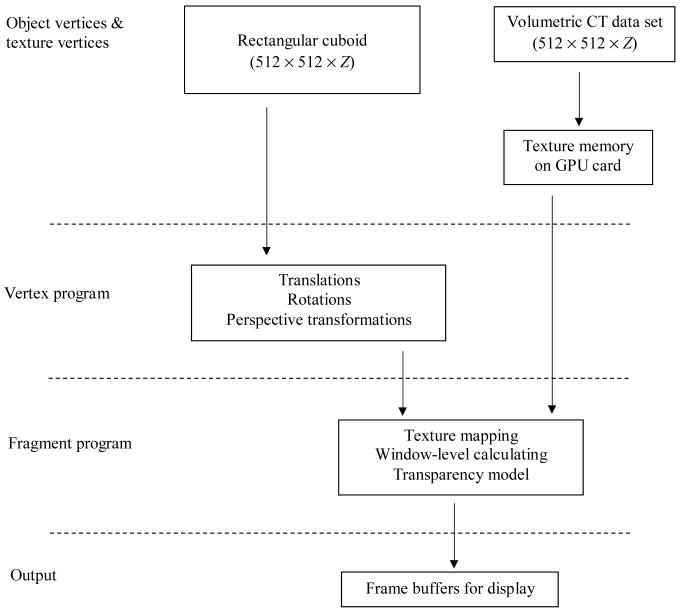
A diagram of stereo image rendering process on GPU card. Z is the depth measure of a given rendering volume.
References
-
- Brown DG, Riederer SJ. Contrast-to-noise ratios in maximum intensity projection images. Magn Reson Med. 1992;23:130–137. - PubMed
-
- Keller PJ, Drayer BP, Fram EK, et al. Angiography with two-dimensional acquisition and three-dimensional display. Work in progress. Radiology. 1989;173:527–32. - PubMed
-
- Roberts JW, Slattery OT. Display characteristics and the impact on usability for stereo. Proc. SPIE, Stereoscopic Displays and Virtual Reality Systems VIII. 2000;3957:128–138.
-
- Maidment ADA, Bakic PR, Albert M. Effects of quantum noise and binocular summation on dose requirements in stereomammogry. Med Phys. 2003;30:3061–3071. - PubMed
-
- Ujval J, Kapasi UJ, Rixner S, et al. Programmable Stream Processors. Computer. 2003;36:54–62.
Publication types
MeSH terms
Grants and funding
LinkOut - more resources
Full Text Sources
Medical
Miscellaneous
