


Ageing diminishes endothelium-dependent vasodilatation and tetrahydrobiopterin content in rat skeletal muscle arterioles
- PMID: 18063659
- PMCID: PMC2375630
- DOI: 10.1113/jphysiol.2007.147686
Ageing diminishes endothelium-dependent vasodilatation and tetrahydrobiopterin content in rat skeletal muscle arterioles
Abstract
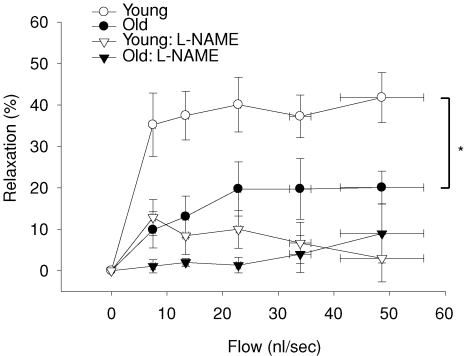
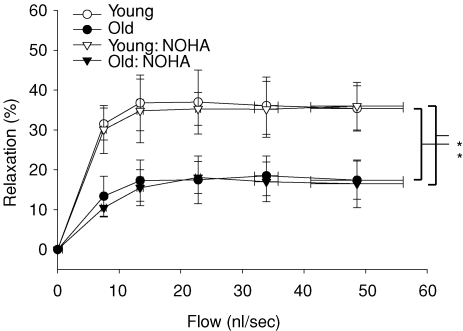
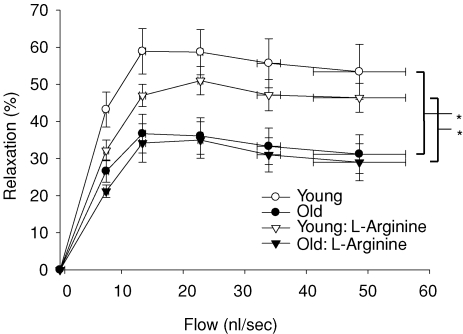
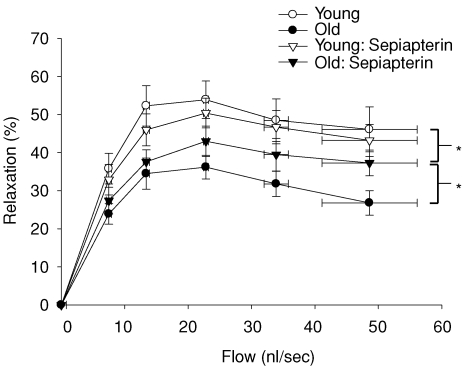
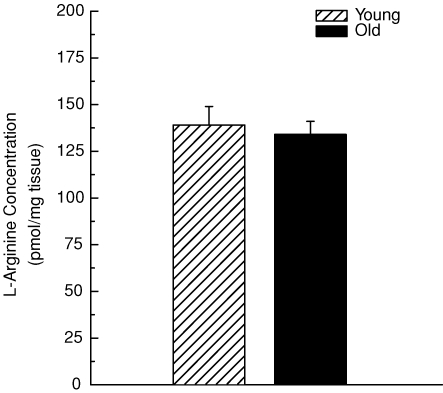
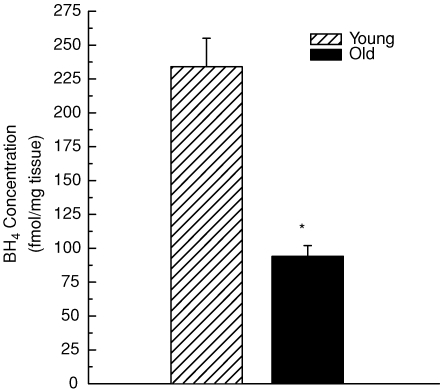
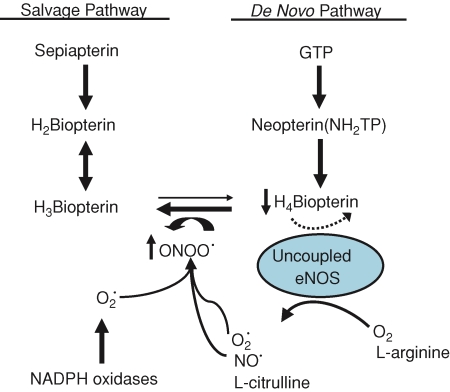
Ageing reduces endothelium-dependent vasodilatation through an endothelial nitric oxide synthase (NOS) signalling pathway. The purpose of this study was to determine whether arginase activity diminishes endothelium-dependent vasodilatation in skeletal muscle arterioles from old rats, and whether NOS substrate (L-arginine) and cofactor (tetrahydrobiopterin; BH(4)) concentrations are reduced. First-order arterioles were isolated from the soleus muscle of young (6 months old) and old (24 months old) male Fischer 344 rats. In vitro changes in luminal diameter in response to stepwise increases in flow were determined in the presence of the NOS inhibitor N(G)-nitro-L-arginine methyl ester (l-NAME, 10(-5) mol l(-1)), the arginase inhibitor N(omega)-hydroxy-nor-L-arginine (NOHA, 5 x 10(-4) mol l(-1)), exogenous L-arginine (3 x 10(-3) mol l(-1)) or the precursor for BH(4) synthesis sepiapterin (1 micromol l(-1)). Arteriolar L-arginine and BH(4) content were determined via HPLC. Ageing decreased flow-mediated vasodilatation by 52%, and this difference was abolished with NOS inhibition. Neither inhibition of arginase activity nor addition of exogenous L-arginine had any effect on flow-mediated vasodilatation; arteriolar l-arginine content was also not different between age groups. BH(4) content was lower in arterioles from old rats (94 +/- 8 fmol (mg tissue)(-1)) relative to controls (234 +/- 21 fmol (mg tissue)(-1)), and sepiapterin elevated flow-mediated vasodilatation in arterioles from old rats. These results demonstrate that the impairment of endothelium-dependent vasodilatation induced by old age is due to an altered nitric oxide signalling mechanism in skeletal muscle arterioles, but is not the result of increased arginase activity and limited L-arginine substrate. Rather, the age-related deficit in flow-mediated vasodilatation appears to be the result, in part, of limited BH(4) bioavailability.
Figures
Comment in
-
Microvascular function and ageing L-arginine, tetrahydrobiopterin and the search for the fountain of vascular youth.J Physiol. 2008 Apr 15;586(8):2041-2. doi: 10.1113/jphysiol.2008.151381. Epub 2008 Mar 6. J Physiol. 2008. PMID: 18325977 Free PMC article. Review. No abstract available.
References
-
- Bagi Z, Toth E, Koller A, Kaley G. Microvascular dysfunction after transient high glucose is caused by superoxide-dependent reduction in the bioavailability of NO and BH4. Am J Physiol Heart Circ Physiol. 2004;287:H626–H633. - PubMed
-
- Berkowitz DE, White R, Li D, Minhas KM, Cernetich A, Kim S, Burke S, Shoukas AA, Nyhan D, Champion HC, Hare JM. Arginase reciprocally regulates nitric oxide synthase activity and contributes to endothelial dysfunction in aging blood vessels. Circulation. 2003;108:2000–2006. - PubMed
-
- Blackwell KA, Sorenson JP, Richardson DM, Smith LA, Suda O, Nath K, Katusic ZS. Mechanisms of aging-induced impairment of endothelium-dependent relaxation: role of tetrahydrobiopterin. Am J Physiol Heart Circ Physiol. 2004;287:H2448–H2453. - PubMed
-
- Cernadas MR, Sánchez de Miguel L, García-Durán M, González-Fernández F, Millás I, Montón M, et al. Expression of constitutive and inducible nitric oxide synthases in the vascular wall of young and aging rats. Circ Res. 1998;83:279–286. - PubMed
-
- Cook JJ, Wailgum TD, Vasthare US, Mayrovitz HN, Tuma RF. Age-related alterations in the arterial microvasculature of skeletal muscle. J Gerontol. 1992;47:B83–B88. - PubMed
Publication types
MeSH terms
Substances
Grants and funding
LinkOut - more resources
Full Text Sources
Other Literature Sources
Medical
