Short term effects of topical cyclosporine and viscoelastic on the ocular surfaces in patients with dry eye
- PMID: 18063881
- PMCID: PMC2629882
- DOI: 10.3341/kjo.2007.21.4.189
Short term effects of topical cyclosporine and viscoelastic on the ocular surfaces in patients with dry eye
Abstract
Purpose: To compare the short term effects of topical 0.05% cyclosporine (CsA) and a mixture of 0.08% chondroitin sulfate and 0.06% sodium hyaluronate (CS-HA) on dry eye ocular surfaces.
Methods: 36 patients with moderate to severe dry eye (5 mm/5 min or less with Schirmer's test or tear break up time (BUT) less than 6 seconds), were treated with topical application of CS-HA on one eye and CsA on the other 4 times a day for 6-8 weeks. BUT, Schirmer's test without anesthesia, and conjunctival impression cytology (CIC; goblet cell density, nucleus to cytoplasmic ratio, and epithelial cell morphology) were evaluated and compared between eyes before and after treatment (repeated measurement of ANOVA).
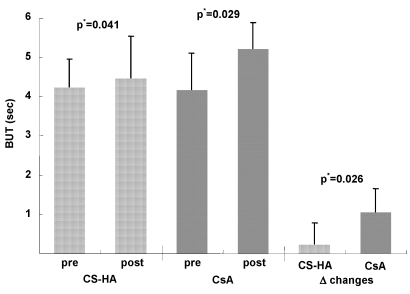
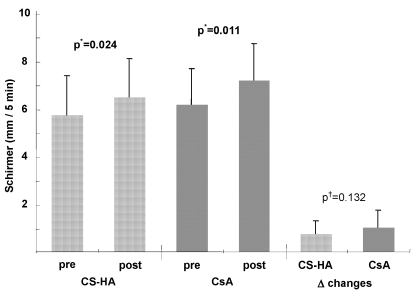
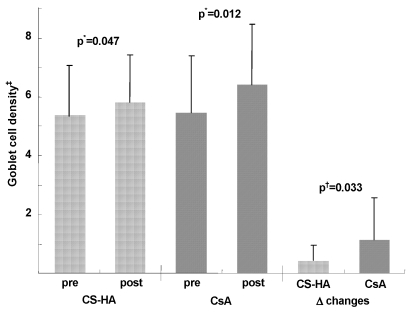
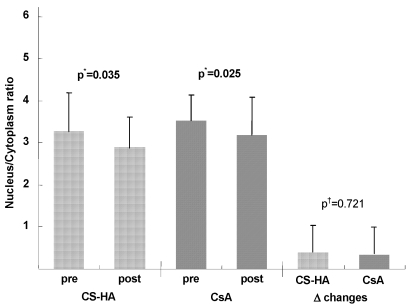
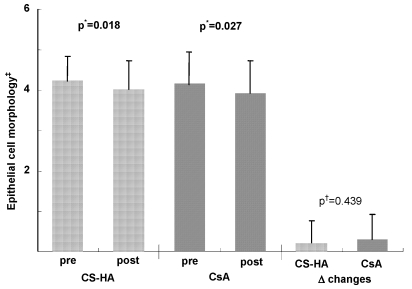
Results: After treatment, BUT and tear wettings were significantly prolonged in each group. Topical CsA treated eyes had greater increase in BUT (p=0.026); there was no significant difference in tear wetting (p=0.132). While the 3 parameters of CIC improved in both groups, goblet cell density was significantly higher in eyes treated with CsA (p=0.033).
Conclusions: While both CS-HA and 0.05% CsA eyedrops improve ocular surfaces, topical CsA may have a better effect on enhancing tear film stability and goblet cell density.
Figures
References
-
- Baudouin C. The pathology of dry eye. Surv Ophthalmol. 2001;45:S211–S220. - PubMed
-
- Lemp MA. Report of the National Eye Institute/Industry workshop on Clinical Trials in Dry Eyes. CLAO J. 1995;21:221–232. - PubMed
-
- Yeh S, Song XJ, Farley W, et al. Apoptosis of ocular surface cells in experimentally induced dry eye. Invest Ophthalmol Vis Sci. 2003;44:124–129. - PubMed
-
- Kunert KS, Tisdale AS, Gipson IK. Goblet cell numbers and epithelial proliferation in the conjunctiva of patients with dry eye syndrome treated with cyclosporine. Arch Ophthalmol. 2002;120:330–337. - PubMed
-
- Turner K, Pflugfelder SC, Ji Z, et al. Interleukin-6 levels in the conjunctival epithelium of patients with dry eye disease treated with cyclosporine ophthalmic emulsion. Cornea. 2000;19:492–496. - PubMed
Publication types
MeSH terms
Substances
LinkOut - more resources
Full Text Sources
Other Literature Sources
Miscellaneous