


Neurofunctional modulation of brain regions by distinct forms of motor cognition and movement features
- PMID: 18064585
- PMCID: PMC6871230
- DOI: 10.1002/hbm.20514
Neurofunctional modulation of brain regions by distinct forms of motor cognition and movement features
Abstract
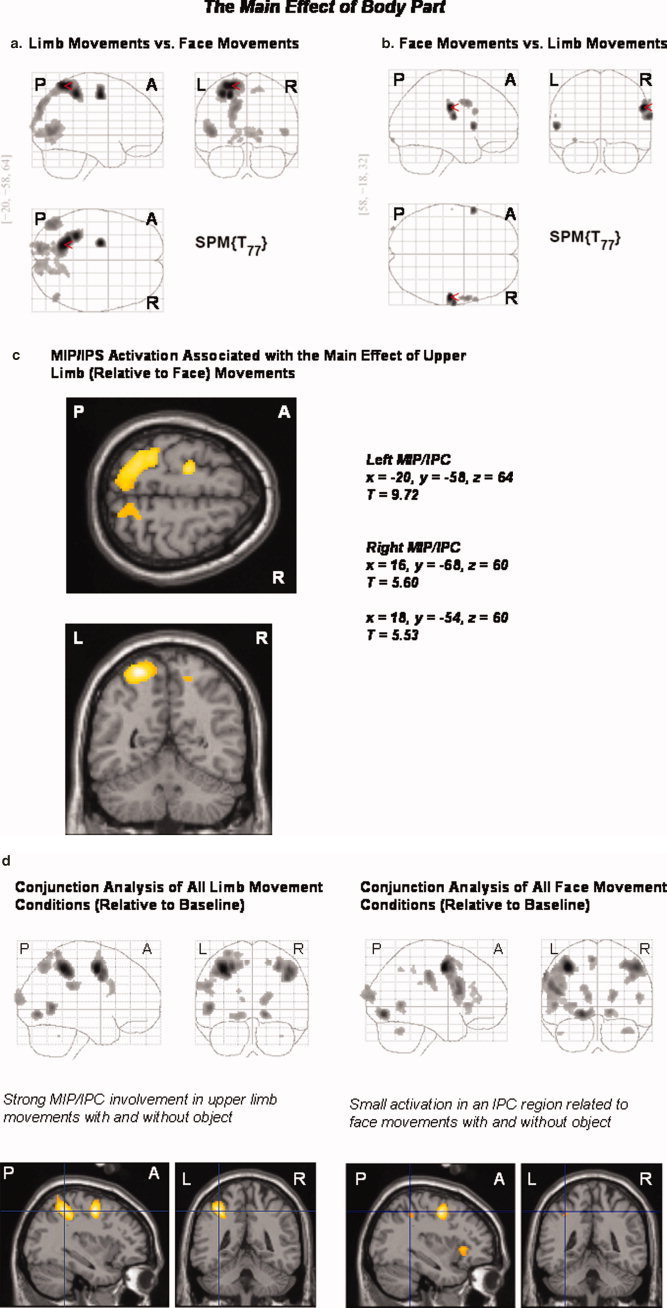
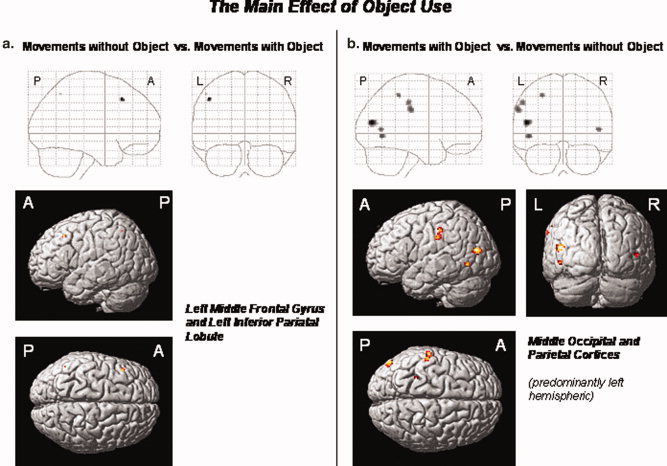
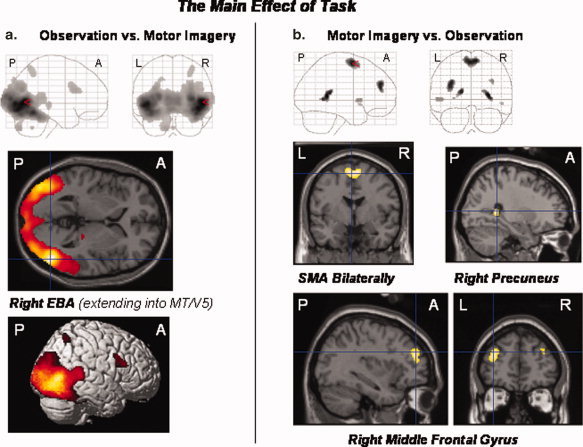
Extrastriate, parietal, and frontal brain regions are differentially involved in distinct kinds of body movements and motor cognition. Using functional magnetic resonance imaging, we investigated the neural mechanisms underlying the observation and mental imagery of meaningful face and limb movements with or without objects. The supplementary motor area was differentially recruited by the mental imagery of movements while there were differential responses of the extrastriate body area (EBA) during the observation conditions. Contrary to most previous reports, the EBA responded to face movements, albeit to a lesser degree than to limb movements. The medial wall of the intraparietal sulcus and adjacent intraparietal cortex was selectively recruited by the processing of meaningful upper limb movements, irrespective of whether these were object-related or not. Besides reach and grasp movements, the intraparietal sulcus may thus be involved in limb gesture processing, that is, in an important aspect of human social communication. We conclude that subregions of a frontal-parietal network differentially interact during the cognitive processing of body movements according to the specific motor-related task at hand and the particular movement features involved.
Figures
References
-
- Assmus A,Marshall JC,Ritzl A,Noth J,Zilles K,Fink GR ( 2003): Left inferior parietal cortex integrates time and space during collision judgements. Neuroimage 20 ( Suppl 1): S82–S88. - PubMed
-
- Assmus A,Giessing C,Weiss PH,Fink GR ( 2007): Functional interactions during the retrieval of conceptual action knowledge: An fMRI study. J Cogn Neurosci 19: 1004–1012. - PubMed
-
- Astafiew SV,Stanley CM,Shulman GL,Corbetta M ( 2004): Extrastriate body area in human occipital cortex responds to the performance of motor actions. Nat Neurosci 7: 422–423. - PubMed
-
- Aziz‐Zadeh L,Iacoboni M,Zaidel E ( 2006a): Hemispheric sensitivity to body stimuli in simplke reaction time. Exp Brain Res 170: 116–121. - PubMed
Publication types
MeSH terms
LinkOut - more resources
Full Text Sources
