. 2008 Mar;198(3):318.e1-7.
doi: 10.1016/j.ajog.2007.09.042. Epub 2008 Feb 20.

Hematogenous infection of Sprague-Dawley rats with Mycoplasma pulmonis: development of a model for maternal and fetal infection

Affiliations

Hematogenous infection of Sprague-Dawley rats with Mycoplasma pulmonis: development of a model for maternal and fetal infection

Margaret A Riggs et al. Am J Obstet Gynecol. 2008 Mar.

Abstract

Objectives: The specific objective of this study was to conduct a dose response experiment with Mycoplasma pulmonis in Sprague-Dawley rats to develop a reproducible animal model of maternal and fetal infection that would provide a versatile mechanism to address the innate fetal immune response during intrauterine infection.

Study design: Pregnant rats were infected intravenously at gestation day 14 with 0 (control), 10(1), 10(3), 10(5), and 10(7) colony forming units of M. pulmonis and necropsied at gestational day 18. Quantitative culture of maternal and fetal tissues as well as histopathologic examination of the placenta were performed.

Results: We have characterized a rat model of maternal and fetal infection that can be manipulated by alteration of infectious dose. Colonization of Sprague-Dawley rat dam and fetal tissues by M. pulmonis occurred in a dose-dependent manner after intravenous inoculation (P < .001). Placental lesion severity increased with infection dose (P = .0001). The minimum threshold dose required to establish infection of the dam and fetus was at least 10(3) colony forming units, with consistent colonization of maternal and fetal tissues achieved only with 10(7) colony forming units. In some instances, rat fetal tissues could be colonized in the absence of concomitant amniotic fluid colonization. Interestingly, there appeared to be a predilection for colonization of the reproductive tissues.

Conclusions: In the Sprague-Dawley rat, the infection rate of both the dam and fetus can be controlled by the inoculum dose. Our data support the concept that hematogenous spread of M. pulmonis to the rat fetus can occur without amniotic fluid infection and suggest that the fetus itself can potentially seed the amniotic fluid with microorganisms. Importantly, manipulation of both the route of infection as well as infection dose provide a reproducible way to study both maternal and fetal immune response to infection during pregnancy.


Figures
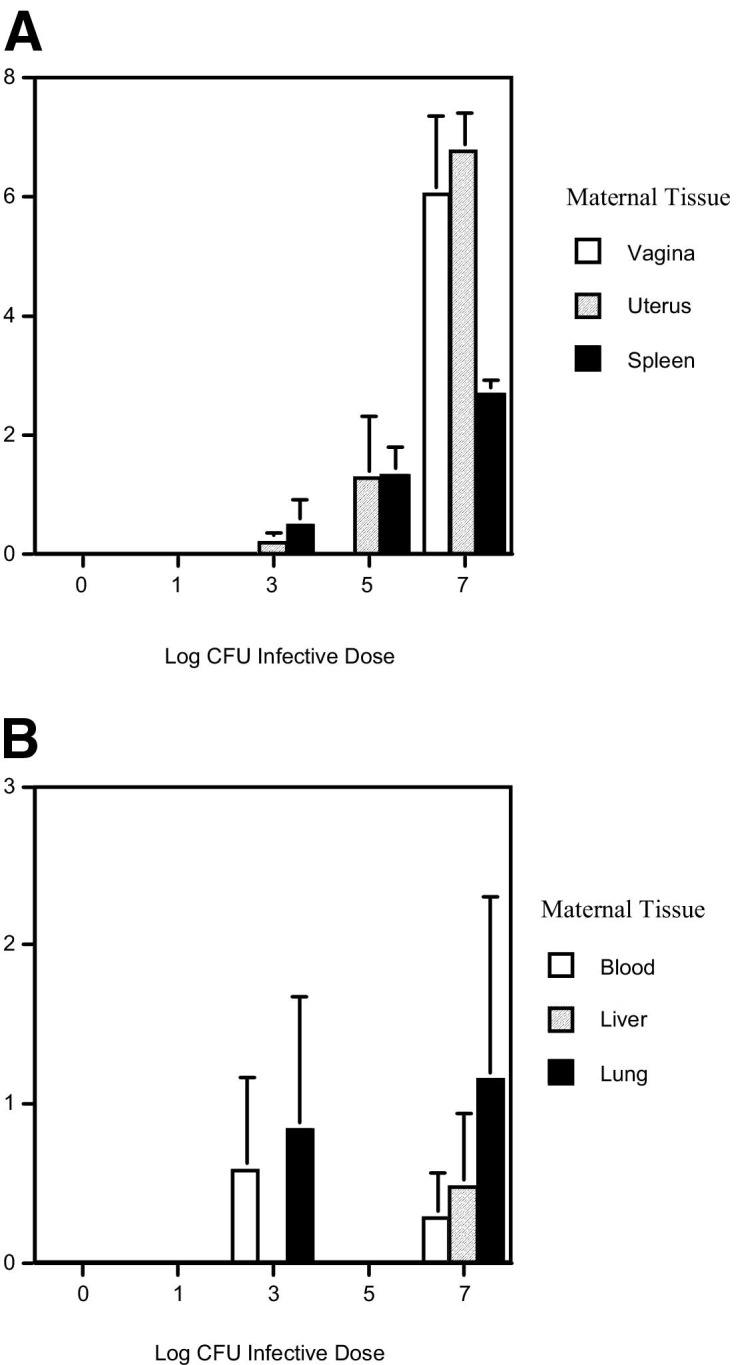
FIGURE 1
FIGURE 1
Number of M pulmonis isolated from dam tissues at gestational day 18 Rats were inoculated IV at GD 14 with 0 (n = 5), 101 (n = 4), 103 (n = 6), 105 (n = 6), or 107 (n = 5) CFU M pulmonis diluted in sterile Frey’s broth. Results are expressed as mean log CFU + standard error (SE) of M pulmonis isolated from each site. A, Vagina, uterus, and spleen. There were significant increases in number of M pulmonis colonies isolated from the vagina (P = .0001), uterus (P = .0001), spleen (P = .0005) at 107 dose when compared with all other doses. B, Blood, liver, and lung. No significant differences were detected in blood (P = .62), liver (P = .27), or lung (P = .60). Riggs. Hematogenous infection of Sprague-Dawley rats with Mycoplasma pulmonis. Am J Obstet Gynecol 2008.
FIGURE 2
FIGURE 2
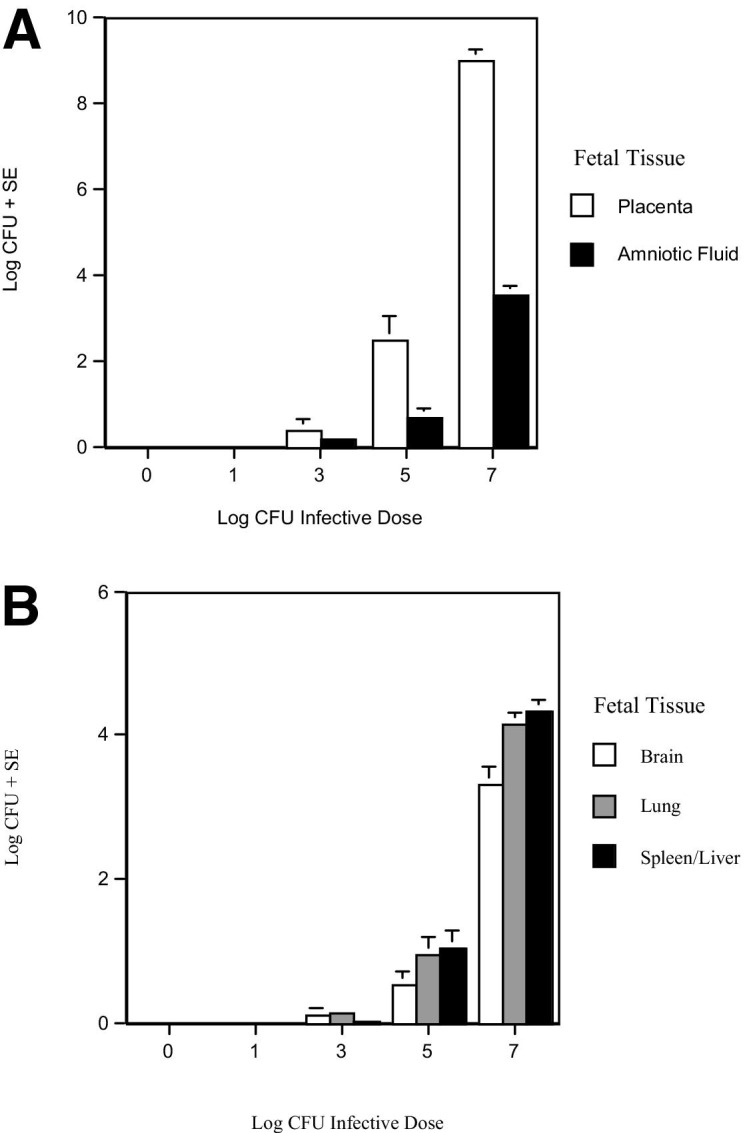
Number of M pulmonis isolated from fetal tissues at gestational day 18 Dams were inoculated IV at GD 14 with (n = 5), 101 (n = 4), 103 (n = 6), 105 (n = 6), or 107 (n = 5) CFU M pulmonis diluted in sterile Frey’s broth. Six fetal units were cultured per dam. Results are expressed as mean log CFU + standard error (SE) of M pulmonis isolated from each site. A, Placenta and amniotic fluid. There was an increase in number of CFU isolated from AF (P = .0001), and placenta (P = .0001), at 107 compared to all other doses. B, Brain, lung, and spleen/liver. Similar results were found for brain (P = .0001), lung (P = .0001), and spleen/liver (P = .0001). Riggs. Hematogenous infection of Sprague-Dawley rats with Mycoplasma pulmonis. Am J Obstet Gynecol 2008.
FIGURE 3
FIGURE 3
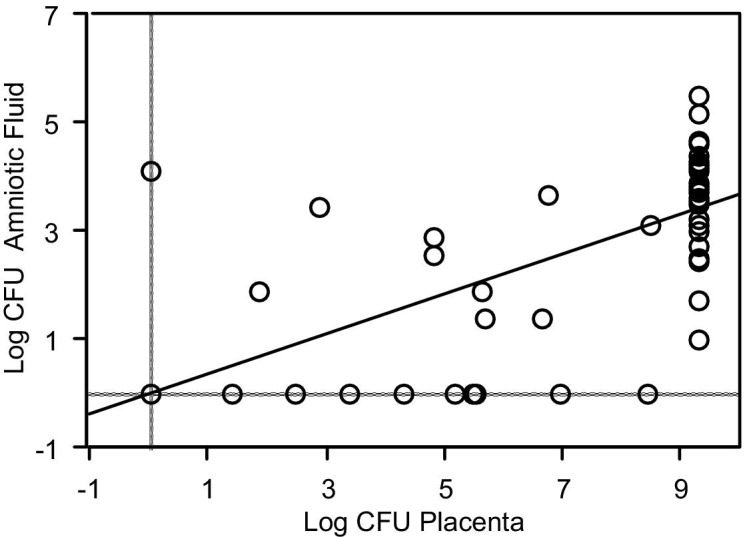
Correlation between colonization of placenta and amniotic fluid CFU determinations for 126 matched samples were compared by regression analysis (correlation R = .864, R2 = .754, P < .0001). Overlapping points occurred if CFU were identical for samples. Ten placentas were colonized by M pulmonis in the absence of concomitant colonization of the paired amniotic fluid. One amniotic fluid was colonized by M pulmonis in the absence of concomitant colonization of the paired placenta. Riggs. Hematogenous infection of Sprague-Dawley rats with Mycoplasma pulmonis. Am J Obstet Gynecol 2008.
FIGURE 4
FIGURE 4
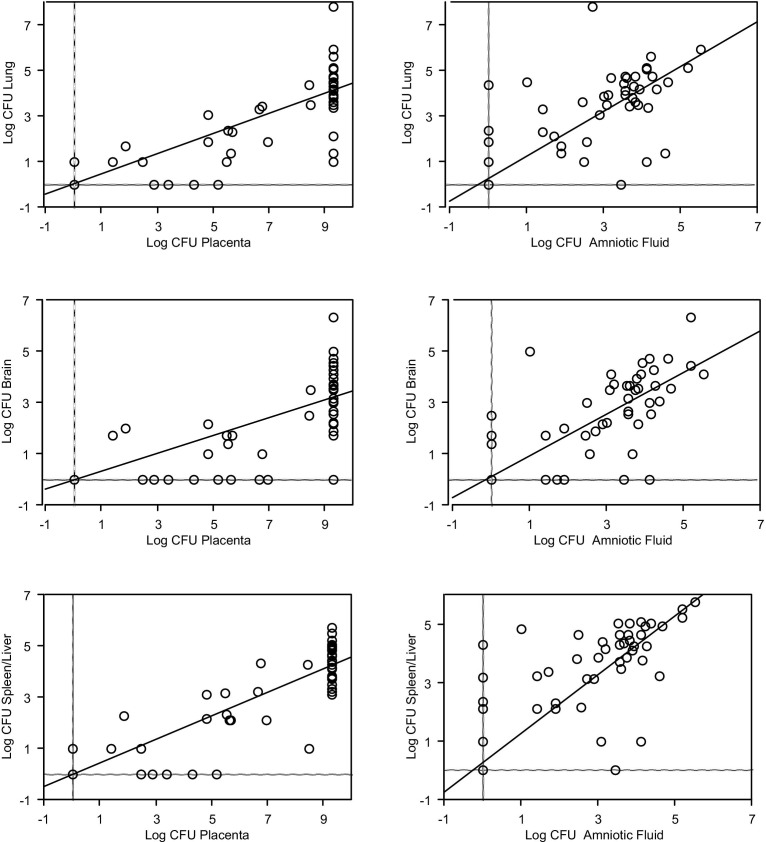
Correlation between colonization of placenta or amniotic fluid and fetal tissues CFU determinations for 126 matched samples were compared by regression analysis; overlapping points occurred if CFU were identical for samples. Correlations with placental CFU are shown on left and correlations with amniotic fluid CFU are shown on right. CFU of M pulmonis recovered from fetal lung (top) was correlated with recovery from the placenta (R = .923, R2 = .85, P < .0001) and amniotic fluid (R = 0.863, R2 = .743, P < .0001). M pulmonis was recovered from 2 fetal lungs in the absence of concomitant colonization of the paired placenta and from 8 fetal lungs in the absence of concomitant colonization of the paired amniotic fluid. CFU of M pulmonis recovered from fetal brain (middle) was correlated with recovery from the placenta (R = .923, R2 = .85, P < .0001) and amniotic fluid (R = .863, R2 = .743, P < .0001). M pulmonis was not recovered from any fetal brain in the absence of concomitant colonization of the paired placenta but was recovered from four fetal brains in the absence of concomitant colonization of the paired amniotic fluid. CFU of M pulmonis recovered from fetal spleen/liver (bottom) was correlated with recovery from the placenta (R = .95, R2 = .901, P < .0001) and amniotic fluid (R = .884, R2 = .78, P < .0001). M pulmonis was recovered from 2 fetal spleen/livers in the absence of concomitant colonization of the paired placenta and from 7 fetal spleen/livers in the absence of concomitant colonization of the paired amniotic fluid. Riggs. Hematogenous infection of Sprague-Dawley rats with Mycoplasma pulmonis. Am J Obstet Gynecol 2008.
FIGURE 5
FIGURE 5
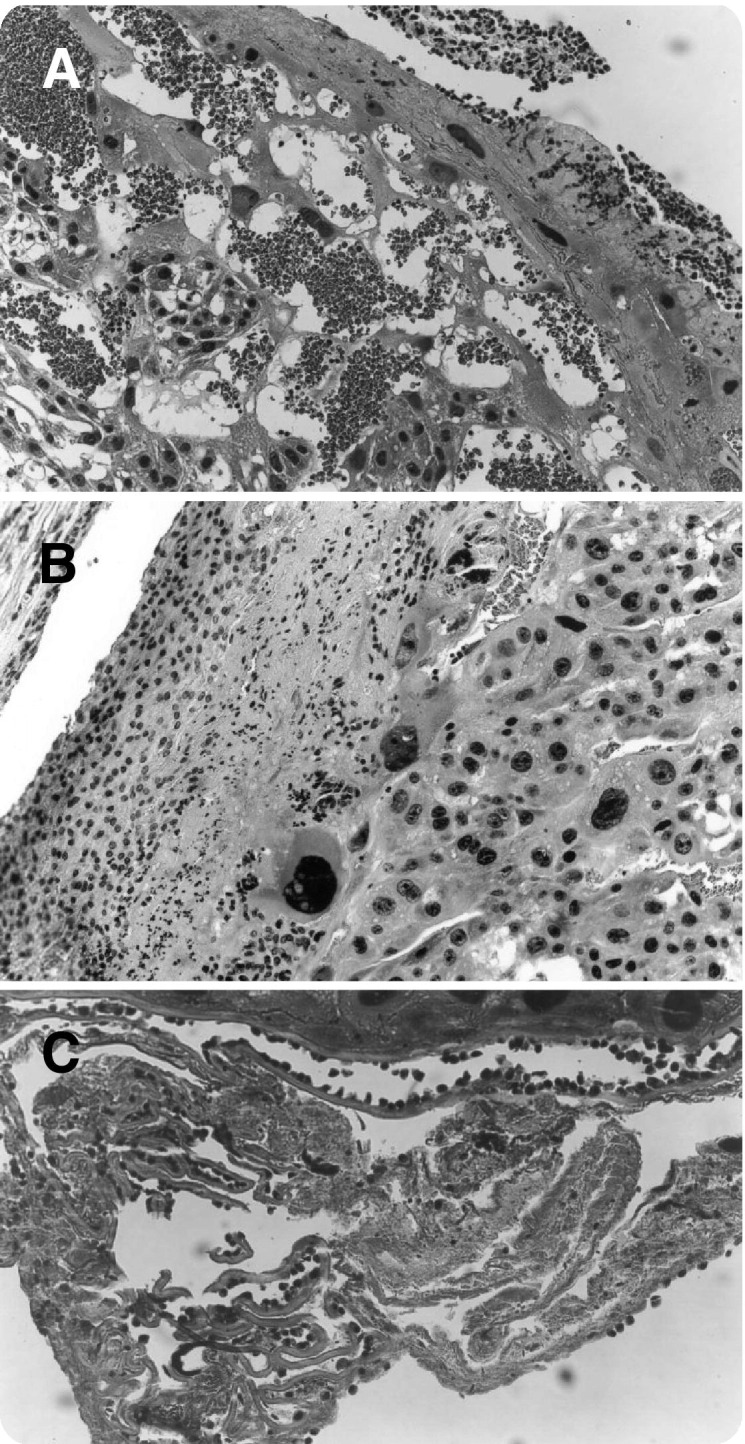
Representative placental lesions A, Severe inflammatory infiltrate indicative of deciduitis. B, Moderate inflammatory infiltrate indicative of deciduitis. C, Normal placenta with absence of significant inflammatory infiltrate. (Hematoxylin-eosin; original magnification, ×20.) Riggs. Hematogenous infection of Sprague-Dawley rats with Mycoplasma pulmonis. Am J Obstet Gynecol 2008.

References

    1. Goncalves L.F., Chaiworapongsa T., Romero R. Intrauterine infection and prematurity. Ment Retard Dev Disabil Res Rev. 2002;8:3–13. - PubMed
    1. Lyon A. Chronic lung disease of prematurity: The role of intra-uterine infection. Eur J Pediatr. 2000;159:798–802. - PubMed
    1. Romero R., Espinoza J., Chaiworapongsa T., Kalache K. Infection and prematurity and the role of preventive strategies. Semin Neonatol. 2002;7:259–274. - PubMed
    1. Romero R., Espinoza J., Kusanovic J.P., et al. The preterm parturition syndrome. BJOG. 2006;113(Suppl 3):17–42. - PMC - PubMed
    1. Romero R., Espinoza J., Goncalves L.F., Kusanovic J.P., Friel L.A., Nien J.K. Inflammation in preterm and term labour and delivery. Semin Fetal Neonatal Med. 2006;11:317–326. - PMC - PubMed

Publication types