. 2007 Dec 11:4:9.
doi: 10.1186/1742-4933-4-9.

Challenges for vaccination in the elderly

Affiliations

Challenges for vaccination in the elderly

Richard Aspinall et al. Immun Ageing. .

Abstract

The increased susceptibility of the elderly to infection presents a major challenge to public health services. An aging immune system is well documented as the cause of increased infection rates in elderly people. Such immunosenescence is multi-factorial and incompletely understood. Immunosenescent changes include malfunctioning of innate immune system cellular receptors; involution of the thymus, with consequent reduction of the naïve T cell population; alteration of the T cell population composition; modified phenotypes of individual T cells; and replicative senescence of memory cells expressing naïve markers. Unfortunately, immunosenescence also renders vaccination less effective in the elderly. It is therefore important that the vaccines used against common but preventable diseases, such as influenza, are specifically enhanced to overcome the reduced immune responsiveness of this vulnerable population.


Figures
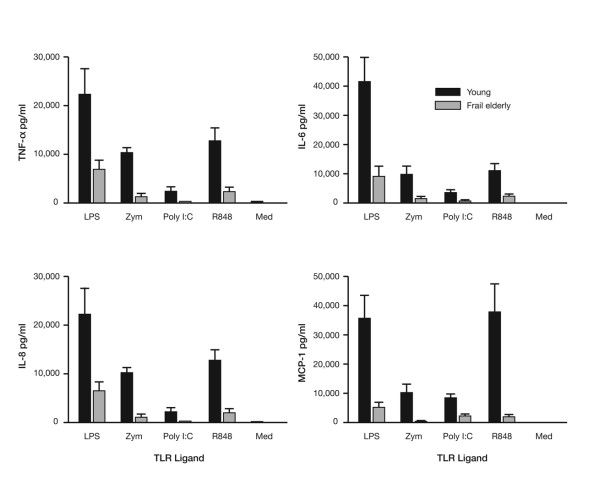
Figure 1
Figure 1
Monocytes from frail elderly subjects secrete reduced levels of proinflammatory cytokines and chemokines in response to toll-like receptors (TLR) ligation. TNF-α, tumour necrosis factor alpha; IL-6, interleukin-6; IL-8, interleukin-8; MCP-1, monocyte chemotactic protein-1; LPS, lipopolysaccharide; Zym, zymosan; Poly I:C, polyinosinic-polycytidylic acid; R848, resiquimod; Med, medium alone. Results are from 1 × 10⁶ monocytes from nine young and nine elderly individuals stimulated with various TLR ligands and analyses of culture supernatants 48 hours post-stimulation. The error bars represent standard error of means.
Figure 2
Figure 2
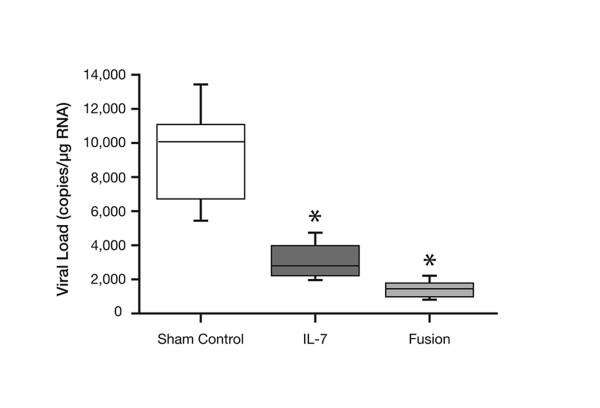
Influenza viral load in the lungs of 20 month old mice, 6 days after infection. Copyright 2005 The American Association of Immunologists, Inc. *P< 0.001 when compared with the control group. These mice had expression plasmids containing either the IL-7 gene, the fusion protein (the extracellular portion of the chemokine receptor CCR9 and interleukin-7) gene, or a sham control gene (the N-terminal portion of CCR9) inserted into their anterior tibial muscle approximately 2 months previously [26].
Figure 3
Figure 3
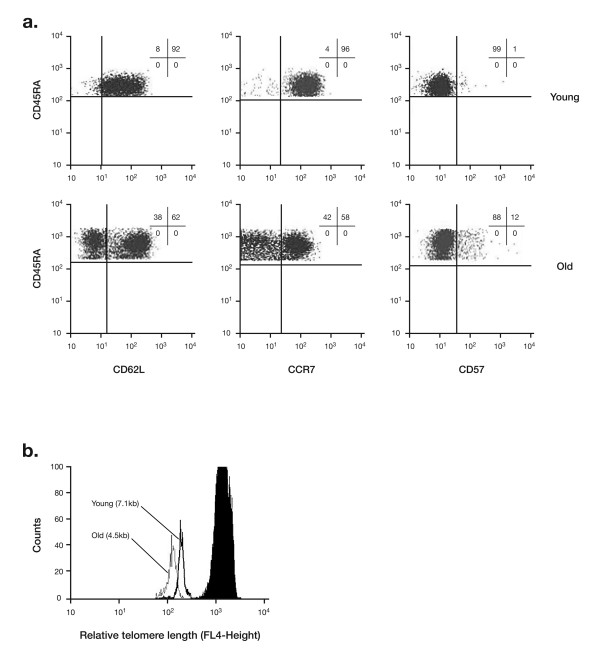
CD8+ CD45RA+CD28+ T-cells from 5 young (<35 years of age) and 5 elderly (>65 years of age) donors. A) Expression of CD surface markers by fluorescent-activated cell sorting (FACS) analysis [30]. Numbers in the graph indicate the percentage of cells in the respective quadrant. Ten identical experiments were performed. B) Flow fluorescent in situ hybridisation (FISH) analysis of the relative telomere length [30]. Filled black peak represents the tetraploid human T-cell leukemia cell line 1301 with a known telomere length of 25 kbp (internal standard). The figure shows one of ten identical experiments.
Figure 4
Figure 4
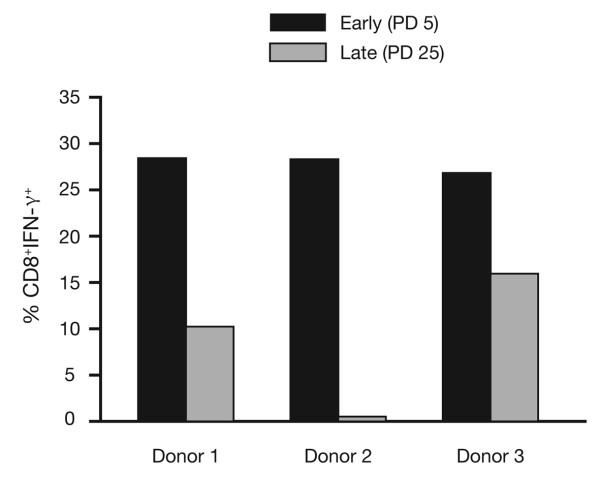
The decline in interferon-γ (IFN-γ) production with culture age [36]. Reproduced with permission from Blackwell Publishing. Long-term HIV-specific cultures were established by repeated stimulation of CD8 T-cells from HLA-A2+ HIV-infected persons with the appropriate gag, pol and env peptides. Early passage (5 population doublings, PD 5) and late passage (PD 25) cultures from three different donors were assessed for intracellular IFN-γ using flow cytometry.

References

    1. United Nations, Department of Economic and Social Affairs, Population Division . Report prepared for the 2nd World Assembly on Ageing, 2002. (ST/ESA/SER.A/207) United Nations Publishing: New York; 2001. World population ageing 1950–2050.http://www.un.org/esa/population/publications/worldageing19502050/ (accessed 14 February 2007)
    1. Gavazzi G, Krause KH. Ageing and infection. Lancet Infect Dis. 2002;2:659–666. doi: 10.1016/S1473-3099(02)00437-1. - DOI - PubMed
    1. Walford RL. The immunologic theory of aging. Munksgaard Press: Copenhagen; 1969.
    1. McElhaney JE. Overcoming the challenges of immunosenescence in the prevention of acute respiratory illness in older people. Conn Med. 2003;67:469–474. - PubMed
    1. Cambier J. Immunosenescence: a problem of lymphopoiesis, homeostatsis, microenvironment and signalling. Immunol Rev. 2005;205:5–6. doi: 10.1111/j.0105-2896.2005.00276.x. - DOI - PubMed

LinkOut - more resources