Gene expression of purified beta-cell tissue obtained from human pancreas with laser capture microdissection
- PMID: 18073315
- PMCID: PMC2266961
- DOI: 10.1210/jc.2007-0931
Gene expression of purified beta-cell tissue obtained from human pancreas with laser capture microdissection
Abstract
Context: Human beta-cell gene profiling is a powerful tool for understanding beta-cell biology in normal and pathological conditions. Assessment is complicated when isolated islets are studied because of contamination by non-beta-cells and the trauma of the isolation procedure.
Objective: The objective was to use laser capture microdissection (LCM) of human beta-cells from pancreases of cadaver donors and compare their gene expression with that of handpicked isolated islets.
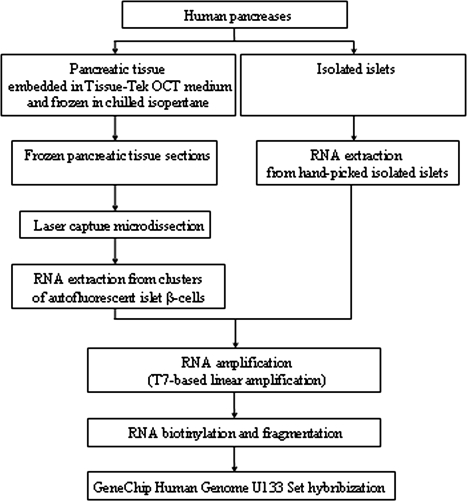
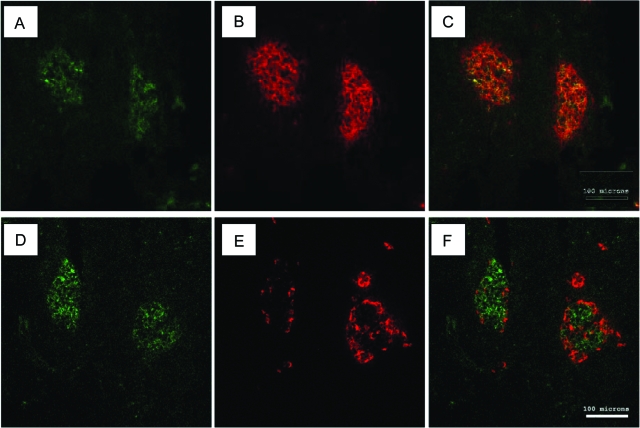
Design: Endogenous autofluorescence of beta-cells facilitated procurement of purified beta-cell tissue from frozen pancreatic sections with LCM. Gene expression profiles of three microdissected beta-cell samples and three isolated islet preparations were obtained. The array data were normalized using DNA-Chip Analyzer software (Harvard School of Public Health, Boston, MA), and the lower confidence bound evaluated differentially expressed genes. Real-time PCR was performed on selected acinar genes and on the duct cell markers, carbonic anhydrase II and keratin 19.
Results: Endogenous autofluorescence facilitates the microdissection of beta-cell rich tissue in human pancreas. When compared with array profiles of purified beta-cell tissue, with lower confidence bound set at 1.2, there were 4560 genes up-regulated and 1226 genes down-regulated in the isolated islets. Among the genes up-regulated in isolated islets were pancreatic acinar and duct genes, chemokine genes, and genes associated with hypoxia, apoptosis, and stress. Quantitative RT-PCR confirmed the differential expression of acinar gene transcripts and the duct marker carbonic anhydrase II in isolated islets.
Conclusion: LCM makes it possible to obtain beta-cell enriched tissue from human pancreas sections without the trauma and ischemia of islet isolation.
Figures
References
-
- Sander M, German MS 1997 The β cell transcription factors and development of the pancreas. J Mol Med 75:327–340 - PubMed
-
- Schuit F, Flamez D, De Vos A, Pipeleers D 2002 Glucose-regulated gene expression maintaining the glucose-responsive state of β-cells. Diabetes 51(Suppl 3):S326–S332 - PubMed
-
- Shalev A, Pise-Masison CA, Radonovich M, Hoffmann SC, Hirshberg B, Brady JN, Harlan DM 2002 Oligonucleotide microarray analysis of intact human pancreatic islets: identification of glucose-responsive genes and a highly regulated TGFβ signaling pathway. Endocrinology 143:3695–3698 - PubMed
-
- Hui H, Wang C, Li H, Bulotta A, D’Amico E, Khoury N, Nguyen E, Di Mario U, Chen IY, Perfetti R 2004 Gene expression profiling of cultured human islet preparations. Diabetes Technol Ther 6:481–492 - PubMed