


Motor skill training, but not voluntary exercise, improves skilled reaching after unilateral ischemic lesions of the sensorimotor cortex in rats
- PMID: 18073324
- PMCID: PMC2586983
- DOI: 10.1177/1545968307308551
Motor skill training, but not voluntary exercise, improves skilled reaching after unilateral ischemic lesions of the sensorimotor cortex in rats
Abstract
Background and purpose: Exercise and rehabilitative training each have been implicated in the promotion of restorative neural plasticity after cerebral injury. Because motor skill training induces synaptic plasticity and exercise increases plasticity-related proteins, we asked if exercise could improve the efficacy of training on a skilled motor task after focal cortical lesions.
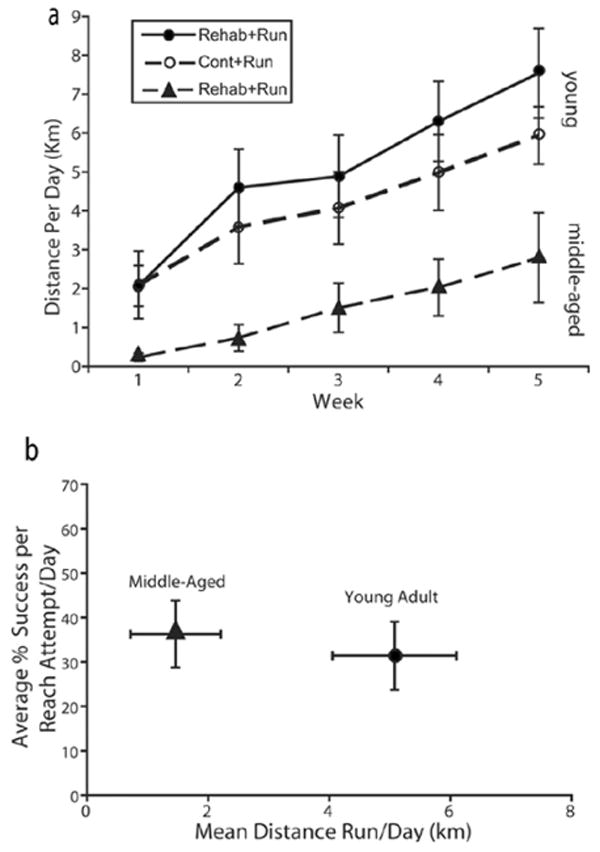
Methods: Female young and middle-aged rats were trained on the single-pellet retrieval task and received unilateral ischemic sensorimotor cortex lesions contralateral to the trained limb. Rats then received both, either, or neither voluntary running and/or rehabilitative training for 5 weeks beginning 5 days postlesion. Motor skill training consisted of daily practice of the impaired forelimb in a tray-reaching task. Exercised rats had free access to running wheels for 6 h/day. Reaching function was periodically probed using the single-pellet retrieval task.
Results: In young adults, motor skill training significantly enhanced skilled reaching recovery compared to controls. However, exercise did not significantly enhance performance when administered alone or in combination with skill training. There was also no major benefit of exercise in older rats. Additionally, there were no effects of exercise in a measure of coordinated forelimb placement (the foot-fault test) or in immunocytochemical measures of several plasticity-related proteins in the motor cortex.
Conclusions: In young and middle-aged animals, exercise did not improve motor skill training efficacy following ischemic lesions. Practicing motor skills more effectively improved recovery of these skills than did exercise. It remains possible that an alternative manner of administering exercise would be more effective.
Figures




References
-
- Kolb B, Gibb R. Environmental enrichment and cortical injury: behavioral and anatomical consequences of frontal cortex lesions. Cereb Cortex. 1991;1(2):189–198. - PubMed
-
- Will B, Galani R, Kelche C, Rosenzweig MR. Recovery from brain injury in animals: relative efficacy of environmental enrichment, physical exercise or formal training (1990-2002) Prog Neurobiol. 2004;72(3):167–182. - PubMed
-
- Vaynman S, Gomez-Pinilla F. License to run: exercise impacts functional plasticity in the intact and injured central nervous system by using neurotrophins. Neurorehabil Neural Repair. 2005;19(4):283–295. - PubMed
-
- Ding Q, et al. Insulin-like growth factor I interfaces with brain-derived neurotrophic factor-mediated synaptic plasticity to modulate aspects of exercise-induced cognitive function. Neuroscience. 2006;140(3):823–833. - PubMed
-
- Griesbach GS, Hovda DA, Molteni R, Wu A, Gómez-Pinilla F. Voluntary exercise following traumatic brain injury: brain-derived neurotrophic factor upregulation and recovery of function. Neuroscience. 2004;125(1):129–139. - PubMed
Publication types
MeSH terms
Grants and funding
LinkOut - more resources
Full Text Sources
Other Literature Sources
