


Prevalence and patterns of soft tissue metastasis: detection with true whole-body F-18 FDG PET/CT
- PMID: 18076764
- PMCID: PMC2235843
- DOI: 10.1186/1471-2342-7-8
Prevalence and patterns of soft tissue metastasis: detection with true whole-body F-18 FDG PET/CT
Abstract
Background: The aim of this retrospective study was to report the prevalence and patterns of soft tissue (ST) metastasis detected with true whole-body (TWB) F-18 FDG PET/CT acquired from the top of the skull through the bottom of the feet and to compare such findings to that of the typically acquired skull-base to upper-thigh, thus limited whole-body (LWB) field of view (FOV).
Methods: TWB FDG-PET/CT scans were performed in 500 consecutive cancer patients. Suspected ST metastasis was verified by correlation with surgical pathology, other imaging modalities, or clinical follow-up.
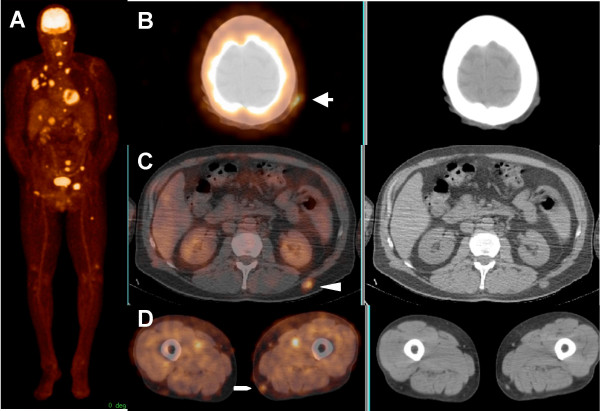
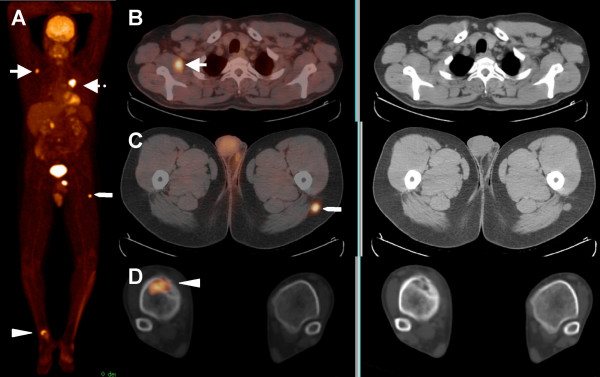
Results: Nine out of 500 patients (1.8 %) had ST metastasis with a prevalence of 4/41 (9.8%) for melanoma, 2/60 (3.3%) for lung carcinoma, 2/88 (2.3%) for lymphoma and 1/13 (77%) for esophageal cancer. Those nine patients had a total of 41 ST lesions: 22 lesions within and 19 outside of LWB FOV. Of those 41 lesions, 19 (46%) were subcutaneous and 22 (54%) were muscular lesions. The presence of ST metastasis neither changed the staging nor the treatment in any of these patients. However, the ST lesions provided a biopsy site in 4 of the 9 patients (44%). Seven out of nine studied patients died of their disease within 1-22 months after ST metastasis was diagnosed.
Conclusion: The detection of ST metastasis may have prognostic implications, provide more accessible biopsy sites and help avoid invasive procedures. A LWB scanning may underestimate the true extent of ST metastasis since a significant percentage of ST metastasis (46%) occurred outside the typical LWB FOV.
Figures
References
-
- Spencer PS, Helm TNL. Skin metastasis in cancer patients. Cutis. 1987;39:119–121. - PubMed
-
- Lookingbill DP, Spangler N, Sexton FM. Skin involvement as the presenting sign of internal carcinoma. A retrospective study of 7316 cancer patients. J Am Acad Dermatol. 1990;22:19–26. - PubMed
-
- Hidaka T, Ischii Y, Kitamura S. Clinical features of skin metastasis from lung cancer. Intern Med. 1996;35:459–62. - PubMed
-
- Czernin J, Allen-Auerbach M, Schelbert HR. Improvements in cancer staging with PET/CT: literature-based evidence as of September 2006. J Nucl Med. 2007;48 Suppl 1:78S–88S. - PubMed
MeSH terms
Substances
LinkOut - more resources
Full Text Sources
Medical
