Comparative Study
. 2008 Feb 22;275(1633):411-8.
doi: 10.1098/rspb.2007.1288.

Old men running: mechanical work and elastic bounce

Affiliations
Comparative Study

Old men running: mechanical work and elastic bounce

G A Cavagna et al. Proc Biol Sci. .

Abstract

It is known that muscular force is reduced in old age. We investigate what are the effects of this phenomenon on the mechanics of running. We hypothesized that the deficit in force would result in a lower push, causing reduced amplitude of the vertical oscillation, with smaller elastic energy storage and increased step frequency. To test this hypothesis, we measured the mechanical energy of the centre of mass of the body during running in old and young subjects. The amplitude of the oscillation is indeed reduced in the old subjects, resulting in an approximately 20% smaller elastic recovery and a greater step frequency (3.7 versus 2.8 Hz, p=1.9x10(-5), at 15-17 km h(-1)). Interestingly, the greater step frequency is due to a lower aerial time, and not to a greater natural frequency of the system, which is similar in old and young subjects (3.6 versus 3.4 Hz, p=0.2). Moreover, we find that in the old subjects, the step frequency is always similar to the natural frequency, even at the highest speeds. This is at variance with young subjects who adopt a step frequency lower than the natural frequency at high speeds, to contain the aerobic energy expenditure. Finally, the external work to maintain the motion of the centre of mass is reduced in the old subjects (0.9 versus 1.2 J kg(-1) m(-1), p=5.1x10(-6)) due to the lower work done against gravity, but the higher step frequency involves a greater internal work to reset the limbs at each step. The net result is that the total work increases with speed more steeply in the old subjects than in young subjects.


Figures
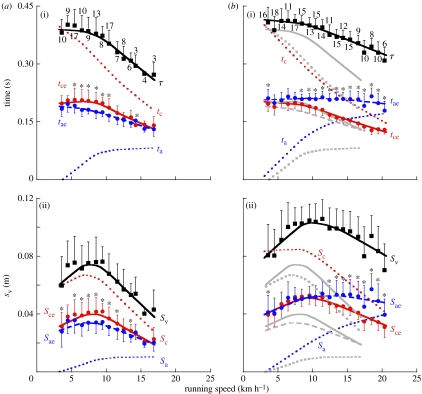
Figure 1
Figure 1
(a) Old subjects. (b) Young subjects, with superposed old subject lines (grey lines) for comparison. (a(i),b(i) indicate the step period (τ, black filled squares) and its fractions). (a(ii), b(ii) indicate the total vertical displacement during the step (Sv, black filled squares) and its fractions). The red circles indicate the duration of the effective contact phase when the vertical force is greater than body weight (tce), and the vertical displacement during this phase (Sce, which represents the amplitude of the oscillation in the spring–mass model of running, Cavagna et al. (1988)). The blue circles indicate the duration of the effective aerial phase when the vertical force is lower than body weight (tae) and the vertical displacement during this phase (Sae). The red dotted line indicates the contact time (tc) and the vertical displacement (Sc) during it. The blue dotted line indicates the aerial time (ta) and the vertical displacement (Sa) during it. The vertical bars indicate the s.d.±mean; the values near the symbols in (a(i),b(i)) indicate the number of items in the mean. Asterisks denote statistically significant difference at p<0.05 between variables within each subject group. Lines represent the weighted mean of all the data (KaleidaGraph v. 4.0.3), their only purpose is to be a guide for the eye: they do not describe the underlying physical mechanism. Note that both the step period τ and the amplitude of the oscillation Sce are smaller in the old than in the young subjects, whereas the time of contact tc and the effective contact time tce are about the same. This indicates that the fraction of the step during which the vertical force exceeds body weight is greater in the old subjects. The similar effective contact time tce in old and young subjects indicates a bouncing system having the same natural frequency (figure 2), with lower amplitude of the oscillation Sce in the old subjects.
Figure 2
Figure 2
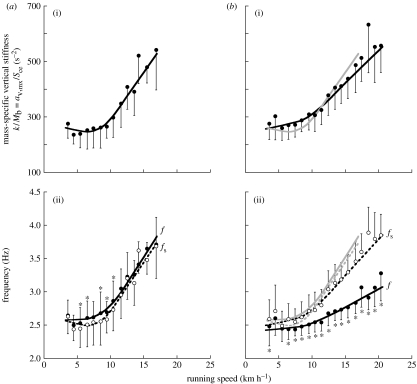
(a) Old subjects. (b) Young subjects. (a(i),b(i)) The mass-specific vertical stiffness, which is similar in old and young subjects. (a(ii),b(ii)) Shows that the step frequency (f, continuous line) is greater in the old than in the young subjects. In addition, over most of the speed range, the step frequency is similar to the natural frequency of the system (fs, dashed line) in the old subjects, whereas it is less than the frequency of the system in the young subjects. Statistics and other indications are the same as in figure 1.
Figure 3
Figure 3
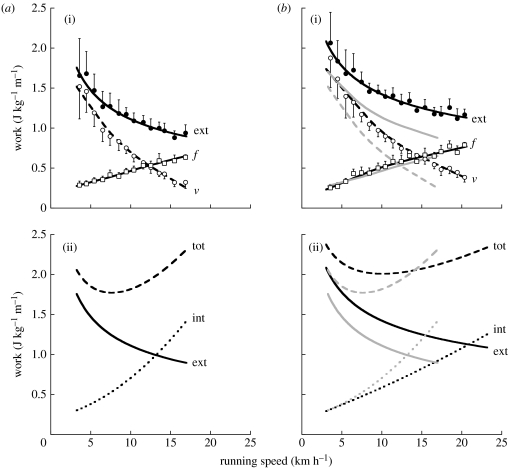
(a) Old subjects. (b) Young subjects. (a(i),b(i)) The external work done per unit distance (filled circles) is plotted with its two components: the work done against gravity (open circles) and to sustain the forward velocity changes (open squares). Note that the external work is lower in old than in the young subjects due to a lower work done against gravity with a similar work to sustain the forward velocity changes. (a(ii),b(ii)) The total mechanical work done per unit distance (dashed line) is given as the sum of the external work (solid line) and the internal work to accelerate the limbs relative to the centre of mass (dotted line). Note the sharp increase with speed of the total work done by the old subjects due to a greater internal work resulting from their greater step frequency (figure 2). Statistics and other indications are the same as in figure 1.

References

    1. Blickhan R. The spring–mass model for running and hopping. J. Biomech. 1989;22:1217–1227. doi:10.1016/0021-9290(89)90224-8 - DOI - PubMed
    1. Cavagna G.A. Force platforms as ergometers. J. Appl. Physiol. 1975;39:174–179. - PubMed
    1. Cavagna G.A. The landing-take-off asymmetry in human running. J. Exp. Biol. 2006;209:4051–4060. doi:10.1242/jeb.02344 - DOI - PubMed
    1. Cavagna G.A, Thys H, Zamboni A. The sources of external work in level walking and running. J. Physiol. 1976;262:639–657. - PMC - PubMed
    1. Cavagna G.A, Franzetti P, Heglund N.C, Willems P.A. The determinants of the step frequency in running, trotting and hopping in man and other vertebrates. J. Physiol. 1988;399:81–92. - PMC - PubMed

Publication types