


Highly permeable polymeric membranes based on the incorporation of the functional water channel protein Aquaporin Z
- PMID: 18077364
- PMCID: PMC2410068
- DOI: 10.1073/pnas.0708762104
Highly permeable polymeric membranes based on the incorporation of the functional water channel protein Aquaporin Z
Abstract
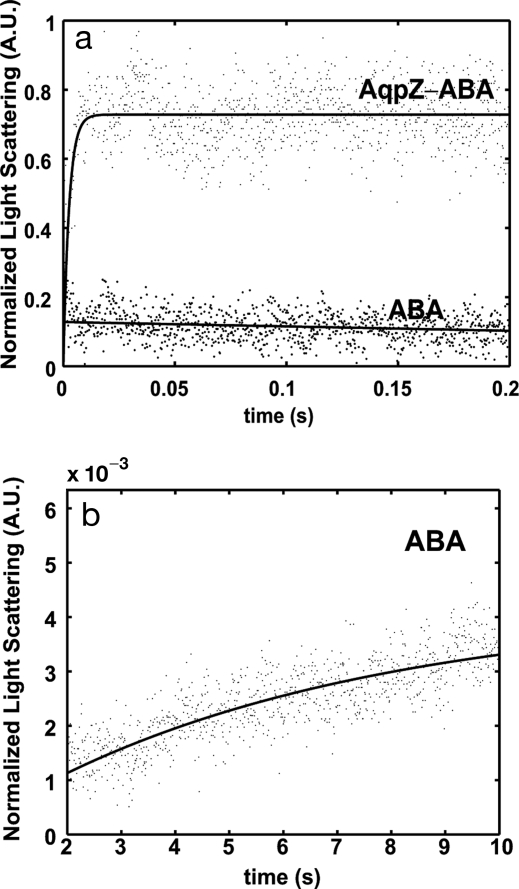
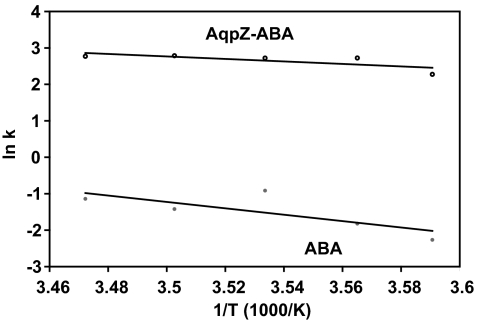
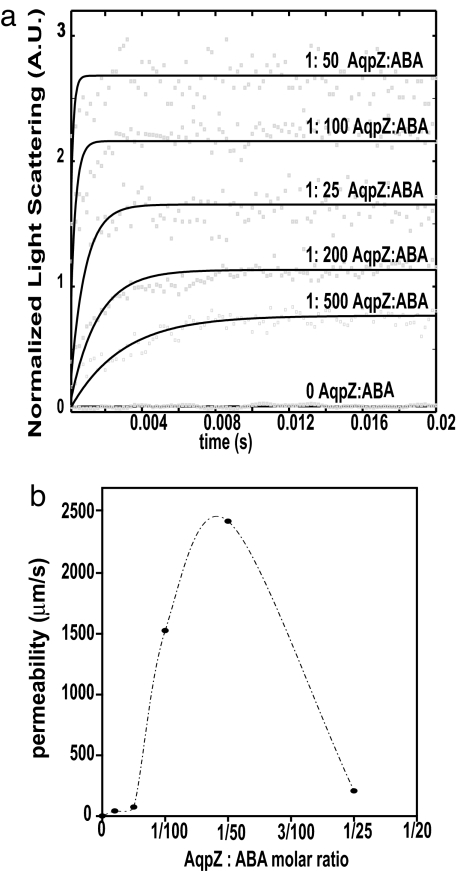
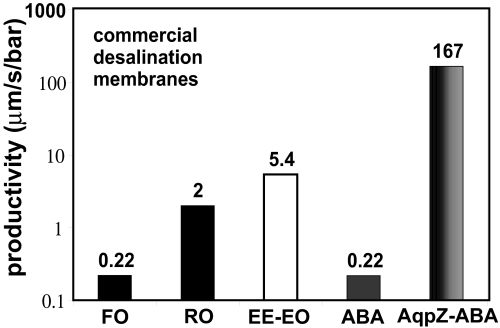
The permeability and solute transport characteristics of amphiphilic triblock-polymer vesicles containing the bacterial water-channel protein Aquaporin Z (AqpZ) were investigated. The vesicles were made of a block copolymer with symmetric poly-(2-methyloxazoline)-poly-(dimethylsiloxane)-poly-(2-methyloxazoline) (PMOXA(15)-PDMS(110)-PMOXA(15)) repeat units. Light-scattering measurements on pure polymer vesicles subject to an outwardly directed salt gradient in a stopped-flow apparatus indicated that the polymer vesicles were highly impermeable. However, a large enhancement in water productivity (permeability per unit driving force) of up to approximately 800 times that of pure polymer was observed when AqpZ was incorporated. The activation energy (E(a)) of water transport for the protein-polymer vesicles (3.4 kcal/mol) corresponded to that reported for water-channel-mediated water transport in lipid membranes. The solute reflection coefficients of glucose, glycerol, salt, and urea were also calculated, and indicated that these solutes are completely rejected. The productivity of AqpZ-incorporated polymer membranes was at least an order of magnitude larger than values for existing salt-rejecting polymeric membranes. The approach followed here may lead to more productive and sustainable water treatment membranes, whereas the variable levels of permeability obtained with different concentrations of AqpZ may provide a key property for drug delivery applications.
Conflict of interest statement
The authors declare no conflict of interest.
Figures
Comment in
-
Controlling water transport through artificial polymer/protein hybrid membranes.Proc Natl Acad Sci U S A. 2007 Dec 26;104(52):20643-4. doi: 10.1073/pnas.0710864105. Epub 2007 Dec 19. Proc Natl Acad Sci U S A. 2007. PMID: 18093908 Free PMC article. No abstract available.
References
-
- Knepper MA, Wade JB, Terris J, Ecelbarger CA, Marples D, Mandon B, Chou CL, Kishore BK, Nielsen S. Kidney Int. 1996;49:1712–1717. - PubMed
-
- Gorin MB, Yancey SB, Cline J, Revel J-P, Horwitz J. Cell. 1984;39:49–59. - PubMed
-
- Preston GM, Carroll TP, Guggino WB, Agre P. Science. 1992;256:385–387. - PubMed
-
- Borgnia MJ, Kozono D, Calamita G, Maloney PC, Agre P. J Mol Biol. 1999;291:1169–1179. - PubMed
Publication types
MeSH terms
Substances
LinkOut - more resources
Full Text Sources
Other Literature Sources
Molecular Biology Databases
