


Life history trade-offs explain the evolution of human pygmies
- PMID: 18077366
- PMCID: PMC2154411
- DOI: 10.1073/pnas.0708024105
Life history trade-offs explain the evolution of human pygmies
Abstract
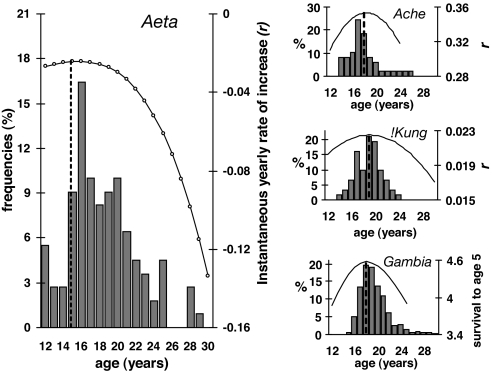
Explanations for the evolution of human pygmies continue to be a matter of controversy, recently fuelled by the disagreements surrounding the interpretation of the fossil hominin Homo floresiensis. Traditional hypotheses assume that the small body size of human pygmies is an adaptation to special challenges, such as thermoregulation, locomotion in dense forests, or endurance against starvation. Here, we present an analysis of stature, growth, and individual fitness for a large population of Aeta and a smaller one of Batak from the Philippines and compare it with data on other pygmy groups accumulated by anthropologists for a century. The results challenge traditional explanations of human pygmy body size. We argue that human pygmy populations and adaptations evolved independently as the result of a life history tradeoff between the fertility benefits of larger body size against the costs of late growth cessation, under circumstances of significant young and adult mortality. Human pygmies do not appear to have evolved through positive selection for small stature-this was a by-product of selection for early onset of reproduction.
Conflict of interest statement
The authors declare no conflict of interest.
Figures


References
-
- Cavalli-Sforza LL. African Pygmies. Orlando, FL: Academic; 1986.
-
- Schmidt E. Globus. 1905;87:121–125.
-
- Migliano AB. Cambridge, UK: University of Cambridge; 2005. Thesis.
-
- Turnbull CM. In: African Pygmies. Cavalli-Sforza LL, editor. Orlando, FL: Academic; 1986. pp. 103–123.
-
- Diamond JM. Nature. 1991;354:111–112. - PubMed
Publication types
MeSH terms
LinkOut - more resources
Full Text Sources
