. 2007 Dec 18;104(51):20262-7.
doi: 10.1073/pnas.0706438104. Epub 2007 Dec 11.

Human neutrophils uniquely release TIMP-free MMP-9 to provide a potent catalytic stimulator of angiogenesis

Affiliations

Human neutrophils uniquely release TIMP-free MMP-9 to provide a potent catalytic stimulator of angiogenesis

Veronica C Ardi et al. Proc Natl Acad Sci U S A. .

Abstract

Several lines of evidence have implicated matrix metalloproteinase 9 (MMP-9) as a protease inducing an angiogenic switch critical for tumor progression. Among MMP-9-expressing cell types, including cancer cells and tumor-associated leukocytes, inflammatory neutrophils appear to provide an important source of MMP-9 for tumor angiogenesis. However, delivery of MMP-9 by neutrophils has not been mechanistically linked to its catalytic activity at the angiogenic site. By using a modified angiogenic model, allowing for a direct analysis of exogenously added cells and their products in collagen onplants grafted on the chorioallantoic membrane of the chicken embryo, we demonstrate that intact human neutrophils and their granule contents are highly angiogenic. Furthermore, purified neutrophil MMP-9, isolated from the released granules as a zymogen (proMMP-9), constitutes a distinctly potent proangiogenic moiety inducing angiogenesis at subnanogram levels. The angiogenic response induced by neutrophil proMMP-9 required activation of the tissue inhibitor of metalloproteinases (TIMP)-free zymogen and the catalytic activity of the activated enzyme. That the high angiogenic potency of neutrophil proMMP-9 is associated with its unique TIMP-free status was confirmed when a generated and purified stoichiometric complex of neutrophil proMMP-9 with TIMP-1 failed to induce angiogenesis. Recombinant human proMMP-9, operationally free of TIMP-1, also induced angiogenesis at subnanomolar levels, but lost its proangiogenic potential when stoichiometrically complexed with TIMP-1. Similar proMMP-9/TIMP-1 complexes, but naturally produced by human monocytic U937 cells and HT-1080 fibrosarcoma cells, did not stimulate angiogenesis. These findings provide biochemical evidence that infiltrating neutrophils, in contrast to other cell types, deliver a potent proangiogenic moiety, i.e., the unencumbered TIMP-free MMP-9.


Conflict of interest statement

The authors declare no conflict of interest.

Figures
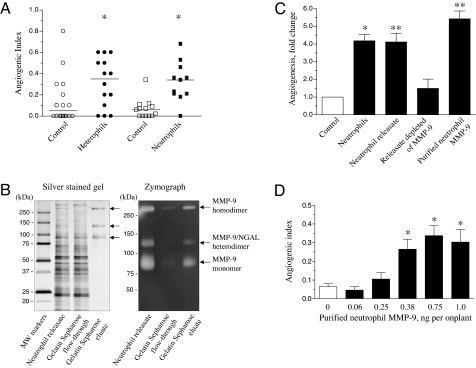
Fig. 1.
Fig. 1.
Angiogenic potential of neutrophils, neutrophil releasate, and purified neutrophil MMP-9. (A) Human neutrophils efficiently induce angiogenesis. Isolated chicken heterophils or human neutrophils were incorporated at 5 × 10⁴ per 30-μl collagen onplant. Control onplants were supplemented with only buffer. Presented is a scatter plot from one of two independent experiments for each cell type. Each point represents the angiogenic index of an individual onplant and horizontal lines are medians (*, P < 0.05). (B) Purification of neutrophil MMP-9. Gelatin Sepharose affinity chromatography was performed on the releasate prepared from PMA-treated neutrophils. Proteins from the original releasate, gelatin Sepharose flow-through fraction, and the DMSO-eluted fraction (eluate) were analyzed by silver staining (Left) and zymography (Right). Positions of molecular mass standards (kDa) are indicated to the left. Zymography analysis indicated gelatinolytic activity of three proteins (arrows) of molecular mass corresponding to the MMP-9 monomer (90–95 kDa), MMP-9/NGAL heterodimer (120–130 kDa), and MMP-9 homodimer (200–300 kDa). (C) MMP-9 is the major angiogenic moiety in neutrophil releasate. Collagen onplants were supplemented with neutrophils (average 1.5 × 10⁴ cells per onplant), neutrophil releasate, purified MMP-9, or releasate depleted of MMP-9 (equivalent of 1.5 × 10⁴ cells per onplant), whereas control onplants (empty bar) contained collagen alone. Bars are means ± SEM fold changes in angiogenesis from three independent experiments (*, P < 0.05; **, P < 0.001). (D) Neutrophil MMP-9 induces angiogenesis in a dose-dependent manner. Collagen onplants were supplemented with purified MMP-9 (0.06–1.0 ng per onplant) or buffer only (empty bar). Bars are means ± SEM angiogenic index from two independent experiments. *, P < 0.05.
Fig. 2.
Fig. 2.
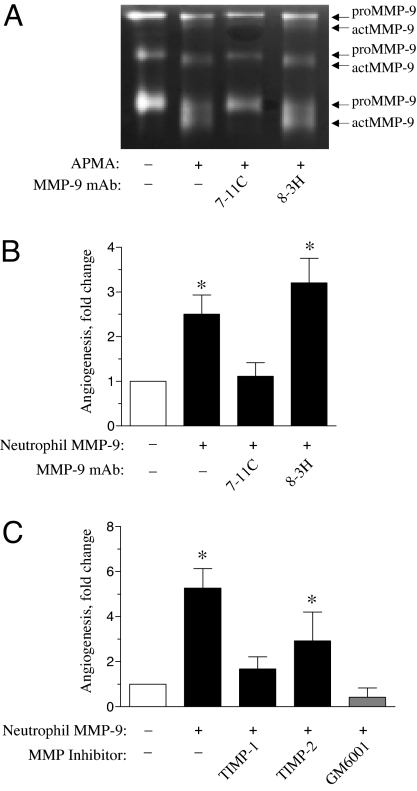
Angiogenesis induced by neutrophil MMP-9 involves activation of MMP-9 zymogen and proteolytic activity of the activated MMP-9 enzyme. (A) MMP-9-specific mAb 7-11C is capable of blocking activation of neutrophil proMMP-9. A total of 0.4 μg of neutrophil proMMP-9 was activated for 1 h with 3 mM APMA in the presence or absence of 90 μg/ml MMP-9-specific mAb 7-11C or mAb 8-3H. Whereas mAb 8-3H does not prevent APMA-induced processing of proMMP-9, mAb 7-11C efficiently blocks the conversion of proMMP-9 into lower molecular mass activated species (actMMP-9). (B) Activation of neutrophil MMP-9 is required for the induction of angiogenesis. Collagen onplants containing (+) purified neutrophil MMP-9 (2 ng per onplant) were additionally supplemented with 30 ng of mAb 7-11C or mAb 8-3H. Control onplants (empty bar) were supplemented with buffer only (−). (C) Catalytic activity of MMP-9 is required for angiogenesis. TIMP-1 or TIMP-2 in a 5-fold molar excess to MMP-9 or a synthetic MMP inhibitor GM6001 at a final concentration of 5 μM was added to the collagen mixture containing purified neutrophil MMP-9 (2 ng per onplant). Bars are means ± SEM fold changes in angiogenesis over control (no MMP-9 added; empty bar) from three independent experiments. *, P < 0.01.
Fig. 3.
Fig. 3.
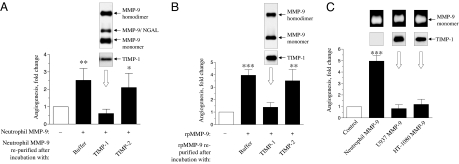
TIMP-1-free proMMP-9 is required for the induction of angiogenesis. (A) Neutrophil proMMP-9 complexed with TIMP-1 loses its proangiogenic capacity. Purified neutrophil proMMP-9 was incubated with PBS or a 5-fold molar excess of TIMP-1 or TIMP-2. MMP-9 and MMP-9/TIMP complexes were purified by gelatin Sepharose affinity chromatography and incorporated at 2 ng (by MMP-9 content) per onplant. Presence of proMMP-9 species and TIMP-1 in the elution fraction from the proMMP-9/TIMP-1 mixture was confirmed by Western blotting with MMP-9- and TIMP-1-specific antibodies (Inset above the corresponding bar). (B) TIMP-free rpMMP-9 induces angiogenesis if not complexed with TIMP-1. Collagen onplants were supplemented with 2.5 ng of rpMMP-9 repurified by gelatin Sepharose affinity chromatography after incubation with PBS or 5-fold molar excess of TIMP-1 or TIMP-2. Composition of MMP-9 monomer/homodimer species and the presence of TIMP-1 in the elution fraction from the rpMMP-9/TIMP-1 mixture were verified by Western blotting with MMP-9- and TIMP-1-specific antibodies (Inset). (C) The proMMP-9/TIMP-1 complex naturally produced by human monocytic and tumor cells is inefficient in the induction of angiogenesis. Collagen onplants were supplemented with 2 ng of proMMP-9 purified from neutrophil releasate or conditioned medium from the U937 cells and HT-1080 fibrosarcoma. Gelatin zymography confirmed presence of proMMP-9 in all gelatin Sepharose elution fractions, whereas TIMP-1-specific mAbs confirmed the presence of TIMP-1 only in the proMMP-9 purified from U937 and HT-1080 conditioned media (Insets above corresponding bars). Bars are means ± SEM fold changes in angiogenesis over control (no MMP-9 added; empty bars) from three independent experiments. *, P < 0.03 in one-tailed Student's t test; ** and ***, P < 0.01 and P < 0.001 in two-tailed Student's t test, respectively.

References

    1. Carmeliet P, Jain RK. Nature. 2000;407:249–257. - PubMed
    1. Folkman J. Annu Rev Med. 2006;57:1–18. - PubMed
    1. Hanahan D, Folkman J. Cell. 1996;86:353–364. - PubMed
    1. Bergers G, Benjamin LE. Nat Rev Cancer. 2003;3:401–410. - PubMed
    1. Egeblad M, Werb Z. Nat Rev Cancer. 2002;2:161–174. - PubMed

Publication types

MeSH terms

Substances