


Global fish production and climate change
- PMID: 18077405
- PMCID: PMC2148362
- DOI: 10.1073/pnas.0702059104
Global fish production and climate change
Abstract
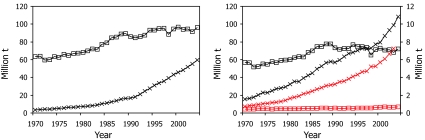
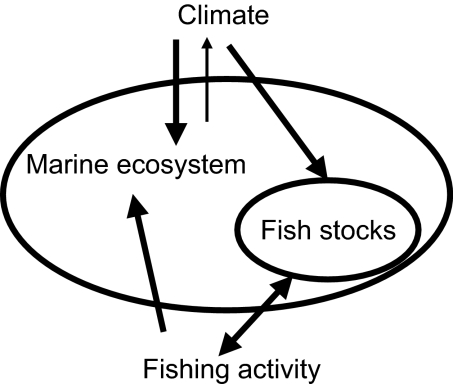
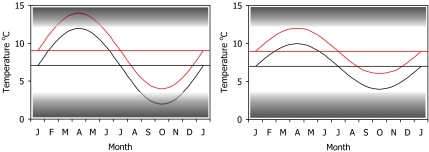
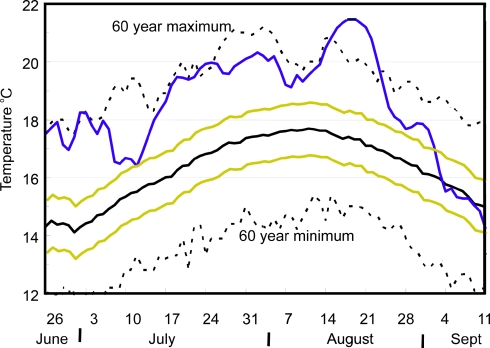
Current global fisheries production of approximately 160 million tons is rising as a result of increases in aquaculture production. A number of climate-related threats to both capture fisheries and aquaculture are identified, but we have low confidence in predictions of future fisheries production because of uncertainty over future global aquatic net primary production and the transfer of this production through the food chain to human consumption. Recent changes in the distribution and productivity of a number of fish species can be ascribed with high confidence to regional climate variability, such as the El Niño-Southern Oscillation. Future production may increase in some high-latitude regions because of warming and decreased ice cover, but the dynamics in low-latitude regions are governed by different processes, and production may decline as a result of reduced vertical mixing of the water column and, hence, reduced recycling of nutrients. There are strong interactions between the effects of fishing and the effects of climate because fishing reduces the age, size, and geographic diversity of populations and the biodiversity of marine ecosystems, making both more sensitive to additional stresses such as climate change. Inland fisheries are additionally threatened by changes in precipitation and water management. The frequency and intensity of extreme climate events is likely to have a major impact on future fisheries production in both inland and marine systems. Reducing fishing mortality in the majority of fisheries, which are currently fully exploited or overexploited, is the principal feasible means of reducing the impacts of climate change.
Conflict of interest statement
The author declares no conflict of interest.
Figures
References
-
- Marshall CT, Browman HI. Mar Ecol Prog Ser. 2007;335:249–310.
-
- Jacobson LD, De Oliveira JAA, Barange M, Cisneros-Mata MA, Félix-Uraga R, Hunter JR, Kim JY, Matsuura Y, Niquen M, Porteiro C, et al. Can J Fish Aquat Sci. 2001;58:1891–1903.
-
- Barber R. In: Encyclopedia of Ocean Sciences. Steele JH, Thorpe SA, Turekian KK, editors. London: Academic; 2001. pp. 3128–3135.
-
- Naylor RL, Goldburg RJ, Primavera JH, Kautsky N, Beveridge MCM, Clay J, Folke C, Lubchenco J, Mooney H, Troell M. Nature. 2000;405:1017–1024. - PubMed
-
- Goldburg RJ, Elliot MS, Naylor RL. Marine Aquaculture in the United States: Environmental Impacts and Policy Options. Arlington, VA: Pew Oceans Commission; 2001.
Publication types
MeSH terms
LinkOut - more resources
Full Text Sources
