A double-blind, randomized, controlled, multicenter safety and immunogenicity study of a refrigerator-stable formulation of Zostavax
- PMID: 18077611
- PMCID: PMC2238040
- DOI: 10.1128/CVI.00310-07
A double-blind, randomized, controlled, multicenter safety and immunogenicity study of a refrigerator-stable formulation of Zostavax
Abstract
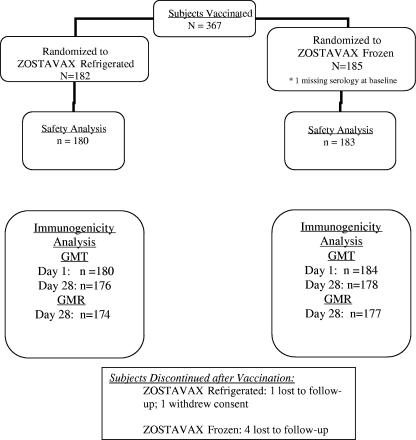
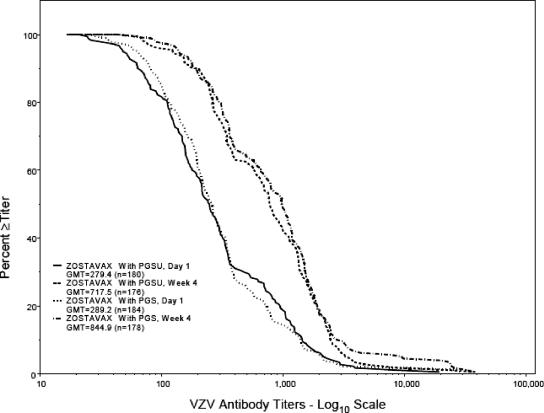
The vaccine Zostavax has been shown to prevent herpes zoster (HZ) and postherpetic neuralgia and is recommended for individuals > or =60 years of age. This study compared the safety and the immunogenicity of a refrigerator-stable formulation (Zostavax refrigerated) with those of the current formulation (Zostavax frozen) in subjects > or =50 years of age. Subjects with a negative history for HZ were randomized 1:1 to receive one dose of either formulation. Enrollment was stratified 1:2 by age (50 to 59 years and > or =60 years). Safety was evaluated for 28 days postvaccination. Varicella-zoster virus (VZV) antibody responses were measured by a glycoprotein enzyme-linked immunosorbent assay (gpELISA). The primary endpoints were the VZV antibody geometric mean titer (GMT; day 28), the VZV antibody geometric mean rise (GMR; days 1 to 28), and the incidence of vaccine-related serious adverse experiences (AEs) over 28 days. The refrigerated (n = 182) and frozen (n = 185) formulations induced similar GMTs (727.4 and 834.4 gpELISA units/ml, respectively); the estimated GMT ratio (refrigerated formulation/frozen formulation) was 0.87 (95% confidence interval, 0.71 to 1.07). The GMRs were 2.6- and 2.9-fold, respectively. No vaccine-related serious AEs were reported in either group, and the safety profiles of the formulations were generally similar. The frequencies of injection-site AEs during follow-up were 35.6% and 46.4% in the refrigerated and the frozen formulation groups, respectively, and were generally mild. The frequencies of systemic AEs were similar in the two groups, and those of vaccine-related AEs were approximately 6% in both groups. The refrigerator-stable formulation of Zostavax has an acceptable safety profile and is as immunogenic as the frozen formulation; thus, the vaccine may be used in clinical settings where freezer availability is limited.
Figures
Comment in
-
Immune response to a refrigerator-stable zoster vaccine.Clin Vaccine Immunol. 2009 Sep;16(9):1381; author reply 1381-2. doi: 10.1128/CVI.00338-08. Clin Vaccine Immunol. 2009. PMID: 19734522 Free PMC article. No abstract available.
References
-
- Bernstein, H. H., K. Eves, K. Campbell, S. B. Black, J. D. Twiggs, K. S. Reisinger, R. M. Conti, C. E. Flodmark, L. Rombo, S. Klopfer, F. Schödel, J. Hartzel, B. J. Kuter, and the Refrigerator-Stable Formulation Study Group for ProQuad. 2007. Comparison of the safety and immunogenicity of a refrigerator-stable versus a frozen formulation of ProQuad (measles, mumps, rubella, and varicella virus vaccine live). Pediatrics 119:e1299-e1305. - PubMed
-
- Brockelsby, G. 2005. Vaccine and drug storage. Dermatol. Nurs. 17:373-374. - PubMed
-
- Centers for Disease Control and Prevention. 2007. Recommended adult immunization schedule—United States, October 2007-September 2008. http://www.cdc.gov/vaccines/recs/schedules/adult-schedule.htm. MMWR Morb. Mortal. Wkly. Rep. 56:Q1-Q4. - PubMed
-
- Cunningham, A. L. 2006. Zoster vaccine live (Oka/Merck). Drugs Aging 23:532. - PubMed
-
- Diaz, C., P. Dentico, R. Gonzalez, R. G. Mendez, S. Cinquetti, J. L. Barben, A. Harmon, I. Chalikonda, J. G. Smith, J. E. Stek, A. Robertson, M. J. Caulfield, L. R. Biasio, J. L. Silber, C. Y. Chan, R. Vessey, J. Sadoff, I. F. S. Chan, H. Matthews, W. Wang, K. Schlienger, F. P. Schödel, and the Protocol 049 Study Group. 2006. Safety, tolerability, and immunogenicity of a two-dose regimen of high-titer varicella vaccine in subjects ≥13 years of age. Vaccine 24:6875-6885. - PubMed
Publication types
MeSH terms
Substances
LinkOut - more resources
Full Text Sources
Medical
Research Materials