


Differences in potential for selection of clindamycin-resistant mutants between inducible erm(A) and erm(C) Staphylococcus aureus genes
- PMID: 18077631
- PMCID: PMC2238126
- DOI: 10.1128/JCM.01925-07
Differences in potential for selection of clindamycin-resistant mutants between inducible erm(A) and erm(C) Staphylococcus aureus genes
Abstract
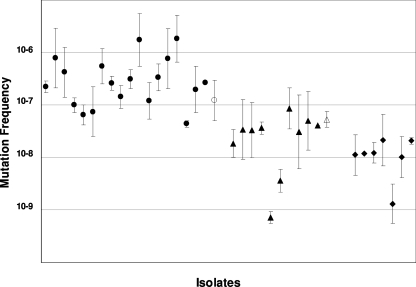
In staphylococci, inducible macrolide-lincosamide-streptogramin B (MLS(B)) resistance is conferred by the erm(C) or erm(A) gene. This phenotype is characterized by the erythromycin-clindamycin "D-zone" test. Although clindamycin appears active in vitro, exposure of MLS(B)-inducible Staphylococcus aureus to this antibiotic may result in the selection of clindamycin-resistant mutants, either in vitro or in vivo. We have compared the frequencies of mutation to clindamycin resistance for 28 isolates of S. aureus inducibly resistant to erythromycin and bearing the erm(C) (n = 18) or erm(A) (n = 10) gene. Seven isolates susceptible to erythromycin or bearing the msr(A) gene (efflux) were used as controls. The frequencies of mutation to clindamycin resistance for the erm(A) isolates (mean +/- standard deviation, 3.4 x 10(-8) +/- 2.4 x 10(-8)) were only slightly higher than those for the controls (1.1 x 10(-8) +/- 6.4 x 10(-9)). By contrast, erm(C) isolates displayed a mean frequency of mutation to clindamycin resistance (4.7 x 10(-7) +/- 5.5 x 10(-7)) 14-fold higher than that of the S. aureus isolates with erm(A). The difference was also observed, although to a lower extent, when erm(C) and erm(A) were cloned into S. aureus RN4220. We conclude that erm(C) and erm(A) have different genetic potentials for selection of clindamycin-resistant mutants. By the disk diffusion method, erm(C) and erm(A) isolates could be distinguished on the basis of high- and low-level resistance to oleandomycin, respectively.
Figures
References
-
- Comité de l'Antibiogramme de la Société Française de Microbiologie. 2007. Communiqué 2007. Société Française de Microbiologie, Paris, France. http://www.sfm.asso.fr/.
-
- Di Modugno, V., M. Guerrini, S. Shah, and J. Hamilton-Miller. 2002. Low level resistance to oleandomycin as a marker of ermA in staphylococci. J. Antimicrob. Chemother. 49425-427. - PubMed
-
- Drinkovic, D., E. R. Fuller, K. P. Shore, D. J. Holland, and R. Ellis-Pegler. 2001. Clindamycin treatment of Staphylococcus aureus expressing inducible clindamycin resistance. J. Antimicrob. Chemother. 48315-316. - PubMed
-
- Fleiss, J. L. 1981. Statistical methods for rates and populations, 2nd ed. Wiley, New York, NY.
Publication types
MeSH terms
Substances
LinkOut - more resources
Full Text Sources
Medical
Molecular Biology Databases
