


Abnormal expression of differentiation related proteins and proteoglycan core proteins in the urothelium of patients with interstitial cystitis
- PMID: 18082196
- PMCID: PMC2652890
- DOI: 10.1016/j.juro.2007.09.022
Abnormal expression of differentiation related proteins and proteoglycan core proteins in the urothelium of patients with interstitial cystitis
Abstract
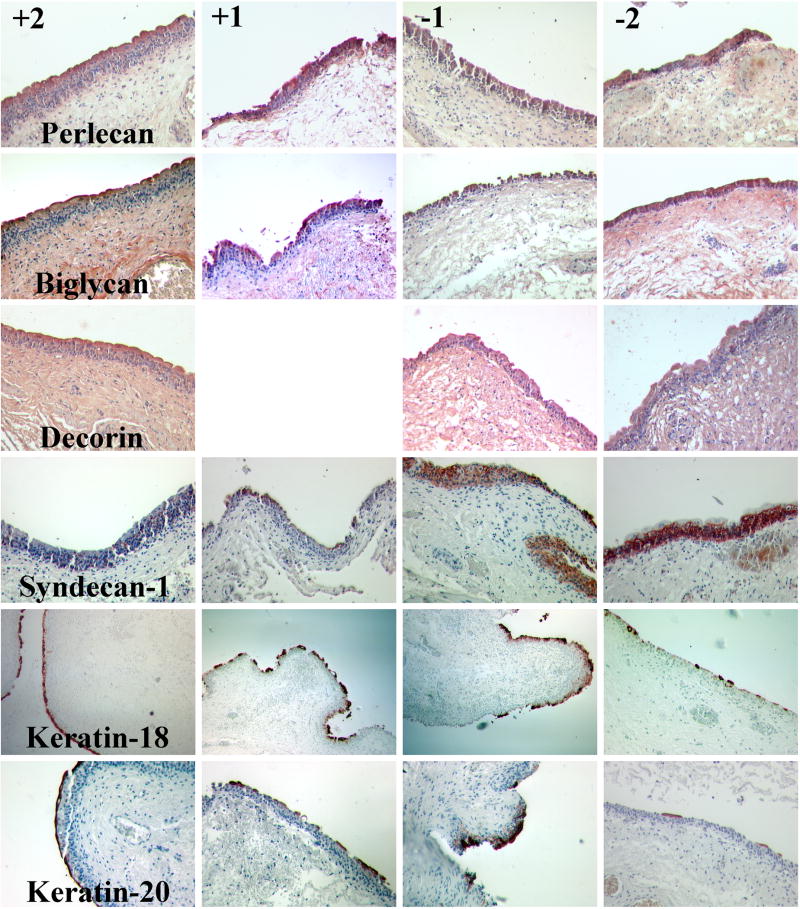
Purpose: Expression of the proteoglycan core proteins biglycan, decorin, perlecan and syndecan-1, and differentiation related markers of keratins 18 and 20 were examined to determine the origins of the loss of the glycosaminoglycan layer and investigate more fully the altered differentiation of the urothelium in interstitial cystitis.
Materials and methods: Formalin fixed biopsies from 27 patients with interstitial cystitis and 5 controls were immunohistochemically labeled for the described proteins and scored using a modification of previous scoring for other markers. Inflammation was scored from hematoxylin and eosin stained slides. By combining previous with new data, cluster analysis showed the relationships among the markers and samples.
Results: Interstitial cystitis specimens clustered into 4 groups, ranging from most biomarkers abnormal to most biomarkers normal, but all clustered separately from normal controls. One group of interstitial cystitis specimens mainly showed aberrant expression of E-cadherin, which might represent an early abnormality. The biomarkers fell into 2 major groupings. One group consisted of chondroitin sulfate, perlecan, biglycan, decorin and the tight junction protein ZO-1. A second cluster consisted of uroplakin, the epithelial marker keratin 18 and 20, and the morphology of the layer. E-cadherin and syndecan-1 showed little relation to the other 2 clusters or to each other. Inflammation correlated moderately with syndecan-1 but to no other marker.
Conclusions: Findings strongly suggest abnormal differentiation in the interstitial cystitis urothelium with a loss of barrier function markers and altered differentiation markers being independent and occurring independently of inflammation. Loss of the glycosaminoglycan layer was associated with a loss of biglycan and perlecan on the luminal layer.
Figures

References
-
- Graham E, Chai TC. Dysfunction of bladder urothelium and bladder urothelial cells in interstitial cystitis. Curr Urol Rep. 2006;7:440. - PubMed
-
- Slobodov G, Feloney M, Gran C, Kyker KD, Hurst RE, Culkin DJ. Abnormal Expression of Molecular Markers for Bladder Impermeability and Differentiation in Urothelium of Interstitial Cystitis Patients. J Urol. 2004;171:1554. - PubMed
-
- Leiby BE, Landis JR, Propert KJ, Tomaszewski JE. Discovery of morphological subgroups that correlate with severity of symptoms in interstitial cystitis: a proposed biopsy classification system. J Urol. 2007;177:142. - PubMed
-
- Keay S, Seillier-Moiseiwitsch F, Zhang CO, Chai T, Zhang J. Changes in human bladder epithelial cell gene expression associated with interstitial cystitis or antiproliferative factor treatment. Physiol Genomics. 2003;14:107. - PubMed
-
- Hu P, Meyers S, Liang FX, Deng FM, Kachar B, Zeidel ML, et al. Role of membrane proteins in permeability barrier function: uroplakin ablation elevates urothelial permeability. Am J Physiol Renal Physiol. 2002;283:F1200. - PubMed
Publication types
MeSH terms
Substances
Grants and funding
LinkOut - more resources
Full Text Sources
Other Literature Sources
Medical
