


Improvement in distance stereoacuity following surgery for intermittent exotropia
- PMID: 18082437
- PMCID: PMC2675644
- DOI: 10.1016/j.jaapos.2007.09.015
Improvement in distance stereoacuity following surgery for intermittent exotropia
Abstract
Purpose: To evaluate whether distance stereoacuity improves following surgery for intermittent exotropia using the Frisby Davis Distance (FD2) and Distance Randot stereotests.
Methods: Eighteen patients (median age, 24 years; range, 5 to 68 years) with intermittent exotropia were prospectively enrolled. Stereoacuity was measured pre- and 6 weeks postoperatively using the FD2 and Frisby near tests (real depth tests) and Preschool Randot and Distance Randot tests (polaroid vectographs).
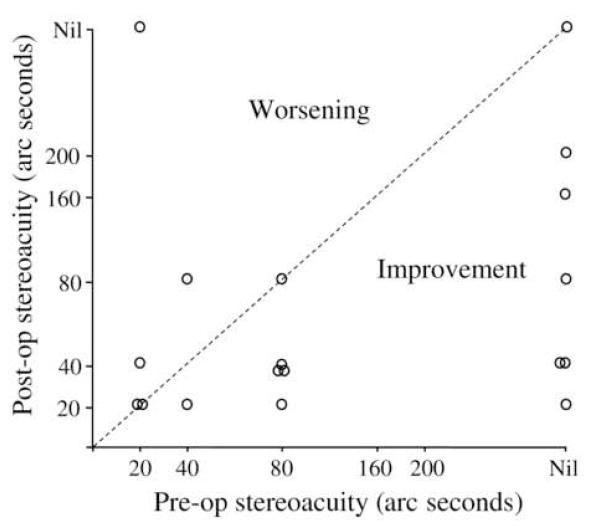
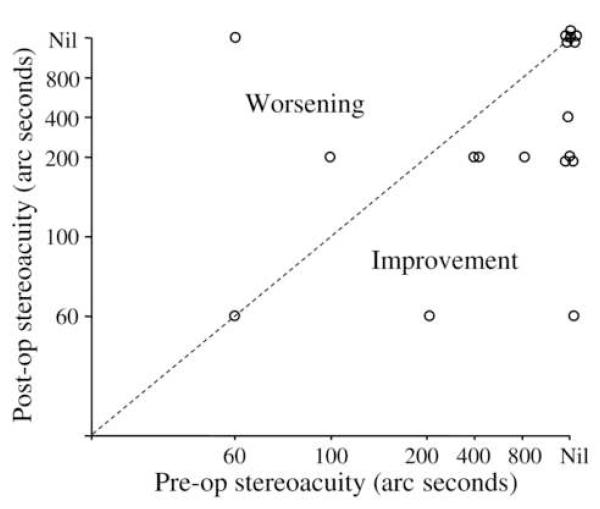
Results: Distance stereoacuity measured with the FD2 improved from a median preoperative value of 80 to 40 arcsec postoperatively (p = 0.04) and stereoacuity measured with the Distance Randot improved from a median of nil to 200 arcsec (p = 0.06). In those that had subnormal stereoacuity preoperatively, there was even more marked improvement in distance stereoacuity (FD2 median nil vs 40 arcsec, p = 0.002; Distance Randot median nil vs 200 arcsec, p = 0.004). Near stereoacuity measured with Frisby and Preschool Randot remained unchanged pre- to postoperatively (median, 60 and 80 arcsec, respectively).
Conclusions: There was improvement in distance stereoacuity measured with both the FD2 and the Distance Randot stereotests in patients who underwent surgery for intermittent exotropia. The FD2 and Distance Randot may be useful outcome measures in future clinical trials of interventions for intermittent exotropia.
Figures
References
-
- von Noorden GK. Binocular Vision and Ocular Motility: Theory and Management of Strabismus. 5th ed Mosby; St Louis, Mo: 1996. pp. 206–96.
-
- Stathacopoulos RA, Rosenbaum AL, Zanoni D, Stager DR, McCall LC, Ziffer AJ, et al. Distance stereoacuity. Assessing control in intermittent exotropia. Ophthalmology. 1993;100:495–500. - PubMed
-
- O’Neal TD, Rosenbaum AL, Stathacopoulos RA. Distance stereo acuity improvement in intermittent exotropic patients following strabismus surgery. J Pediatr Ophthalmol Strabismus. 1995;32:353–7. - PubMed
-
- Yildirim C, Mutlu FM, Chen Y, Altinsoy HI. Assessment of central and peripheral fusion and near and distance stereoacuity in intermittent exotropic patients before and after strabismus surgery. Am J Ophthalmol. 1999;128:222–30. - PubMed
Publication types
MeSH terms
Grants and funding
LinkOut - more resources
Full Text Sources
