. 2007 Dec 14;28(5):773-85.
doi: 10.1016/j.molcel.2007.09.023.

Purification of human telomerase complexes identifies factors involved in telomerase biogenesis and telomere length regulation

Affiliations

Purification of human telomerase complexes identifies factors involved in telomerase biogenesis and telomere length regulation

Dragony Fu et al. Mol Cell. .

Abstract

The identities and roles of proteins associated with human telomerase remain poorly defined. To gain insight, we undertook an affinity purification of endogenously assembled human telomerase complexes. We show that specific subsets of H/ACA, Sm, and hnRNP proteins associate with active and inactive telomerase RNPs, while two NTPase proteins associate preferentially with active enzyme. All three core H/ACA-motif binding proteins are telomerase holoenzyme components essential for RNP accumulation. On the other hand, telomerase RNPs lacking interaction with Sm proteins or hnRNP C remain fully functional for telomere elongation. Curiously, overexpression of either associated hnRNP protein (hnRNP C and hnRNP U) or either NTPase protein (NAT10 and GNL3L) induced telomere shortening. Our findings suggest that endogenous human telomerase complexes are more heterogeneous than those of single-celled eukaryotes, have predominantly shared rather than telomerase-specific proteins, and make numerous regulatory interactions.


Figures

Figure 1
Figure 1. Human Telomerase Affinity Purification
(A) Nuclear extracts were analyzed by immunoblot to detect the TAP tag or hnRNP C loading control (LC). (B) Total RNA was analyzed by northern blot to detect hTR and a cross-reacting LC. (C) Nuclear extracts were analyzed for telomerase activity by TRAP using a series of 2.5-fold dilutions normalized by total protein. (D) Telomere lengths were analyzed by in-gel hybridization. (E) Nuclear extract from HeLa TAP-hTERT+hTR cells was fractionated in a 15%–35% glycerol gradient. RC denotes the recovery control added before RNA extraction. (F and G) RNA from 0.005% of the input nuclear extracts or 1% of the final elutions was analyzed by northern blot. Elutions were analyzed by TRAP using a series of 5-fold dilutions. (H) Proteins identified by mass spectrometry in TAP-hTERT samples are summarized.
Figure 2
Figure 2. Roles for H/ACA-Motif Binding Proteins in Telomerase Biogenesis
(A) Sizes and domain structures of the H/ACA-motif binding proteins are illustrated. (B and C) 293T cells were transfected to express TAP tag alone or TAP-tagged protein. Whole-cell extracts were analyzed by immunoblot. Following affinity purification on IgG resin, RNA from 5% of input lysates or 100% of bound fractions was analyzed by northern blot. (D) HeLa cells transfected with shRNA constructs were harvested at 96 hr. Asterisk indicates a nonspecific protein. Signal intensity was normalized to HSP70 protein or U2 RNA and divided by signal intensity in the control lane; substantially reduced levels are highlighted with a box.
Figure 3
Figure 3. Telomerase RNP Association with hnRNP C and hnRNP U
(A) Sizes and domain structures of hnRNP C and hnRNP U are illustrated. RRM and RGG are RNA binding domains, and SAP is the scaffold attachment protein motif. (B) Immunopurifications were performed from HeLa cell nuclear extract using nonspecific polyclonal antibody, hnRNP U polyclonal antibody, or monoclonal antibody against hnRNP C or hnRNP Q/R. Bound samples were tested by TRAP using 5-fold dilutions. IC denotes the internal amplification control. (C) 293T cells were transfected to express the FLAG tag alone or FLAG-hTERT. Following affinity purification, protein from 2.5% of the input lysates and 100% of the bound fractions was analyzed by immunoblot. (D and E) VA13 hTR cells were transfected to express TAP-tagged hnRNP C1 or hnRNP U in the presence or absence of hTERT; proteins were analyzed as Figure 2C. (F) 293T cells were transfected to express tagged wild-type (WT) hTR or hTR U39-42A along with the TAP tag or TAP-tagged protein. Following affinity purification on IgG resin, RNA from 5% of the input lysates or 100% of bound fractions was analyzed by northern blot.
Figure 4
Figure 4. Lack of Impact of hTR Interactions with hnRNP C and Sm Proteins on Telomere Length
Retroviral constructs expressing no hTR, wild-type (WT) hTR, or an hTR variant were integrated in human X-linked DC patient fibroblasts expressing hTERT. Following selection, cells were analyzed for hTR by northern blot (A and D), telomerase activity by TRAP of 2.5-fold dilutions of cell extract (B and E), and TRF length by in-gel hybridization (C and F). Genomic DNA used for the TRF analysis shown was harvested from cells within 10 PDL of release from selection. The two panels merged in (D) were cropped from the same image.
Figure 5
Figure 5. Impact of hnRNP C or hnRNP U Overexpression on Telomere Length
HTC75 cells were selected for integration of FLAG-tagged hnRNP C1 or hnRNP U. (A) Antibodies specific for hnRNP C or hnRNP U were used for immunoblots. (B) Cells were collected at the indicated PDL of protein overexpression for telomere length analysis.
Figure 6
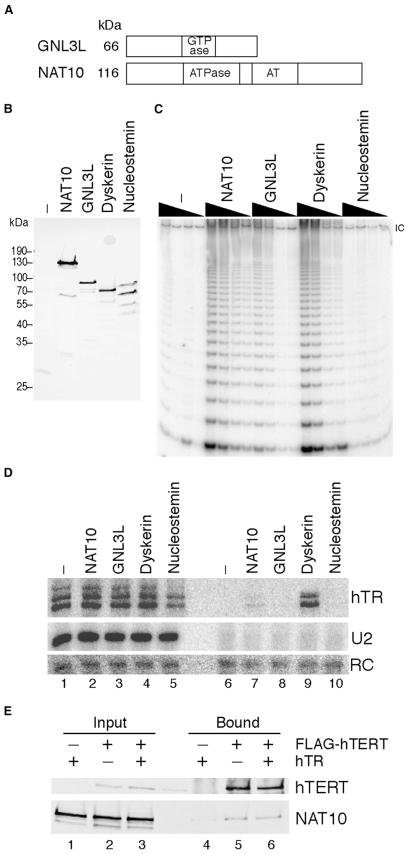
Figure 6. NAT10 and GNL3L Association with Telomerase Holoenzyme and hTERT
(A) Sizes and domain structures of NAT10 and GNL3L are illustrated. AT indicates N-acetyltransferase domain. (B–D) 293T cells were transfected to express the TAP tag alone or protein tagged at the N terminus with a TAP tag (NAT10, dyskerin) or C terminus with protein A domains (GNL3L, nucleostemin). (B) Whole-cell extracts were analyzed by immunoblot. (C) Following affinity purification on IgG resin, the bound fraction was assayed by TRAP in a series of 5-fold dilutions. IC denotes the internal amplification control. (D) RNA from 5% of the input lysates or 100% of bound fractions was analyzed by northern blot. (E) Constructs expressing N-terminal RFP-tagged NAT10 or FLAG-tagged hTERT were transfected into VA13 cells in the presence or absence of hTR. Following purification on FLAG resin, protein from 2.5% of the input lysates and 100% of the bound fractions was used for immunoblot.
Figure 7
Figure 7. Impact of GNL3L, NAT10, or Nucleostemin Overexpression on Telomere Length
HTC75 cells were selected for integration of the indicated expression vector followed by induction of protein overexpression. (A) Total RNA was used to assay mRNA by RT-PCR or hTR by northern blot. Band intensities were normalized to GAPDH mRNA for RT-PCR or a non-specific crossreacting RNA for hTR and then divided by band intensity in the vector control. (B) Telomerase activity was measured by TRAP using a series of 2.5-fold dilutions of whole-cell extract. (C and D) Cells were collected at the indicated PDL of protein overexpression for telomere length analysis. (E) Model for regulation of human telomerase holoenzyme.

References

    1. Cohen SB, Graham ME, Lovrecz GO, Bache N, Robinson PJ, Reddel RR. Protein composition of catalytically active human telomerase from immortal cells. Science. 2007;315:1850–1853. - PubMed
    1. Collins K. The biogenesis and regulation of telomerase holoenzymes. Nat Rev Mol Cell Biol. 2006;7:484–494. - PMC - PubMed
    1. Cristofari G, Lingner J. Telomere length homeostasis requires that telomerase levels are limiting. EMBO J. 2006;25:565–574. - PMC - PubMed
    1. Darzacq X, Kittur N, Roy S, Shav-Tal Y, Singer RH, Meier UT. Stepwise RNP assembly at the site of H/ACA RNA transcription in human cells. J Cell Biol. 2006;173:207–218. - PMC - PubMed
    1. Dreyfuss G, Kim VN, Kataoka N. Messenger-RNA-binding proteins and the messages they carry. Nat Rev Mol Cell Biol. 2002;3:195–205. - PubMed

Publication types

MeSH terms