


Human face preference in gamma-frequency EEG activity
- PMID: 18083564
- PMCID: PMC2268116
- DOI: 10.1016/j.neuroimage.2007.10.025
Human face preference in gamma-frequency EEG activity
Abstract
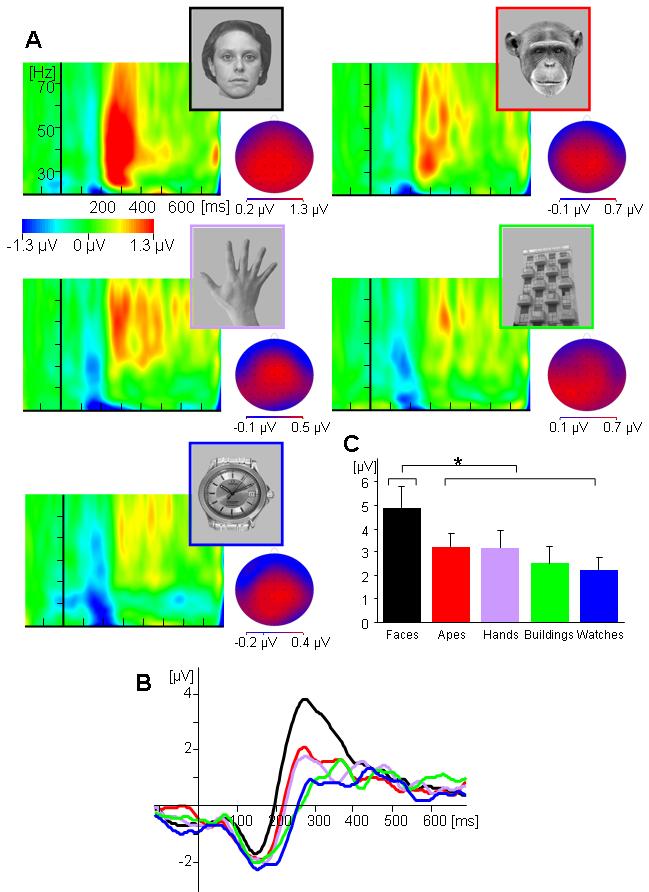
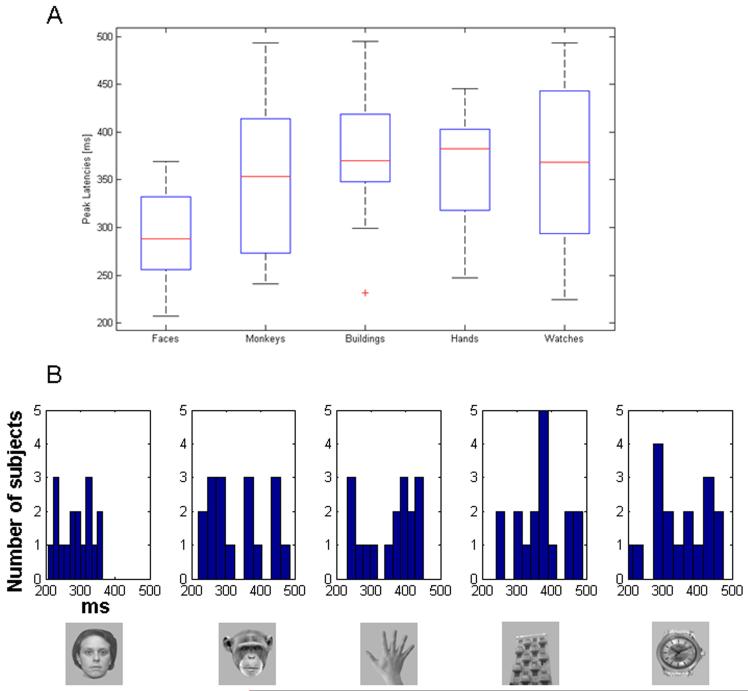
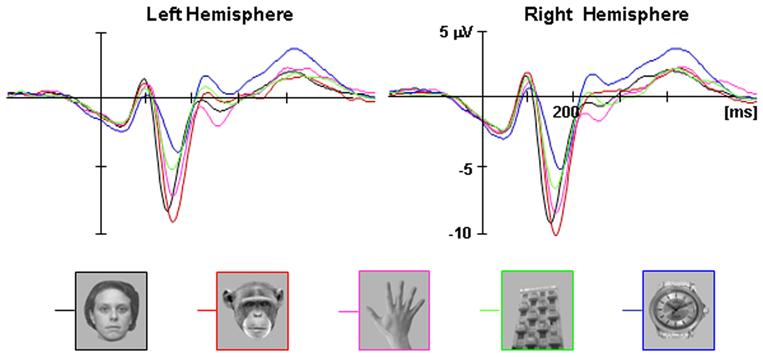
Previous studies demonstrated that induced EEG activity in the gamma band (iGBA) plays an important role in object recognition and is modulated by stimulus familiarity and its compatibility with pre-existent representations. In the present study we investigated the modulation of iGBA by the degree of familiarity and perceptual expertise that observers have with stimuli from different categories. Specifically, we compared iGBA in response to human faces versus stimuli which subjects are not expert with (ape faces, human hands, buildings and watches). iGBA elicited by human faces was higher and peaked earlier than that elicited by all other categories, which did not differ significantly from each other. These findings can be accounted for by two characteristics of perceptual expertise. One is the activation of a richer, stronger and, therefore, more easily accessible mental representation of human faces. The second is the more detailed perceptual processing necessary for within-category distinctions, which is the hallmark of perceptual expertise. In addition, the sensitivity of iGBA to human but not ape faces was contrasted with the face-sensitive N170-effect, which was similar for human and ape faces. In concert with previous studies, this dissociation suggests a multi-level neuronal model of face recognition, manifested by these two electrophysiological measures, discussed in this paper.
Figures
References
-
- Anaki D, Zion-Golumbic E, Bentin S. Electrophysiological neural mechanisms for detection, configural analysis and recognition of faces. NeuroImage. in press. - PubMed
-
- Bauer R, Brosch M, Eckhorn R. Different rules of spatial summation from beyond the receptive field for spike rates and oscillation amplitudes in cat visual cortex. Brain Res. 1995;669(2):291–7. - PubMed
-
- Bertrand O, Tallon-Baudry C. Oscillatory gamma activity in humans: a possible role for object representation. Int. J. Psychophysiol. 2000;38:211–223. - PubMed
-
- Boutet I, Gentes-Hawn A, Chaudhuri A. The influence of attention on holistic face encoding. Cognition. 2002;84:321–341. - PubMed
-
- Bruce V, Young A. Understanding face recognition. Br J Psychol. 1986;77:305–27. - PubMed
Publication types
MeSH terms
Grants and funding
LinkOut - more resources
Full Text Sources
Molecular Biology Databases
Research Materials
Miscellaneous
