CTA4 transcription factor mediates induction of nitrosative stress response in Candida albicans
- PMID: 18083829
- PMCID: PMC2238162
- DOI: 10.1128/EC.00240-07
CTA4 transcription factor mediates induction of nitrosative stress response in Candida albicans
Abstract
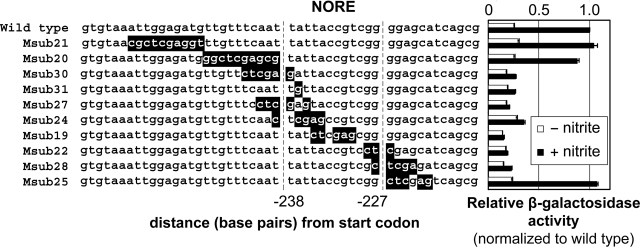
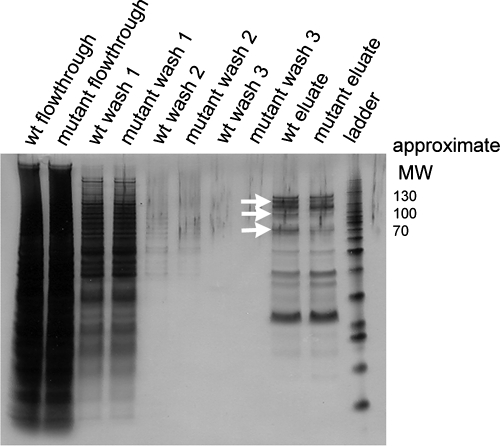
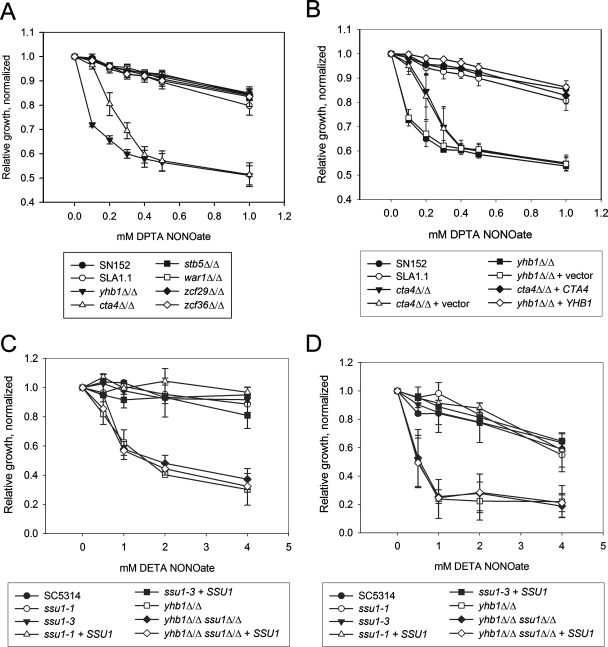
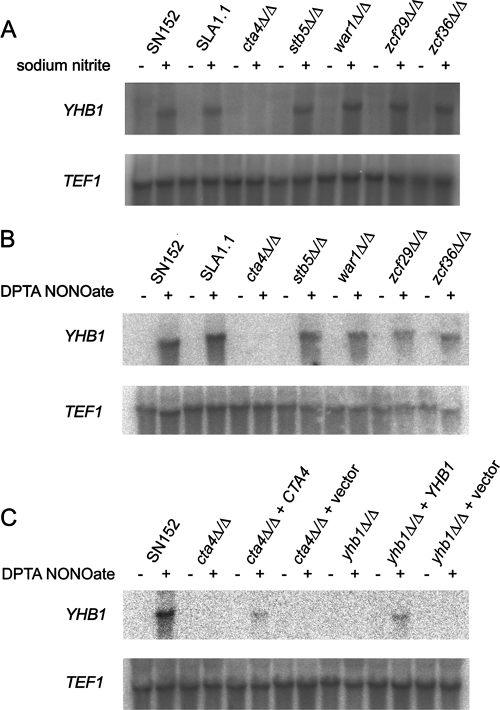
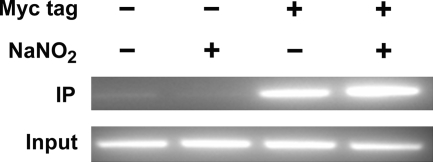
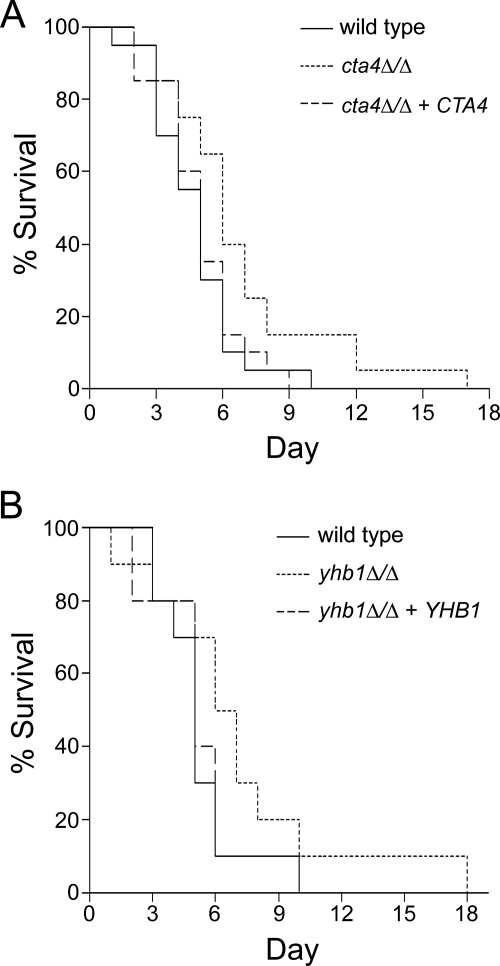
This work has identified regulatory elements in the major fungal pathogen Candida albicans that enable response to nitrosative stress. Nitric oxide (NO) is generated by macrophages of the host immune system and commensal bacteria, and the ability to resist its toxicity is one adaptation that promotes survival of C. albicans inside the human body. Exposing C. albicans to NO induces upregulation of the flavohemoglobin Yhb1p. This protein confers protection by enzymatically converting NO to harmless nitrate, but it is unknown how C. albicans is able to detect NO in its environment and thus initiate this defense only as needed. We analyzed this problem by incrementally mutating the YHB1 regulatory region to identify a nitric oxide-responsive element (NORE) that is required for NO sensitivity. Five transcription factor candidates of the Zn(II)2-Cys6 family were then isolated from crude whole-cell extracts by using magnetic beads coated with this DNA element. Of the five, only deletion of the CTA4 gene prevented induction of YHB1 transcription during nitrosative stress and caused growth sensitivity to the NO donor dipropylenetriamine NONOate; Cta4p associates in vivo with NORE DNA from the YHB1 regulatory region. Deletion of CTA4 caused a small but significant decrease in virulence. A CTA4-dependent putative sulfite transporter encoded by SSU1 is also implicated in NO response, but C. albicans ssu1 mutants were not sensitive to NO, in contrast to findings in Saccharomyces cerevisiae. Cta4p is the first protein found to be necessary for initiating NO response in C. albicans.
Figures
References
-
- Akache, B., and B. Turcotte. 2002. New regulators of drug sensitivity in the family of yeast zinc cluster proteins. J. Biol. Chem. 27721254-21260. - PubMed
-
- Aparicio, O., J. V. Geisberg, A. Sekinger, A. Yang, Z. Moqtaderi, and K. Struhl. 2005. Chromatin immunoprecipitation for determining the association of proteins with specific genomic sequences in vivo, p. 1-33. In F. M. Ausubel, R. Brent, R. E. Kingston, D. D. Moore, J. G. Seidman, J. A. Smith, and K. Struhl (ed.), Current protocols in molecular biology. John Wiley and Sons, Inc., New York, NY. - PubMed
-
- Baumgartner, U., B. Hamilton, M. Piskacek, H. Ruis, and H. Rottensteiner. 1999. Functional analysis of the Zn(2)Cys(6) transcription factors Oaf1p and Pip2p. Different roles in fatty acid induction of beta-oxidation in Saccharomyces cerevisiae. J. Biol. Chem. 27422208-22216. - PubMed
-
- Boccara, M., C. E. Mills, J. Zeier, C. Anzi, C. Lamb, R. K. Poole, and M. Delledonne. 2005. Flavohaemoglobin HmpX from Erwinia chrysanthemi confers nitrosative stress tolerance and affects the plant hypersensitive reaction by intercepting nitric oxide produced by the host. Plant J. 43226-237. - PubMed
Publication types
MeSH terms
Substances
Grants and funding
LinkOut - more resources
Full Text Sources
Molecular Biology Databases