


Monitoring late-onset toxicities in phase I trials using predicted risks
- PMID: 18084008
- PMCID: PMC3294317
- DOI: 10.1093/biostatistics/kxm044
Monitoring late-onset toxicities in phase I trials using predicted risks
Abstract
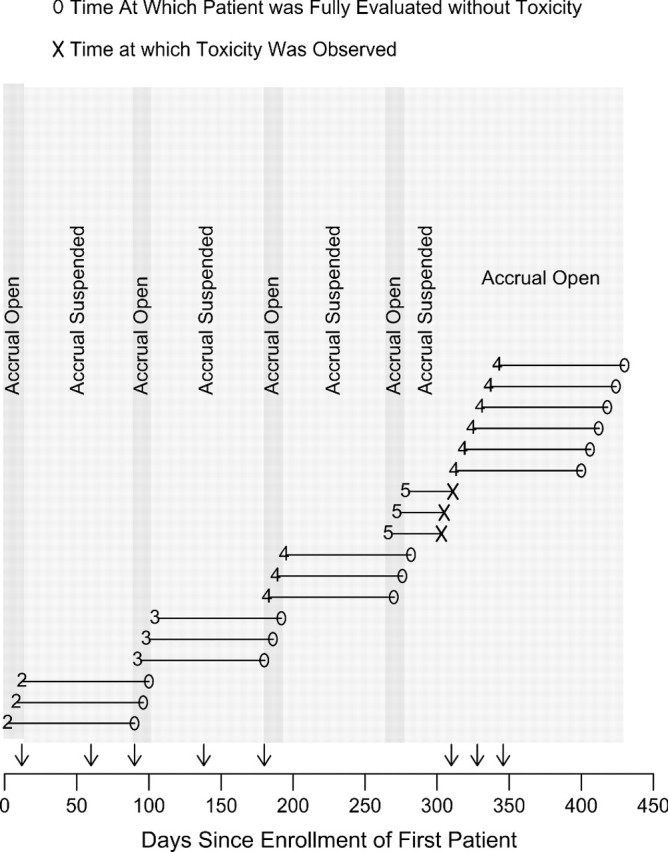
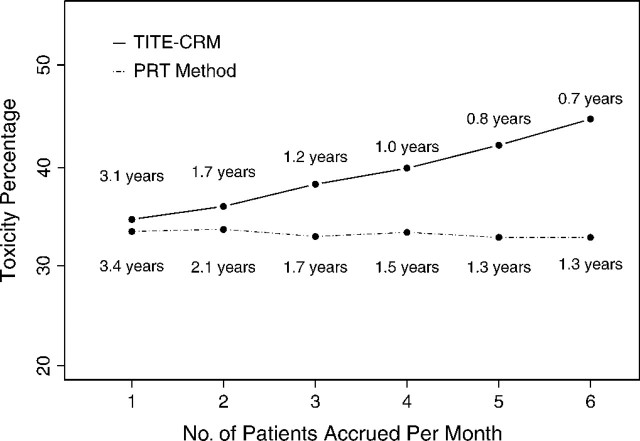
Late-onset (LO) toxicities are a serious concern in many phase I trials. Since most dose-limiting toxicities occur soon after therapy begins, most dose-finding methods use a binary indicator of toxicity occurring within a short initial time period. If an agent causes LO toxicities, however, an undesirably large number of patients may be treated at toxic doses before any toxicities are observed. A method addressing this problem is the time-to-event continual reassessment method (TITE-CRM, Cheung and Chappell, 2000). We propose a Bayesian dose-finding method similar to the TITE-CRM in which doses are chosen using time-to-toxicity data. The new aspect of our method is a set of rules, based on predictive probabilities, that temporarily suspend accrual if the risk of toxicity at prospective doses for future patients is unacceptably high. If additional follow-up data reduce the predicted risk of toxicity to an acceptable level, then accrual is restarted, and this process may be repeated several times during the trial. A simulation study shows that the proposed method provides a greater degree of safety than the TITE-CRM, while still reliably choosing the preferred dose. This advantage increases with accrual rate, but the price of this additional safety is that the trial takes longer to complete on average.
Figures
References
-
- Albert JH, Chib S. Bayesian analysis of binary and polytomous response data. Journal of the American Statistical Association. 1993;88:669–679.
-
- Albert JH, Chib S. Sequential ordinal modeling with applications to survival data. Biometrics. 2001;57:829–836. - PubMed
-
- Babb J, Rogatko A, Zacks S. Cancer phase I clinical trials; escalation with overdose control. Statistics in Medicine. 1998;17:1103–1120. - PubMed
-
- Cheung Y-K, Chappell R. Sequential designs for phase I clinical trials with late-onset toxicities. Biometrics. 2000;56:1177–1182. - PubMed
-
- Dunson DB, Neelon B. Bayesian inference on order-constrained parameters in generalized linear models. Biometrics. 2003;59:286–295. - PubMed
Publication types
MeSH terms
Substances
Grants and funding
LinkOut - more resources
Full Text Sources
Medical
