doi: 10.1371/journal.pgen.0030224.
A bacterial kind of aging
Affiliations
- PMID: 18085827
- PMCID: PMC2134940
- DOI: 10.1371/journal.pgen.0030224
Item in Clipboard
A bacterial kind of aging
PLoS Genet.
2007 Dec.
No abstract available
Conflict of interest statement
Competing interests. The author has declared that no competing interests exist.
Figures
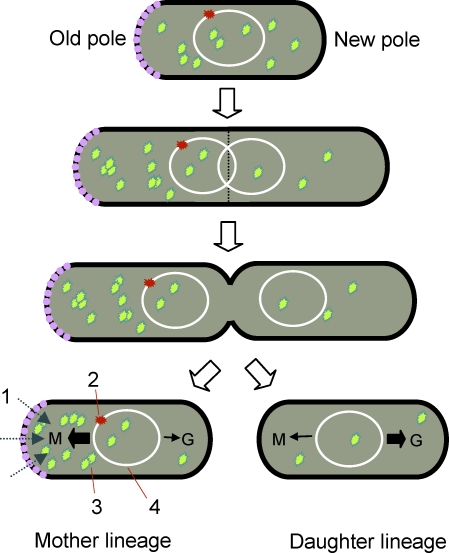
During cytokinesis, one daughter cell will inherit a pole that is older than the one inherited by its sibling. Intriguingly, the “old pole” cells of E. coli display a progressive increase in their generation time [5]. There are several potential reasons for this decline in physiological fitness: (1) Inheritance of older cell-surface material may reduce the ability of the cell to insulate itself against the environment. (2) Segregation of differently damaged, and potentially cytotoxic, DNA strands [15] could provide one daughter with a noncorrupt message akin to the “immortal DNA strand” cosegregation mechanism originally proposed by Cairns for preserving the integrity of stem cell genomes [27]. (3) Segregation of cytotoxic molecules, such as extragenomic episomes or oxidatively damaged and aggregated proteins, may result in sibling-specific deterioration. (4) Segregation of damage could cause a reduction in fitness even in the absence of cytotoxicity, since the sibling inheriting more damage may, as a consequence, upregulate maintenance (M) (damage defense) systems. In view of the fact that the transcriptional power of cells like E. coli is limiting, such an elevation of maintenance activities could be traded for a reduction of growth-related activities (G) [28,29].
References
-
- Partridge L, Barton NH. Optimality, mutation and the evolution of ageing. Nature. 1993;362:305–311. - PubMed
-
- Kirkwood TBL. Townsend CR, Calow P, editors. Repair and its evolution: survival versus reproduction. Physiological ecology: an evolutionary approach to resource use. 1981. pp. 165–189.
-
- Ackermann M, Stearns SC, Jenal U. Senescence in a bacterium with asymmetric division. Science. (2003;300:1920. - PubMed
Publication types
MeSH terms
LinkOut - more resources
Full Text Sources