. 2008 Mar;52(3):875-82.
doi: 10.1128/AAC.00642-07. Epub 2007 Dec 17.

The mitochondrion is a site of trypanocidal action of the aromatic diamidine DB75 in bloodstream forms of Trypanosoma brucei

Affiliations

The mitochondrion is a site of trypanocidal action of the aromatic diamidine DB75 in bloodstream forms of Trypanosoma brucei

Charlotte A Lanteri et al. Antimicrob Agents Chemother. 2008 Mar.

Abstract

Human African trypanosomiasis (HAT) is a fatal tropical disease caused by infection with protozoans of the species Trypanosoma brucei gambiense and T. b. rhodesiense. An oral prodrug, DB289, is a promising new therapy undergoing phase III clinical trials for early-stage HAT. DB289 is metabolically converted to the active trypanocidal diamidine DB75 [2,5-bis(4-amidinophenyl)furan]. We previously determined that DB75 inhibits yeast mitochondrial function (C. A. Lanteri, B. L. Trumpower, R. R. Tidwell, and S. R. Meshnick, Antimicrob. Agent Chemother. 48:3968-3974, 2004). The purpose of this study was to investigate if DB75 targets the mitochondrion of T. b. brucei bloodstream forms. DB75 rapidly accumulates within the mitochondria of living trypanosomes, as indicated by the fluorescent colocalization of DB75 with a mitochondrion-specific dye. Fluorescence-activated cell sorting analysis of rhodamine 123-stained living trypanosomes shows that DB75 and other trypanocidal diamidines (pentamidine and diminazene) collapse the mitochondrial membrane potential. DB75 inhibits ATP hydrolysis within T. brucei mitochondria and appears to inhibit the oligomycin-sensitive F 1 F 0-ATPase and perhaps other ATPases. DB75 is most likely not an inhibitor of electron transport within trypanosome mitochondria, since DB75 fails to inhibit mitochondrial respiration when glycerol-3-phosphate is used as the respiratory substrate. However, DB75 inhibits whole-cell respiration (50% inhibitory concentration, 20 microM) at drug concentrations and incubation durations that also result in the dissipation of the mitochondrial membrane potential. Taken together, these findings suggest that the mitochondrion is a target of the trypanocidal action of DB75.


Figures
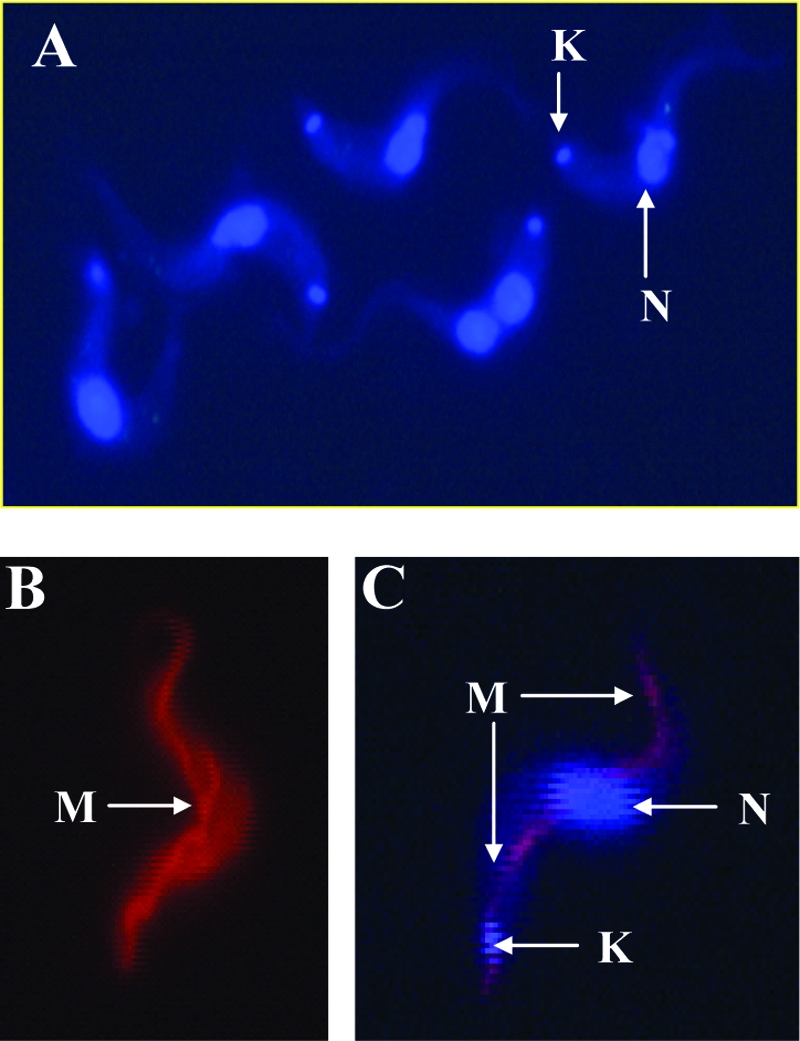
FIG. 1.
FIG. 1.
Cellular distribution of DB75 fluorescence within T. b. brucei BFs. (A) Fluorescent localization of DB75 within the nucleus (N) and kinetoplast (K) of trypanosomes. Cells were incubated at 37°C and 5.0% CO2 in cBMEM containing 1.0 μM DB75, and after 30 min, dried films were prepared for UV fluorescence microscopy with a Nikon Microphot FXA microscope fitted with a Nikon UV2A cube. (B) The elongated, tubular structure of the mitochondrion (M), typical of BF parasites, was observed in living cells treated with the mitochondrion-specific dye MitoTracker Red. Cells were incubated with 25 nM MitoTracker Red for 30 min, washed, and suspended in agarose before UV fluorescence microscopy was performed with living cells with a Nikon Texas Red filter. (C) Fluorescent colocalization of MitoTracker Red and DB75 within the trypanosome mitochondrion. Cells were first treated with 25 nM MitoTracker Red and were next incubated with 100 μM DB75 for 5 min, and wet mounts of agarose mixtures were viewed with a Nikon multiband triple filter block for 4′,6′-diamidino-2-phenylindole-fluorescein isothiocyanate-Texas Red. Fluorescent colocalization, indicated by pink fluorescence, of MitoTracker with DB75 suggests that DB75 enters the mitochondrion. Magnifications, ×63.
FIG. 2.
FIG. 2.
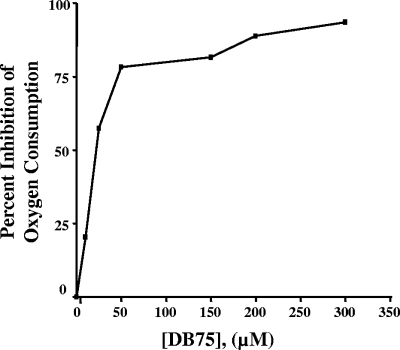
DB75 inhibits glucose-dependent cellular respiration in T. b. brucei BFs. The oxygen consumed by 2 × 10⁶ cells per ml in mannitol-based buffer containing 20 mM glucose was recorded with an oxygen electrode, and the rates of oxygen consumption were determined with Oxyg32 software. The percent inhibition of respiration was determined by comparing the oxygen consumption rates immediately before and after the addition of DB75. The graph depicts the results from two independent experiments; error bars associated with the standard deviations are too small to be represented on the graph.
FIG. 3.
FIG. 3.
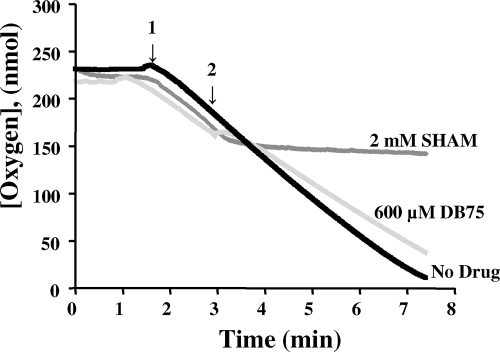
DB75 does not inhibit respiration in T. b. brucei mitochondrial preparations. An oxygen electrode was used to measure the oxygen consumed by mitochondria in mannitol-based buffer containing 20 mM G-3-P as the respiratory substrate in the presence or the absence of DB75 or SHAM. The arrows indicate the time points at which 0.8 mg/ml of T. b. brucei mitochondria (arrow 1) and 600 μM DB75 or 2 mM SHAM (arrow 2) were added to the reaction chamber.
FIG. 4.
FIG. 4.
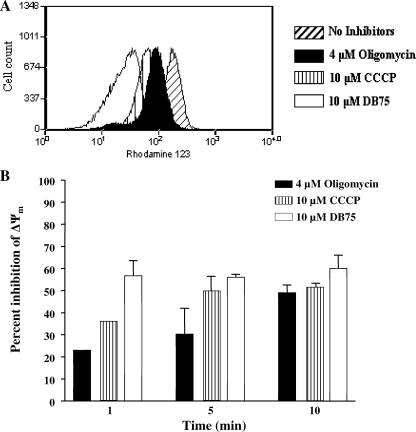
DB75 collapses the mitochondrial membrane potential in T. b. brucei BFs. FACS analysis of the mean Rh123 fluorescence was conducted as a measure of the drug-induced changes in ΔΨm. (A) Rh123 fluorescence distribution plotted as frequency histograms. Trypanosomes (107/ml) were pretreated with 10 μM DB75, 4 μM oligomycin, or 10 μM CCCP for 10 min in Tes buffer supplemented with 1.0% BSA. Next, the cells were treated with 250 nM Rh123 for a further 2 min, diluted 1:10, and subjected to FACS analysis. The results indicate that the mean Rh123 fluorescence (and, therefore, ΔΨm) was decreased in drug-treated cells compared to the fluorescence of the untreated cells. The results shown are representative of at least four independent experiments. (B) FACS analysis results expressed as the percent inhibition of ΔΨm. Trypanosomes were pretreated with drug for the times indicated on the graph. The percent inhibition of ΔΨm was determined by calculating the percent decrease in the mean Rh123 fluorescence of drug-treated cells relative to the mean fluorescence of the untreated cells. The results shown represent the averages of at least three independent experiments and indicate that DB75 inhibits ΔΨm to a similar extent as the mitochondrial inhibitors oligomycin and CCCP.
FIG. 5.
FIG. 5.
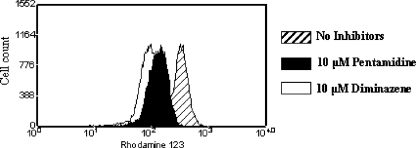
Other trypanocidal diamidine drugs, pentamidine isethionate and diminazene aceturate, collapse the mitochondrial membrane potential in T. b. brucei BFs. Trypanosomes (107/ml) were pretreated with 10 μM pentamidine isethionate or diminazene aceturate for 10 min in Tes buffer supplemented with 1.0% BSA. Next, the cells were treated with 250 nM Rh123 for an additional 2 min, diluted 1:10, and analyzed on the flow cytometer. The Rh123 fluorescence distribution was plotted as frequency histograms. The results indicate that the mean Rh123 fluorescence (and, therefore, ΔΨm) was decreased in drug-treated cells compared to the fluorescence of the untreated controls. The experiment was performed once.
FIG. 6.
FIG. 6.
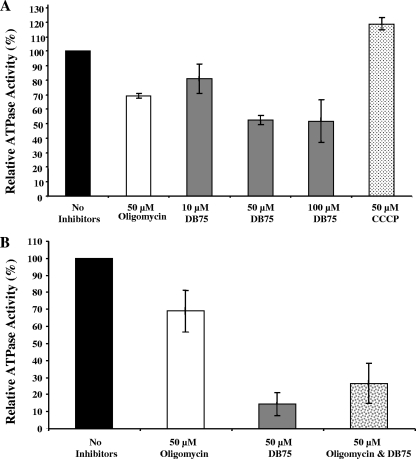
Effects of DB75 and mitochondrial inhibitors on ATP consumption by mitochondria isolated from T. b. brucei BFs. (A) Effects of a 10-min incubation with oligomycin, DB75, and CCCP on ATPase activity. DB75 is a more potent inhibitor of mitochondrial ATPase activity than oligomycin. (B) Effect of a 10-min pretreatment with oligomycin on the ability of DB75 to inhibit ATPase activity. The combination of oligomycin plus DB75 inhibited the activity to the same degree as DB75 alone did. Mitochondria (100 μg protein) were incubated on ice in the absence or the presence of drugs in 150 μl of buffer and were then processed for luciferase-based measurement of ATP consumption (see Materials and Methods). The ATP concentration within the untreated controls was set as 100% ATPase activity, and the relative activity (%) was determined for each drug treatment. The results shown are representative of those from three independent experiments, with error bars representing the standard deviations of duplicate samples.

References

    1. Allemann, N., and A. Schneider. 2000. ATP production in isolated mitochondria of procyclic Trypanosoma brucei. Mol. Biochem. Parasitol. 111:87-94. - PubMed
    1. Barrett, M. P., R. J. Burchmore, A. Stich, J. O. Lazzari, A. C. Frasch, J. J. Cazzulo, and S. Krishna. 2003. The trypanosomiases. Lancet 362:1469-1480. - PubMed
    1. Bienen, E. J., G. C. Hill, and K. O. Shin. 1983. Elaboration of mitochondrial function during Trypanosoma brucei differentiation. Mol. Biochem. Parasitol. 7:75-86. - PubMed
    1. Bienen, E. J., R. K. Maturi, G. Pollakis, and A. B. Clarkson, Jr. 1993. Non-cytochrome mediated mitochondrial ATP production in bloodstream form Trypanosoma brucei brucei. Eur. J. Biochem. 216:75-80. - PubMed
    1. Bouteille, B., O. Oukem, S. Bisser, and M. Dumas. 2003. Treatment perspectives for human African trypanosomiasis. Fundam. Clin. Pharmacol. 17:171-181. - PubMed

Publication types

MeSH terms