. 2007 Dec 19;2(12):e1341.
doi: 10.1371/journal.pone.0001341.

Light variability illuminates niche-partitioning among marine Picocyanobacteria

Affiliations

Light variability illuminates niche-partitioning among marine Picocyanobacteria

Christophe Six et al. PLoS One. .

Abstract

Prochlorococcus and Synechococcus picocyanobacteria are dominant contributors to marine primary production over large areas of the ocean. Phytoplankton cells are entrained in the water column and are thus often exposed to rapid changes in irradiance within the upper mixed layer of the ocean. An upward fluctuation in irradiance can result in photosystem II photoinactivation exceeding counteracting repair rates through protein turnover, thereby leading to net photoinhibition of primary productivity, and potentially cell death. Here we show that the effective cross-section for photosystem II photoinactivation is conserved across the picocyanobacteria, but that their photosystem II repair capacity and protein-specific photosystem II light capture are negatively correlated and vary widely across the strains. The differences in repair rate correspond to the light and nutrient conditions that characterize the site of origin of the Prochlorococcus and Synechococcus isolates, and determine the upward fluctuation in irradiance they can tolerate, indicating that photoinhibition due to transient high-light exposure influences their distribution in the ocean.


Conflict of interest statement

Competing Interests: Douglas A. Campbell is a minority share-holder in Environmental Proteomics, a company which provided an anti-PsbA antibody and associated protein quantitation standard used to generate data for Table 1 and Figure S2 for this study. We do not believe this connection constitutes a competing interest.

Figures

Figure 1
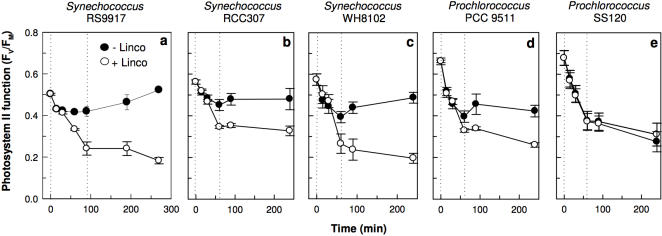
Figure 1. Five marine cyanobacteria from a range of ecological niches show distinct responses of photosystem II quantum yield (FV/FM), reflecting photosystem II activity, to a 10 fold irradiance increase episode followed by recovery under growth light.
The high light episode is delineated by the dotted lines. Cultures were treated (closed) or not (open) with the protein synthesis inhibitor lincomycin to block photosystem II repair (n = 4, ±1 s.e.). Note the strong recovery of photosystem II function in Synechococcus sp. RSS9917, and the lack of recovery in Prochlorococcus sp. SS120.
Figure 2
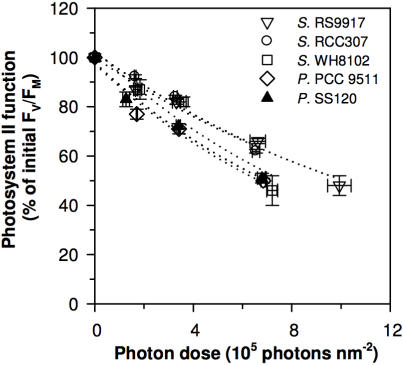
Figure 2. Five marine cyanobacteria show comparable inhibition of Photosystem II plotted versus cumulative photon dose (µmol photons nm−2 s−1×s), when photosystem II repair is blocked (lincomycin treated cultures; n = 4, ±1 s.e.).
Open triangle: Synechococcus RS9917; open circle: Synechococcus RCC307; open square: Synechococcus WH8102; open diamond: Prochlorococcus PCC 9511; closed triangle: Prochlorococcus SS120.
Figure 3
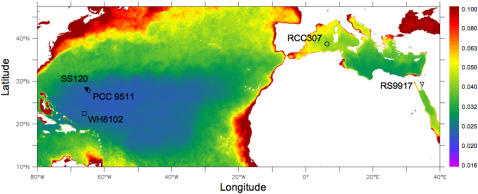
Figure 3. The ability of five marine cyanobacteria strains to tolerate short-term increases in irradiance (E TOL) relates to the vertical light attenuation coefficient (k490) at their location of origin.
Color bar indicates the 2006 annual average vertical attenuation coefficient at 490 nm, k490. Symbols indicate the origin of the strains sampled near the surface (open symbols) except for SS120 strain sampled at 120 meters (closed triangle).
Figure 4
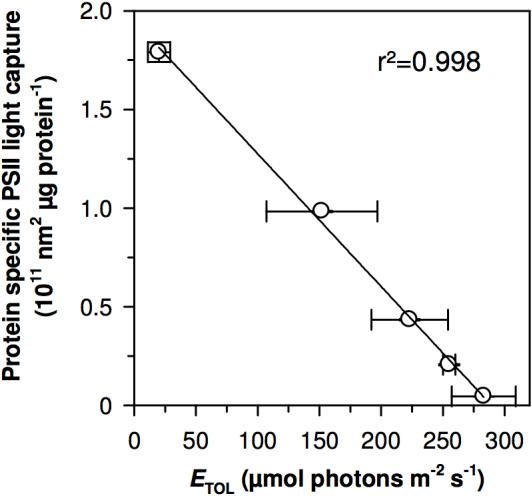
Figure 4. A trade-off between protein specific light capture capacity (protein specific σPSII) and tolerance of irradiance variations (E TOL) across five marine cyanobacteria.
Prochlorococcus strains show a high protein specific σPSII, which varied 40-fold across the strains and shows a strong negative correlation with E TOL (µmol photons m−2 s−1), the capacity to tolerate upward irradiance fluctuations, which was highest in the coastal Synechococcus RSS9917 (n = 4, ±1 s.e.; r2 = 0.98).

References

    1. Richardson TL, Jackson GA. Small phytoplankton and carbon export from the surface ocean. Science. 2007;315:838–840. - PubMed
    1. Partensky F, Hess WR, Vaulot D. Prochlorococcus, a marine photosynthetic prokaryote of global significance. Microbiology and Molecular Biology Reviews. 1999;63:106–127. - PMC - PubMed
    1. Bouman HA, Ulloa O, Scanlan DJ, Zwirglmaier K, Li WK, et al. Oceanographic basis of the global surface distribution of Prochlorococcus ecotypes. Science. 2006;312:918–921. - PubMed
    1. Johnson ZI, Zinser ER, Coe A, McNulty NP, Woodward EM, et al. Niche partitioning among Prochlorococcus ecotypes along ocean-scale environmental gradients. Science. 2006;311:1737–1740. - PubMed
    1. Zwirglmaier K, Heywood JL, Chamberlain K, Woodward EM, Zubkov MV, et al. Basin-scale distribution patterns of picocyanobacterial lineages in the Atlantic Ocean. Environ Microbiol. 2007;9:1278–1290. - PubMed

Publication types

MeSH terms

Substances