


Hemodynamic parameters and timing of surgical decompression in acute cervical spinal cord injury
- PMID: 18092565
- PMCID: PMC2141731
- DOI: 10.1080/10790268.2007.11754582
Hemodynamic parameters and timing of surgical decompression in acute cervical spinal cord injury
Abstract
Background/objectives: To evaluate the relationship between the severity of cervical spinal cord injury (SCI) (American Spinal Injury Association [ASIA] grade), presence of neurogenic shock, and timing of surgical intervention. This is a post-hoc analysis from the Sygen multicenter randomized controlled trial.
Methods: Blood pressure (BP) and heart rate (HR) data were collected when patients were first assessed in the emergency room (Time A) and at the time of randomization (Time B). Individuals were subdivided by ASIA grade and by the level of the systolic BP (SBP).
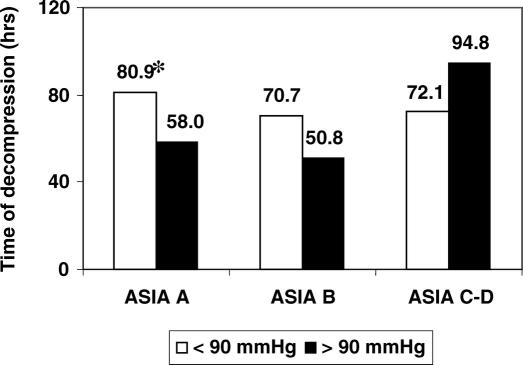
Results: Only individuals with cervical SCI from the Sygen trial (n = 577) were evaluated. Severe complete SCI (ASIA grade = A) was established in 57% of these patients. A total of 74 (13%) patients with neurogenic shock (SBP < 90 mmHg) at Time A were identified. The SBP increased significantly from Time A to Time B (P < 0.0001). The median time from SCI to surgical intervention, for ASIA A, was 80.9 hours for patients with initial SBP < 90 mmHg and 58 hours for patients with initial SBP > or = 90 mmHg (P = 0.025). Multivariable analysis after adjusting for confounders revealed a statistically significant difference in the time to surgical intervention based on SBP for ASIA A (P = 0.026), yet not for ASIA B or C/D.
Conclusions: The presence of neurogenic shock was associated with a delay in the timing of surgical intervention in patients with cervical SCI. Detailed evaluation of autonomic dysfunctions following SCI including cardiovascular instability could improve our understanding of the complexities of clinical presentations and possible neurological outcomes.
Figures
References
-
- Atkinson PP, Atkinson JLD. Subject review. Spinal shock. Mayo Clin Proc. 1996;71:384–389. - PubMed
-
- Krassioukov A, Claydon VE. The clinical problems in cardiovascular control following spinal cord injury: an overview. Prog Brain Res. 2006;152:223–229. - PubMed
-
- Mayorov DN, Adams MA, Krassioukov AV. Telemetric blood pressure monitoring in conscious rats before and after compression injury of spinal cord. J Neurotrauma. 2001;18:727–736. - PubMed
-
- Ditunno JF, Little JW, Tessler A, Burns AS. Spinal shock revisited: a four-phase model. Spinal Cord. 2004;42:383–395. - PubMed
-
- Nacimiento W, Noth J. What, if anything, is spinal shock. Arch Neurol. 1999;56:1033–1035. - PubMed
Publication types
MeSH terms
LinkOut - more resources
Full Text Sources
Medical
