


A sequence-independent study of the influence of short loop lengths on the stability and topology of intramolecular DNA G-quadruplexes
- PMID: 18092816
- PMCID: PMC2408741
- DOI: 10.1021/bi701873c
A sequence-independent study of the influence of short loop lengths on the stability and topology of intramolecular DNA G-quadruplexes
Abstract
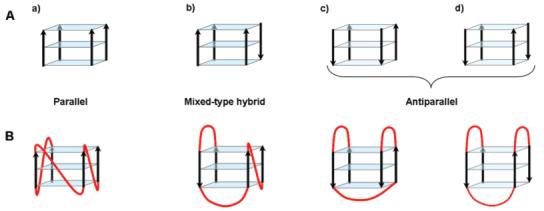
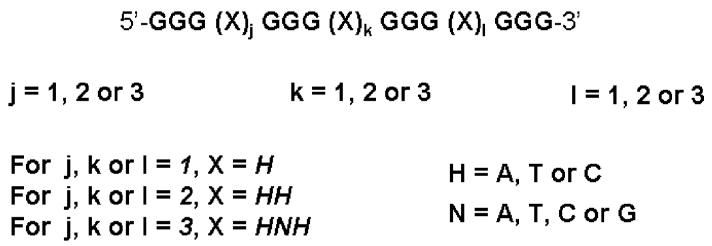
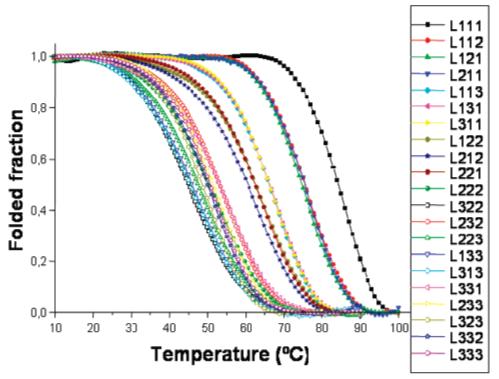
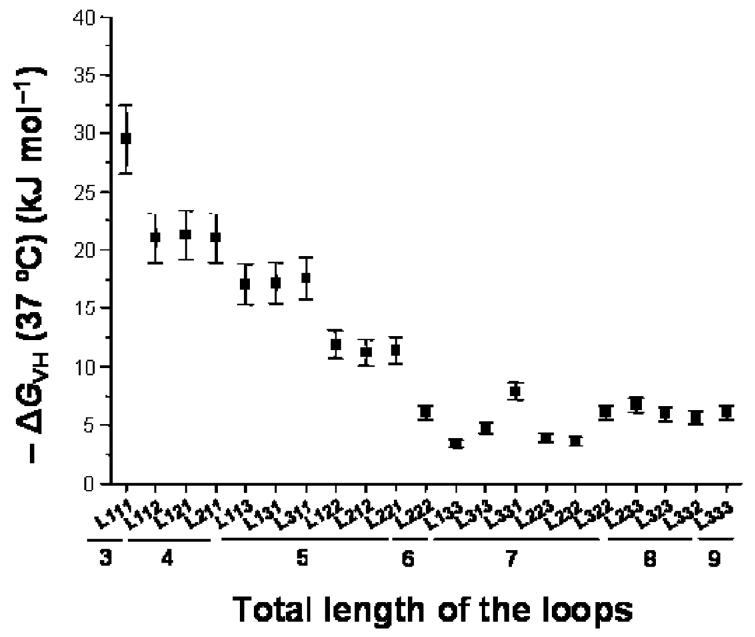
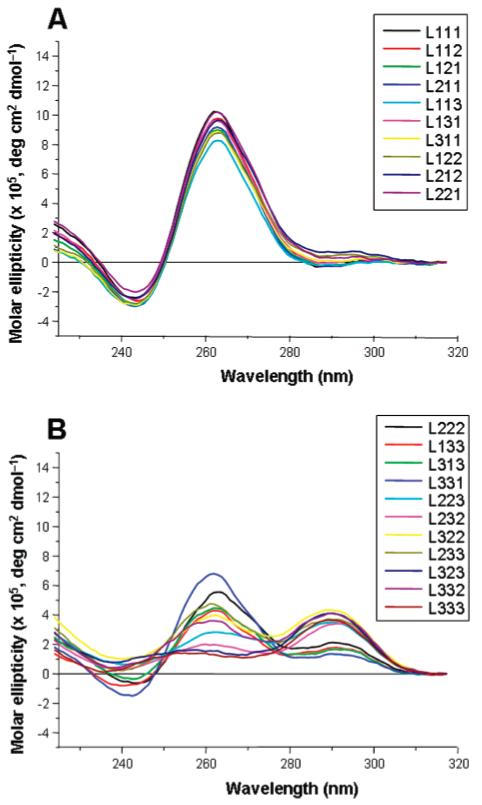
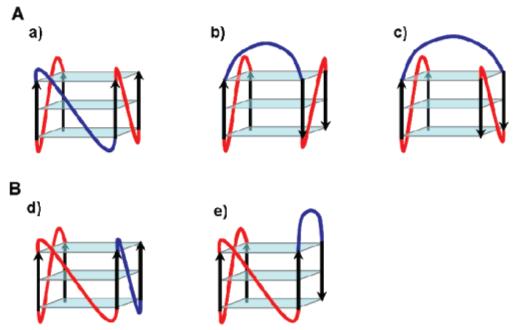
G-Rich sequences found within biologically important regions of the genome have been shown to form intramolecular G-quadruplexes with varied loop lengths and sequences. Many of these quadruplexes will be distinguishable from each other on the basis of their thermodynamic stabilities and folded conformations. It has been proposed that loop lengths can strongly influence the topology and stability of intramolecular G-quadruplexes. Previous studies have been limited to the analysis of quadruplex sequences with particular loop sequences, making it difficult to make generalizations. Here, we describe an original study that aimed to elucidate the effect of loop length on the biophysical properties of G-quadruplexes in a sequence-independent context. We employed UV melting and circular dichroism spectroscopy to examine and compare the properties of 21 DNA quadruplex libraries, each comprising partially randomized loop sequences with lengths ranging from one to three nucleotides. Our work supports a number of general predictions that can be made solely on the basis of loop lengths. In particular, the results emphasize the strong influence of single-nucleotide loops on quadruplex properties. This study provides a predictive framework that may help identify or classify biologically relevant G-quadruplex-forming sequences.
Figures
References
-
- Williamson JR, Raghuraman MK, Cech TR. Monovalent cation-induced structure of telomeric DNA: The G-quartet model. Cell. 1989;59:871–880. - PubMed
-
- Sen D, Gilbert W. A sodium-potassium switch in the formation of four-stranded G4-DNA. Nature. 1990;344:410–414. - PubMed
-
- Henderson E, Hardin CC, Walk SK, Tinoco I, Jr., Blackburn EH. Telomeric DNA oligonucleotides form novel intramolecular structures containing guanine-guanine base pairs. Cell. 1987;51:899–908. - PubMed
-
- Wang Y, Patel DJ. Solution structure of the human telomeric repeat d[AG3(T2AG3)3] G-tetraplex. Structure. 1993;1:263–282. - PubMed
-
- Wang Y, Patel DJ. Solution structure of the Tetrahymena telomeric repeat d(T2G4)4 G-tetraplex. Structure. 1994;2:1141–1156. - PubMed
Publication types
MeSH terms
Grants and funding
LinkOut - more resources
Full Text Sources
Other Literature Sources
