


Post-exercise heart rate recovery in HIV-positive individuals on highly active antiretroviral therapy. Early indicator of cardiovascular disease?
- PMID: 18093131
- PMCID: PMC4297631
- DOI: 10.1111/j.1468-1293.2007.00524.x
Post-exercise heart rate recovery in HIV-positive individuals on highly active antiretroviral therapy. Early indicator of cardiovascular disease?
Abstract
Background: HIV infection and its treatment, specifically protease inhibitor (PI) therapy, have been associated with an increased risk for cardiovascular disease. Heart rate recovery (HRR) following peak exercise is predictive of future cardiovascular events and mortality in the general population. Nothing is known regarding HRR in individuals infected with HIV on highly active antiretroviral therapy (HAART).
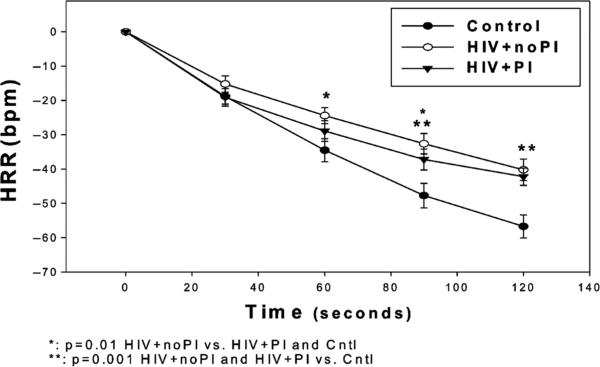
Subjects and methods: HIV-positive subjects on HAART that included a PI (HIV+PI, n=19), HIV-positive subjects on HAART that did not include a PI (HIV+noPI, n=19) and HIV-seronegative age, gender and body mass index (BMI) matched controls (Cntl, n=15) underwent a graded maximal exercise test on a cycle ergometer to volitional exhaustion. A continuous electrocardiogram was recorded and HRR was monitored every 30 s for 2 min post exercise.
Results: HRR at 1.5 and 2 min was significantly delayed in HIV-positive subjects both on and not on PI-based HAART compared with controls (P<0.01).
Conclusion: HRR is impaired in HIV-positive individuals on HAART, whether or not the HAART includes a PI, compared with age, gender, BMI, and activity level matched HIV-seronegative controls. Abnormal HRR may reflect cardio-autonomic dysfunction and may be an independent risk factor for future cardiac events in HIV-positive individuals that receive HAART.
Figures
References
-
- Passalaris JD, Sepkowitz KA, Glesby MJ. Coronary artery disease and human immunodeficiency virus infection. Clin Infect Dis. 2000;31:787–797. - PubMed
-
- Friis-Moller N, Sabin CA, Weber R, et al. Combination antiretroviral therapy and the risk of myocardial infarction. N Engl J Med. 2003;349:1993–2003. - PubMed
-
- Calza L, Manfredi R, Chiodo F. Dyslipidaemia associated with antiretroviral therapy in HIV-infected patients. J Antimicrob Chemother. 2004;53:10–14. - PubMed
Publication types
MeSH terms
Grants and funding
- R01 DK059531/DK/NIDDK NIH HHS/United States
- P30 DK056341/DK/NIDDK NIH HHS/United States
- K23 RR019508/RR/NCRR NIH HHS/United States
- K12 DK063683/DK/NIDDK NIH HHS/United States
- DK63683/DK/NIDDK NIH HHS/United States
- DK59531/DK/NIDDK NIH HHS/United States
- R01 DK054163/DK/NIDDK NIH HHS/United States
- DK49393/DK/NIDDK NIH HHS/United States
- DK020579/DK/NIDDK NIH HHS/United States
- T32 AG000078/AG/NIA NIH HHS/United States
- F32 DK066977-01/DK/NIDDK NIH HHS/United States
- DK54163/DK/NIDDK NIH HHS/United States
- M01 RR000036/RR/NCRR NIH HHS/United States
- R01 DK049393/DK/NIDDK NIH HHS/United States
- R21 DK074345/DK/NIDDK NIH HHS/United States
- U01 AI025903/AI/NIAID NIH HHS/United States
- F32 DK066977/DK/NIDDK NIH HHS/United States
- R56 DK049393/DK/NIDDK NIH HHS/United States
- P30 DK020579/DK/NIDDK NIH HHS/United States
- R21 AT003083/AT/NCCIH NIH HHS/United States
- RR19508/RR/NCRR NIH HHS/United States
- DK-56341/DK/NIDDK NIH HHS/United States
- RR-00036/RR/NCRR NIH HHS/United States
- AG00078/AG/NIA NIH HHS/United States
- AI25903/AI/NIAID NIH HHS/United States
LinkOut - more resources
Full Text Sources
Medical
Research Materials
Miscellaneous
