


The enhanced expression of the matrix metalloproteinase 9 in nasal NK/T-cell lymphoma
- PMID: 18093334
- PMCID: PMC2238761
- DOI: 10.1186/1471-2407-7-229
The enhanced expression of the matrix metalloproteinase 9 in nasal NK/T-cell lymphoma
Erratum in
- BMC Cancer. 2008;8:45. Ichimiya, Shingo [added]
Abstract
Background: Nasal NK/T cell lymphoma is an aggressive disease and has a poor prognosis. Nasal NK/T cell lymphoma is refractory to conventional chemotherapy and has strong tendency of widespread relapse or dissemination into distant sites.
Methods: We immunohistochemically studied nasal NK/T-cell lymphoma to elucidate the unique characteristics of nasal NK/T-cell lymphoma, such as its higher metastatic tendency and its vast necrosis which leads to destruction of the involved tissues. The expression of P-glycoprotein and MMP-9 was evaluated in the 20 patients with nasal NK/T-cell lymphoma and 25 with nasal non-NK/T-cell lymphoma and the relationship between expression of these proteins and clinical results were analyzed in this report.
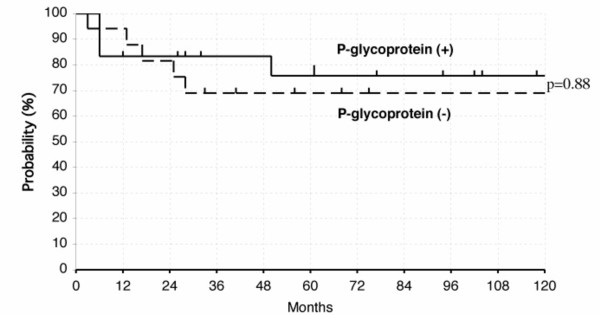
Results: Overall 5-year survival rates for patients with nasal NK/T cell lymphoma, and nasal non-NK/T cell lymphoma were 51%, and 84%. Distant involvement free 5-year survival rates for patients with nasal NK/T cell lymphoma, and nasal non-NK/T cell lymphoma were 53%, and 79%. Overall positivity for P-glycoprotein was observed in 10 of 19 patients with NTL and in 13 of 23 patients with non-NTL. When the overall survival rate was compared between patients with P-glycoprotein positive and negative, there was no difference between them. Sixteen of the 19 patients with nasal NK/T cell lymphoma expressed MMP-9. In contrast, only 8 of the 22 patients with nasal non-NK/T cell lymphoma expressed MMP-9. Distant involvement free 5-year survival rates for patients with MMP-9 negative, and MMP-9 positive were 92%, and 61%, respectively. The difference was statistically significant (p = 0.027).
Conclusion: Positive immunoreactivity for P-glycoprotein was not an independent prognostic factor in nasal NK/T-cell lymphomas, which stresses the importance of exploring other mechanisms of drug resistance. The strong expression of MMP-9 is uniquely characteristic of nasal NK/T cell lymphoma and may contribute to its strong tendency to disseminatate and the extensive necrosis which is always seen. However, our results are based on univariate comparisons, and as such, should be viewed with some caution.
Figures



References
-
- Harris NL, Jaffe ES, Stein H, Banks PM, Chan JK, Cleary ML, Delsol G, De Wolf-Peeters C, Falini B, Gatter KC. A revised European-American classification of lymphoid neoplasms: a proposal from the International Lymphoma Study Group.[comment] Blood. 1994;84:1361–1392. - PubMed
-
- Harris NL, Jaffe ES, Diebold J, Flandrin G, Muller-Hermelink HK, Vardiman J, Lister TA, Bloomfield CD. World Health Organization classification of neoplastic diseases of the hematopoietic and lymphoid tissues: report of the Clinical Advisory Committee meeting-Airlie House, Virginia, November 1997.[comment] Journal of Clinical Oncology. 1999;17:3835–3849. - PubMed
-
- Aozasa K, Ohsawa M, Tajima K, Sasaki R, Maeda H, Matsunaga T, Friedmann I. Nation-wide study of lethal mid-line granuloma in Japan: frequencies of wegener's granulomatosis, polymorphic reticulosis, malignant lymphoma and other related conditions. International Journal of Cancer. 1989;44:63–66. doi: 10.1002/ijc.2910440112. - DOI - PubMed
-
- Ferry JA, Sklar J, Zukerberg LR, Harris NL. Nasal lymphoma. A clinicopathologic study with immunophenotypic and genotypic analysis. American Journal of Surgical Pathology. 1991;15:268–279. - PubMed
-
- Ho FC, Choy D, Loke SL, Kung IT, Fu KH, Liang R, Todd D, Khoo RK. Polymorphic reticulosis and conventional lymphomas of the nose and upper aerodigestive tract: a clinicopathologic study of 70 cases, and immunophenotypic studies of 16 cases. Human Pathology. 1990;21:1041–1050. doi: 10.1016/0046-8177(90)90254-3. - DOI - PubMed
MeSH terms
Substances
LinkOut - more resources
Full Text Sources
Medical
Miscellaneous
