


eap Gene as novel target for specific identification of Staphylococcus aureus
- PMID: 18094124
- PMCID: PMC2238111
- DOI: 10.1128/JCM.01425-07
eap Gene as novel target for specific identification of Staphylococcus aureus
Abstract
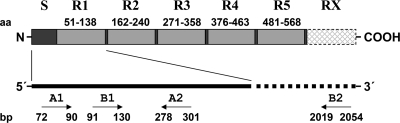
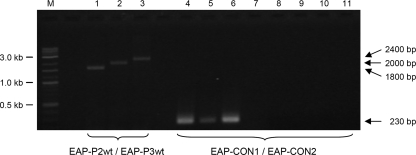
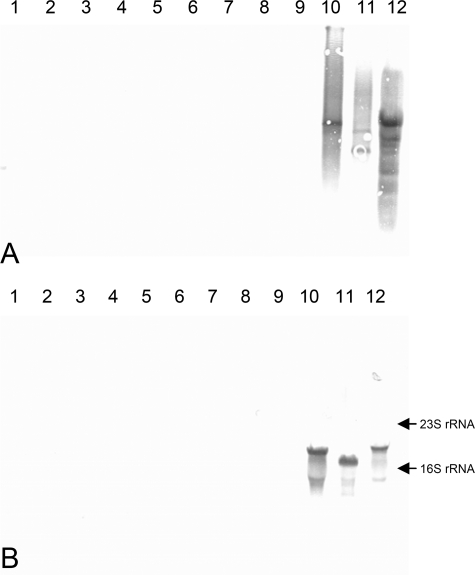
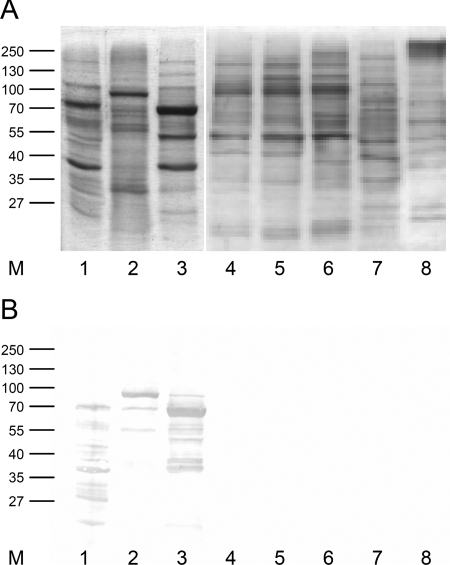
The cell surface-associated extracellular adherence protein (Eap) mediates adherence of Staphylococcus aureus to host extracellular matrix components and inhibits inflammation, wound healing, and angiogenesis. A well-characterized collection of S. aureus and non-S. aureus staphylococcal isolates (n = 813) was tested for the presence of the Eap-encoding gene (eap) by PCR to investigate the use of the eap gene as a specific diagnostic tool for identification of S. aureus. Whereas all 597 S. aureus isolates were eap positive, this gene was not detectable in 216 non-S. aureus staphylococcal isolates comprising 47 different species and subspecies of coagulase-negative staphylococci and non-S. aureus coagulase-positive or coagulase-variable staphylococci. Furthermore, non-S. aureus isolates did not express Eap homologs, as verified on the transcriptional and protein levels. Based on these data, the sensitivity and specificity of the newly developed PCR targeting the eap gene were both 100%. Thus, the unique occurrence of Eap in S. aureus offers a promising tool particularly suitable for molecular diagnostics of this pathogen.
Figures
References
-
- Athanasopoulos, A. N., M. Economopoulou, V. V. Orlova, A. Sobke, D. Schneider, H. Weber, H. G. Augustin, S. A. Eming, U. Schubert, T. Linn, P. P. Nawroth, M. Hussain, H. P. Hammes, M. Herrmann, K. T. Preissner, and T. Chavakis. 2006. The extracellular adherence protein (Eap) of Staphylococcus aureus inhibits wound healing by interfering with host defense and repair mechanisms. Blood 1072720-2727. - PMC - PubMed
-
- Becker, K., R. Roth, and G. Peters. 1998. Rapid and specific detection of toxigenic Staphylococcus aureus: use of two multiplex PCR enzyme immunoassays for amplification and hybridization of staphylococcal enterotoxin genes, exfoliative toxin genes, and toxic shock syndrome toxin 1 gene. J. Clin. Microbiol. 362548-2553. - PMC - PubMed
-
- Becker, K., C. von Eiff, B. Keller, M. Brück, J. Etienne, and G. Peters. 2005. Thermonuclease gene as a target for specific identification of Staphylococcus intermedius isolates: use of a PCR-DNA enzyme immunoassay. Diagn. Microbiol. Infect. Dis. 51237-244. - PubMed
Publication types
MeSH terms
Substances
LinkOut - more resources
Full Text Sources
Medical
Molecular Biology Databases
Research Materials
