


Multi-locus sequence typing of Bartonella henselae isolates from three continents reveals hypervirulent and feline-associated clones
- PMID: 18094753
- PMCID: PMC2147075
- DOI: 10.1371/journal.pone.0001346
Multi-locus sequence typing of Bartonella henselae isolates from three continents reveals hypervirulent and feline-associated clones
Abstract
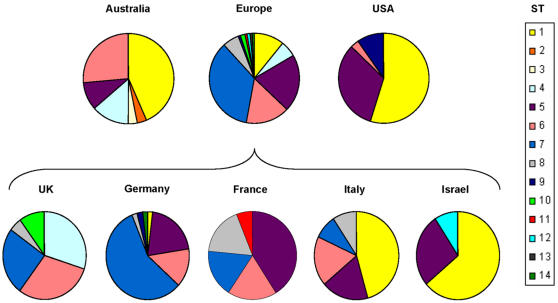
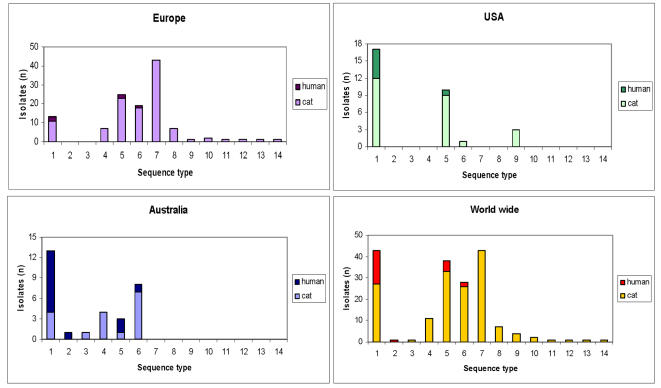
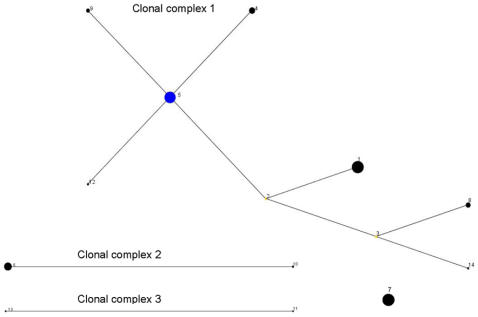
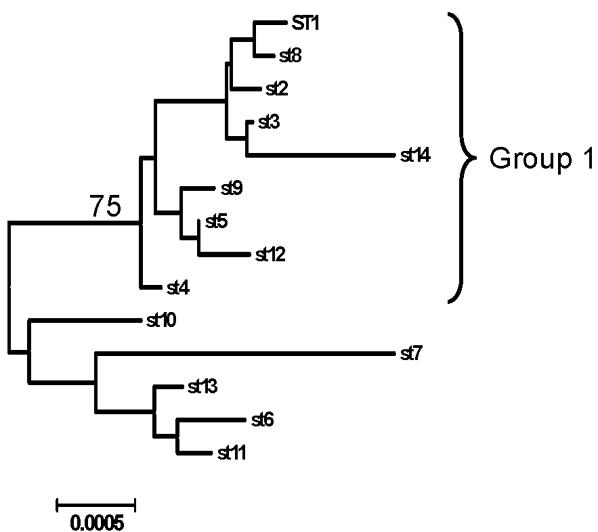
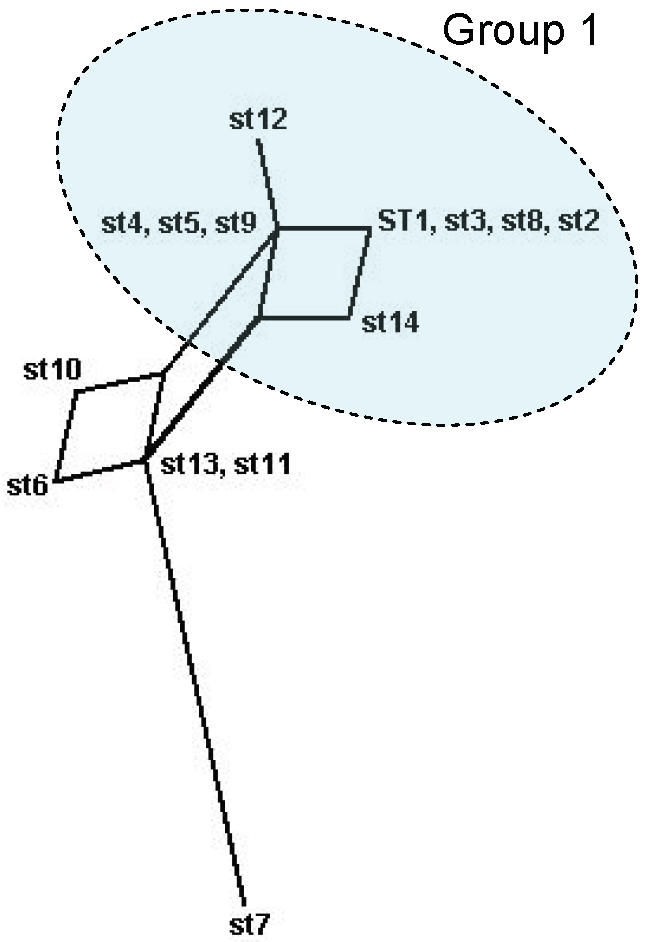
Bartonella henselae is a zoonotic pathogen and the causative agent of cat scratch disease and a variety of other disease manifestations in humans. Previous investigations have suggested that a limited subset of B. henselae isolates may be associated with human disease. In the present study, 182 human and feline B. henselae isolates from Europe, North America and Australia were analysed by multi-locus sequence typing (MLST) to detect any associations between sequence type (ST), host species and geographical distribution of the isolates. A total of 14 sequence types were detected, but over 66% (16/24) of the isolates recovered from human disease corresponded to a single genotype, ST1, and this type was detected in all three continents. In contrast, 27.2% (43/158) of the feline isolates corresponded to ST7, but this ST was not recovered from humans and was restricted to Europe. The difference in host association of STs 1 (human) and 7 (feline) was statistically significant (P< or =0.001). eBURST analysis assigned the 14 STs to three clonal lineages, which contained two or more STs, and a singleton comprising ST7. These groups were broadly consistent with a neighbour-joining tree, although splits decomposition analysis was indicative of a history of recombination. These data indicate that B. henselae lineages differ in their virulence properties for humans and contribute to a better understanding of the population structure of B. henselae.
Conflict of interest statement
Figures
References
-
- Margileth AM. Cat scratch disease. Adv Pediatr Infect Dis. 1993;8:1–21. - PubMed
-
- Koehler JE, Quinn FD, Berger TG, LeBoit PE, Tappero JW. Isolation of Rochalimaea species from cutaneous and osseous lesions of bacillary angiomatosis. N Engl J Med. 1992;327:1625–1631. - PubMed
-
- Guptill L, Slater L, Wu CC, Lin TL, Glickman LT, et al. Experimental infection of young specific pathogen-free cats with Bartonella henselae. J Infect Dis. 1997;176:206–216. - PubMed
-
- Avidor B, Varon M, Marmor S, Lifschitz-Mercer B, Kletter Y, et al. DNA amplification for the diagnosis of cat-scratch disease in small-quantity clinical specimens. Am J Clin Pathol. 2001;115:900–909. - PubMed
Publication types
MeSH terms
LinkOut - more resources
Full Text Sources
Miscellaneous
