


Hearing aid fitting process in users fitted in a federal public institution: part II--Self-assessment questionnaire results
- PMID: 18094808
- PMCID: PMC9445697
- DOI: 10.1016/s1808-8694(15)30127-0
Hearing aid fitting process in users fitted in a federal public institution: part II--Self-assessment questionnaire results
Abstract
An efficient rehabilitation must be able to reduce impairment effects over the auditory and communication skills of individuals and promote psychosocial well being.
Aims: check the feasibility of using self-assessment questionnaires and compare the results achieved by hearing aid fitting in users from a federal public institution, with and without complaints related to hearing amplification characteristics.
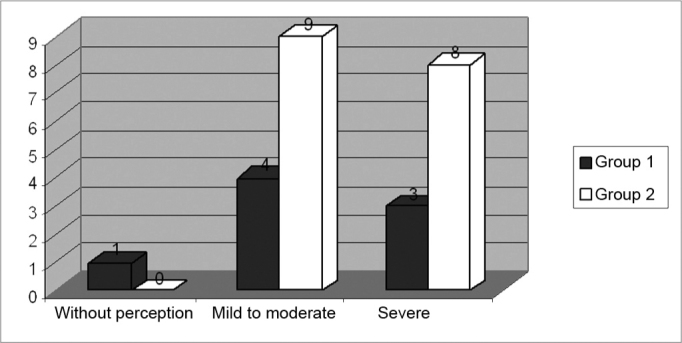
Materials and methods: 25 individuals, from 13 to 77 years of age, users of hearing aids. The HHIE-S/HHIA (Hearing Handicap Inventory for the Elderly Screening Version or for Adult) and APHAB (Abbreviated Profile of Hearing Aid Benefit) self-assessment questionnaires used with individuals without (Group 1) and with complaints related to amplification characteristics (Group 2).
Results: we did not find significant differences between the HHIE-S/HHIA and APHAB groups; except in APHABs ease of communication item, where Group 1 seemed to benefit more. Moreover, we noticed a significant reduction in hearing disability with the use of hearing aids in favorable communication situations, noisy environments for both groups.
Conclusion: these questionnaires proved to be valuable for predicting the difficulties faced by the users, and significant differences were found in favorable communication situations, where the group without complaints had the most benefit.
Figures


References
-
- Weinstein BE. Treatment efficacy: hearing aids in the management of hearing loss in adults. J Speech Hear Res. 1996;39(5):S37–S45. - PubMed
-
- Almeida K. Avaliação objetiva e subjetiva do benefício de próteses auditivas em adultos (Dissertação) Universidade Federal de São Paulo/Escola Paulista de Medicina; São Paulo: 1998.
-
- Ventry IM, Weinstein BE. The hearing handicap inventory for the elderly: a new tool. Ear Hear. 1982;3:128–134. - PubMed
-
- Newman CW, Weinstein BE, Jacobson GP, Hug GA. The hearing handicap inventory for adults: psychometric adequacy and audiometric correlates. Ear Hear. 1990;11(6):430–433. - PubMed
-
- Matas CG, Iório MCM. In: Próteses auditivas: fundamentos teóricos & aplicações clínicas. 2ª. Almeida K, Iório MCM, editors. Lovise; São Paulo: 2003. Verificação e validação do processo de seleção e adaptação de próteses auditivas; pp. 305–320.
Uncited Reference
-
- Wieselberg MB. A auto-avaliação do handicap em idosos portadores de deficiência auditiva: o uso de HHIE (Dissertação) Pontifícia Universidade Católica de São Paulo; São Paulo: 1997.
-
- Cox RM, Alexander GC. The abbreviated profile of hearing aid benefit. Ear Hear. 1995;16(2):176–183. - PubMed
Publication types
MeSH terms
LinkOut - more resources
Full Text Sources
Medical
