


Functional neuroanatomy of CCK-4-induced panic attacks in healthy volunteers
- PMID: 18095276
- PMCID: PMC6870703
- DOI: 10.1002/hbm.20522
Functional neuroanatomy of CCK-4-induced panic attacks in healthy volunteers
Abstract
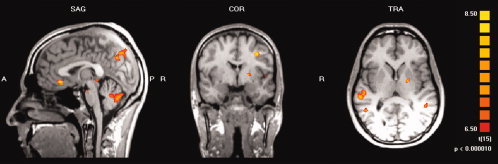
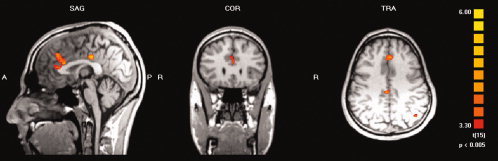
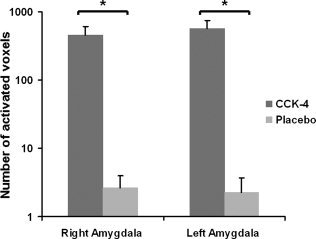
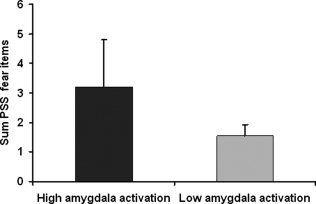
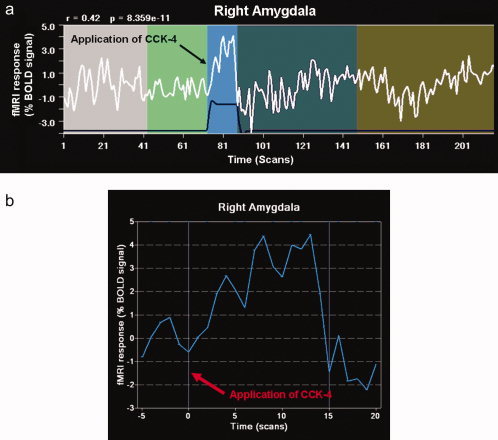
Experimental panic induction with cholecystokinin tetrapeptide (CCK-4) is considered as a suitable model to investigate the pathophysiology of panic attacks. While only a few studies investigated the brain activation patterns following CCK-4, no data are available on the putative involvement of the amygdala in the CCK-4 elicited anxiety response. We studied the functional correlates of CCK-4-induced anxiety in healthy volunteers by means of functional magnetic resonance imaging (fMRI) and region of interest (ROI) analysis of the amygdala. Sixteen healthy volunteers underwent challenge with CCK-4 compared with placebo in a single-blind design. Functional brain activation patterns were determined for the CCK-4-challenge, the placebo response and anticipatory anxiety (AA). CCK-4-induced anxiety was accompanied by a strong and robust activation (random effects analysis, P < 0.00001, uncorrected for multiple testing) in the ventral anterior cingulate cortex (ACC), middle and superior frontal gyrus, precuneus, middle and superior temporal gyrus, occipital lobe, sublobar areas, cerebellum, and brainstem. In contrast, random effects group analysis for placebo and AA using the same level of significance generated no significant results. Using a more liberal level of significance, activations could be observed in some brain regions such as the dorsal part of the ACC during AA (random effects analysis, P < 0.005). Overall functional responses did not differ between panickers and nonpanickers. Only 5 of 11 subjects showed strong amygdala activation. However, ROI analysis pointed towards higher scores in fear items in these subjects. In conclusion, while overall brain activation patterns are not related to the subjective anxiety response to CCK-4, amygdala activation may be involved in the subjective perception of CCK-4-induced fear.
Figures
References
-
- Akiyoshi J,Isogawa K,Tsutsumi T,Kasturagi S,Kohno K,Furuta M,Yamamoto Y,Yamada K,Fujii I ( 1997): Cholecystokinin tetrapeptide‐induced calcium mobilization in T cells of patients with panic disorder, major depression, or schizophrenia. Biol Psychiatry 42: 151–154. - PubMed
-
- Aluoja A,Shlik J,Vasar V,Kingisepp PH,Jagomagi K,Vasar E,Bradwejn J ( 1997): Emotional and cognitive factors connected with response to cholecystokinin tetrapeptide in healthy volunteers. Psychiatry Res 66: 59–67. - PubMed
-
- Aronson TA,Whitaker‐Azmitia P,Caraseti I ( 1989): Differential reactivity to lactate infusions: the relative role of biological, psychological, and conditioning variables. Biol Psychiatry 25: 469–481. - PubMed
-
- Beinfeld MC,Meyer DK,Eskay RL,Jensen RT,Brownstein MJ ( 1981): The distribution of cholecystokinin immunoreactivity in the central nervous system of the rat as determined by radioimmunoassay. Brain Res 212: 51–57. - PubMed
-
- Benkelfat C,Bradwejn J,Meyer E,Ellenbogen M,Milot S,Gjedde A,Evans A ( 1995): Functional neuroanatomy of CCK4‐induced anxiety in normal healthy volunteers. Am J Psychiatry 152: 1180–1184. - PubMed
MeSH terms
Substances
LinkOut - more resources
Full Text Sources
Medical
