


Flow-mediated dilatation in the superficial femoral artery is nitric oxide mediated in humans
- PMID: 18096601
- PMCID: PMC2375653
- DOI: 10.1113/jphysiol.2007.145722
Flow-mediated dilatation in the superficial femoral artery is nitric oxide mediated in humans
Abstract
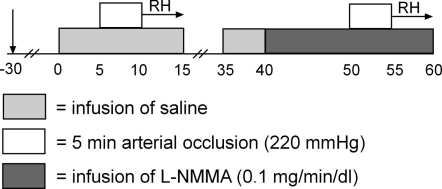
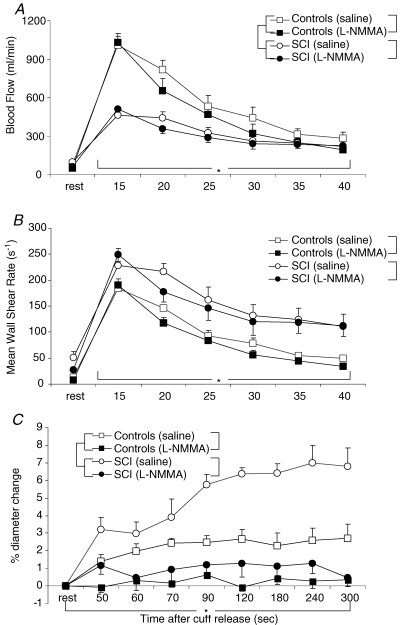
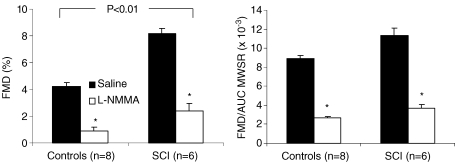
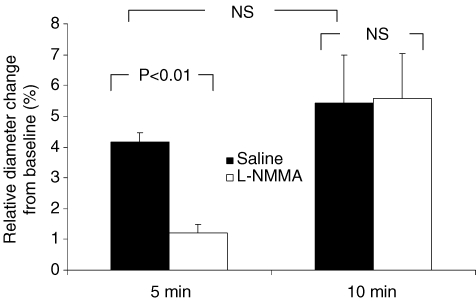
Flow-mediated dilatation (FMD) of the brachial and radial arteries is an important research tool for assessment of endothelial function in vivo, and is nitric oxide (NO) dependent. The leg skeletal muscle vascular bed is an important territory for studies in exercise physiology. However, the role of endothelial NO in the FMD response of lower limb arteries has never been investigated. The purpose of this study was to examine the contribution of NO to FMD in the superficial femoral artery in healthy subjects. Since physical inactivity may affect endothelial function, and therefore NO availability, spinal cord-injured (SCI) individuals were included as a model of extreme deconditioning. In eight healthy men (34 +/- 13 years) and six SCI individuals (37 +/- 10 years), the 5 min FMD response in the superficial femoral artery was assessed by echo-Doppler, both during infusion of saline and during infusion of the NO synthase blocker N(G)-monomethyl-L-arginine (L-NMMA). In a subset of the controls (n = 6), the 10 min FMD response was also examined using the same procedure. The 5 min FMD response in controls (4.2 +/- 0.3%) was significantly diminished during L-NMMA infusion (1.0 +/- 0.2%, P < 0.001). In SCI, L-NMMA also significantly decreased the FMD response (from 8.2 +/- 0.4% during saline to 2.4 +/- 0.5% during L-NMMA infusion). The hyperaemic flow response during the first 45 s after cuff deflation was lower in both groups during infusion of L-NMMA, but the effect of L-NMMA on FMD persisted in both groups after correction for the shear stress stimulus. The 10 min FMD was not affected by L-NMMA (saline: 5.4 +/- 1.6%, L-NMMA: 5.6 +/- 1.5%). Superficial femoral artery FMD in response to distal arterial occlusion for a period of 5 min is predominantly mediated by NO in healthy men and in the extremely deconditioned legs of SCI individuals.
Figures
References
-
- Allen JD, Geaghan JP, Greenway F, Welsch MA. Time course of improved flow-mediated dilation after short-term exercise training. Med Sci Sports Exerc. 2003;35:847–853. - PubMed
-
- Berger R, Stanek B, Hulsmann M, Frey B, Heher S, Pacher R, Neunteufl T. Effects of endothelin A receptor blockade on endothelial function in patients with chronic heart failure. Circulation. 2001;103:981–986. - PubMed
-
- Bleeker MW, De Groot PC, Poelkens F, Rongen GA, Smits P, Hopman MT. Vascular adaptation to 4 wk of deconditioning by unilateral lower limb suspension. Am J Physiol Heart Circ Physiol. 2005a;288:H1747–H1755. - PubMed
-
- Bleeker MW, De Groot PC, Rongen GA, Rittweger J, Felsenberg D, Smits P, Hopman MT. Vascular adaptation to deconditioning and the effect of an exercise countermeasure: results of the Berlin Bed Rest study. J Appl Physiol. 2005b;99:1293–1300. - PubMed
Publication types
MeSH terms
Substances
LinkOut - more resources
Full Text Sources
