


Trajectory patterns of dental caries experience in the permanent dentition to the fourth decade of life
- PMID: 18096897
- PMCID: PMC2254448
- DOI: 10.1177/154405910808700112
Trajectory patterns of dental caries experience in the permanent dentition to the fourth decade of life
Abstract
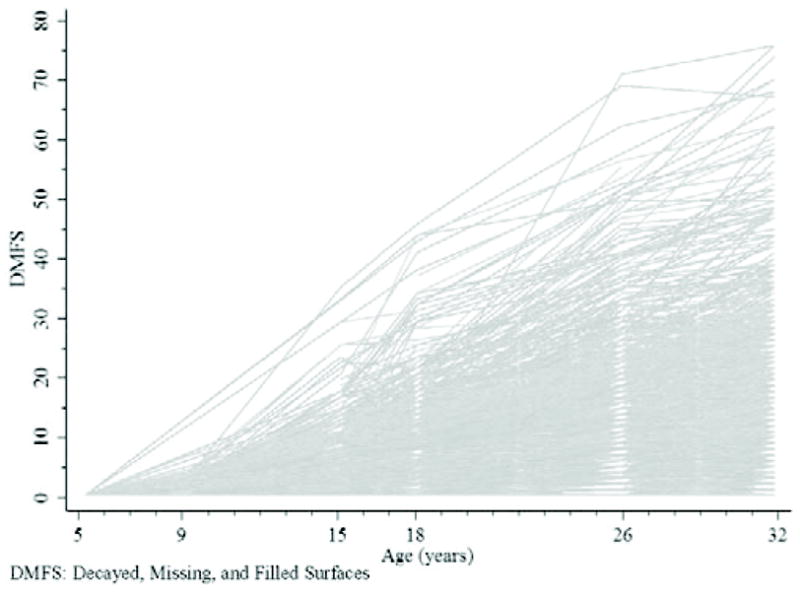
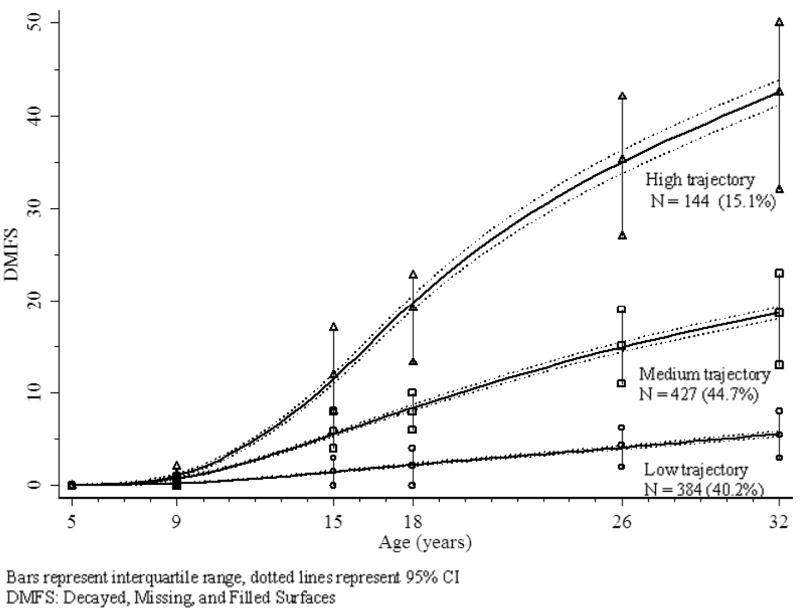
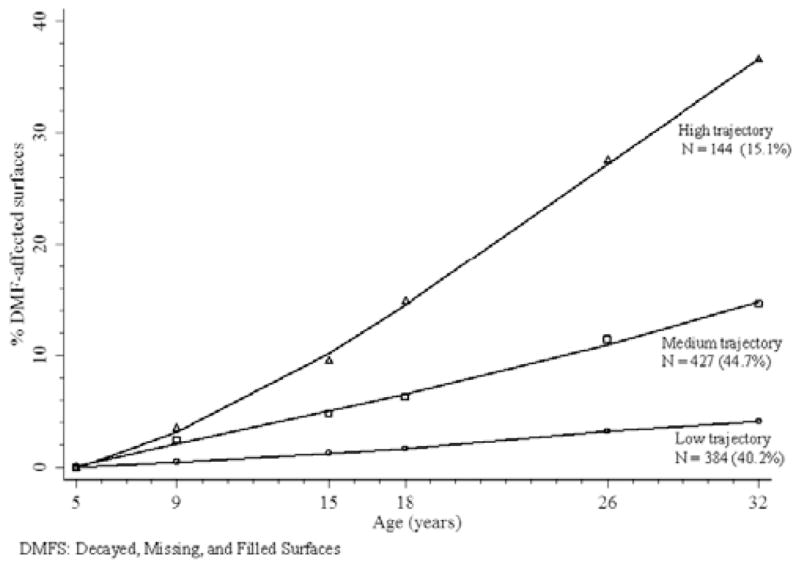
Dental caries is a chronic, cumulative disease, but no studies have investigated longitudinal patterns of caries experience. The objective of this study was to identify and describe developmental trajectories of caries experience in the permanent dentition to age 32. Longitudinal caries data for 955 participants in a longstanding birth cohort study were analyzed by trajectory analysis. Three caries experience trajectories were identified by the SAS macro PROC TRAJ; these were categorized as "high" (approximately 15%), "medium" (approximately 43%), and "low" (approximately 42%) DMFS (Decayed, Missing, and Filled Surfaces). All were relatively linear, although the higher trajectories were more "S-shaped". This effect disappeared following adjustment for the number of unaffected surfaces remaining at each age, suggesting that, among individuals following a similar caries trajectory, caries rate is relatively constant across time.
Figures
References
-
- Ben-Shlomo Y, Kuh D. A life course approach to chronic disease epidemiology: conceptual models, empirical challenges and interdisciplinary perspectives. Int J Epidemiol. 2002;31:285–293. - PubMed
-
- Carlos JP, Gittelsohn AM. Longitudinal studies of the natural history of caries - II. Arch Oral Biol. 1965;10:739–751. - PubMed
-
- Dennis JE, Gay DM, Welsch RE. An adaptive nonlinear least-squares algorithm. ACM Trans Mathematical Software. 1981;7:348–368.
Publication types
MeSH terms
Grants and funding
LinkOut - more resources
Full Text Sources
