


A heuristic indication and warning staging model for detection and assessment of biological events
- PMID: 18096906
- PMCID: PMC2274782
- DOI: 10.1197/jamia.M2558
A heuristic indication and warning staging model for detection and assessment of biological events
Abstract
Objective: This paper presents a model designed to enable rapid detection and assessment of biological threats that may require swift intervention by the international public health community.
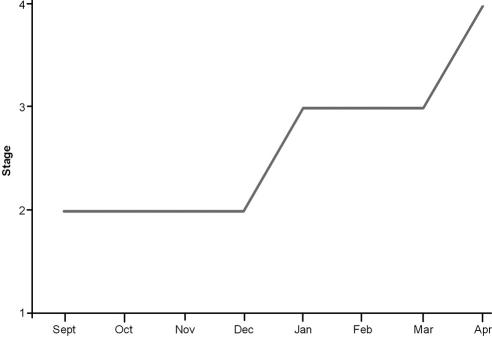
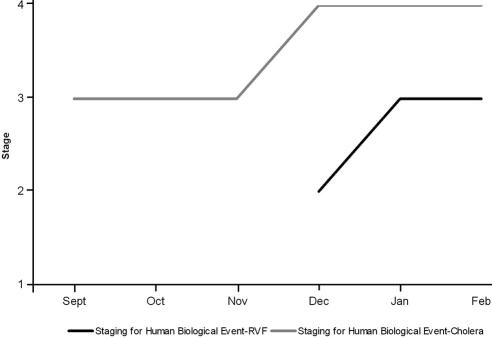
Design: We utilized Strauss' grounded theory to develop an expanded model of social disruption due to biological events based on retrospective and prospective case studies. We then applied this model to the temporal domain and propose a heuristic staging model, the Wilson-Collmann Scale for assessing biological event evolution.
Measurements: We retrospectively and manually examined hard copy archival local media reports in the native vernacular for three biological events associated with substantial social disruption. The model was then tested prospectively through media harvesting based on keywords corresponding to the model parameters.
Results: Our heuristic staging model provides valuable information about the features of a biological event that can be used to determine the level of concern warranted, such as whether the pathogen in question is responding to established public health disease control measures, including the use of antimicrobials or vaccines; whether the public health and medical infrastructure of the country involved is adequate to mount the necessary response; whether the country's officials are providing an appropriate level of information to international public health authorities; and whether the event poses a international threat. The approach is applicable for monitoring open-source (public-domain) media for indications and warnings of such events, and specifically for markers of the social disruption that commonly occur as these events unfold. These indications and warnings can then be used as the basis for staging the biological threat in the same manner that the United States National Weather Service currently uses storm warning models (such as the Saffir-Simpson Hurricane Scale) to detect and assess threatening weather conditions.
Conclusion: Used as a complement to current epidemiological surveillance methods, our approach could aid global public health officials and national political leaders in responding to biological threats of international public health significance.
Figures



Comment in
-
Biosurveillance, classification, and semantic health technologies.J Am Med Inform Assoc. 2008 Mar-Apr;15(2):172-3. doi: 10.1197/jamia.m2693. J Am Med Inform Assoc. 2008. PMID: 18396506 Free PMC article. No abstract available.
References
-
- Heyman DL, Rodier G. Global surveillance, national surveillance, and SARS. Emerg Infect Dis. http://www.cdc.gov/ncidod/EID/vol10no2/03-1038.htmAccessed Feb 2003. - PMC - PubMed
-
- Avian influenza: perfect storm now gathering? Lancet 2005;365(9462):820http://thelancet.url123.com/26swp 2005. Mar 5–11. - PubMed
-
- Ferguson NM, Cummings DA, Cauchemez S, Fraser C, Riley S, Meeyai A, Iamsirithaworn S, Burke DS. Strategies for containing an emerging influenza pandemic in Southeast Asia Nature 2005;437(7056):209-214Sep 8. - PubMed
-
- World Health Organization Global outbreak alert and response network [online]http://www.who.int/csr/outbreaknetwork/en/ 2005. Accessed May 23, 2005.
Publication types
MeSH terms
Grants and funding
LinkOut - more resources
Full Text Sources
Other Literature Sources
Medical
