


A skewed view of X chromosome inactivation
- PMID: 18097476
- PMCID: PMC2147673
- DOI: 10.1172/JCI34470
A skewed view of X chromosome inactivation
Abstract
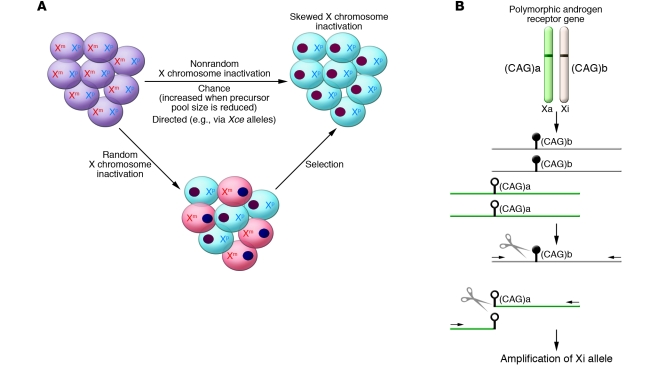
X chromosome inactivation involves a random choice to silence either X chromosome early in mammalian female development. Once silenced the inactive X is stably inherited through subsequent somatic cell divisions, and thus, females are generally mosaics, having a mixture of cells with one or the other parental X active. While in most females the number of cells with either X being active is roughly equal, skewing of X chromosome inactivation is observed in a percentage of women. In this issue of the JCI, Bolduc and colleagues address whether skewing of X chromosome inactivation in humans is influenced by an X-linked locus that can alter this initial random inactivation (see the related article beginning on page 333). Their data indicate that most of the skewing observed in humans results from secondary events rather than being due to an inherited tendency to inactivate a particular X chromosome.
Figures
Comment on
-
No evidence that skewing of X chromosome inactivation patterns is transmitted to offspring in humans.J Clin Invest. 2008 Jan;118(1):333-41. doi: 10.1172/JCI33166. J Clin Invest. 2008. PMID: 18097474 Free PMC article.
References
-
- Lyon M.F. Gene action in the X-chromosome of the mouse (Mus musculus L.). . Nature. 1961;190:372–373. - PubMed
-
- Migeon, B.R. 2007.Females are mosaics: X inactivation and sex differences in disease. Oxford University Press. New York, New York, USA. 296 pp. - PubMed
-
- Cattanach B.M., Williams C.E. Evidence of non-random X chromosome activity in the mouse. Genet. Res. 1972;19:229–240. - PubMed
-
- Avner P., et al. Molecular correlates of the murine Xce locus. Genet. Res. . 1998;72:217–224. - PubMed
-
- Heard E., Disteche C.M. Dosage compensation in mammals: fine-tuning the expression of the X chromosome. Genes Dev. 2006;20:1848–1867. - PubMed
Publication types
MeSH terms
LinkOut - more resources
Full Text Sources
Other Literature Sources
Medical
