Meta-Analysis
. 2007 Oct;17(10):1357-66.
doi: 10.1007/s11695-007-9241-9.

The health-related quality of life of obese persons seeking or not seeking surgical or non-surgical treatment: a meta-analysis

Affiliations
Meta-Analysis

The health-related quality of life of obese persons seeking or not seeking surgical or non-surgical treatment: a meta-analysis

Annemieke M A van Nunen et al. Obes Surg. 2007 Oct.

Abstract

Background: This meta-analysis examined differences in health-related quality of life (HRQoL) between seekers of surgical and non-surgical treatment, and non-treatment seekers, over and above differences that are explained by weight, age, and gender.

Methods: Our literature search focused on the 'Impact of Weight on Quality of Life-Lite' (IWQOL-Lite) and the 'Short Form-36' (SF-36) questionnaires. Included were studies published between 1980 and April 2006 providing pre-treatment descriptive statistics of adult overweight, obese or morbidly obese persons. Excluded were elderly and ill patient groups.

Results: 54 articles, with a total number of nearly 100,000 participants, met the inclusion criteria. Persons seeking surgical treatment demonstrated the most severely reduced HRQoL. IWQOL-Lite scores showed larger differences between populations than SF-36 scores. After adjustment for weight, the population differences on the IWQOL disappeared. In contrast, the differences on the SF-36 between the surgical treatment seeking population and the other populations were maintained after adjustment for weight.

Conclusion: The IWQOL-Lite questionnaire predominantly reflects weight-related HRQoL, whereas the SF-36 mostly reflects generic HRQoL that is determined by both weight and other factors. Our meta-analysis provides reference values that are useful when explaining or evaluating obesity-specific (IWQOL-Lite) or generic (SF-36) HRQoL, weight, and demographic characteristics of obese persons seeking or not seeking surgical or non-surgical treatment.


Figures
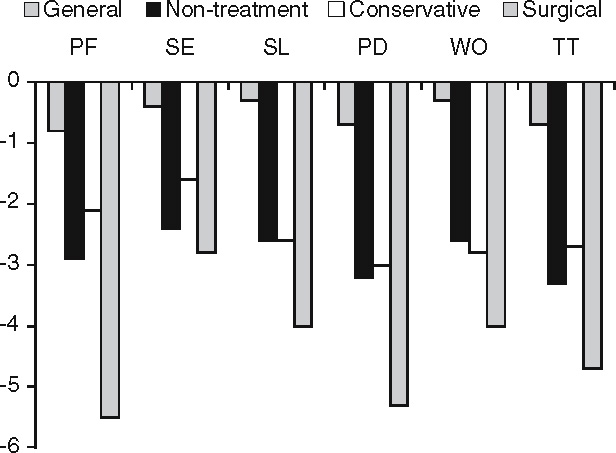
Figure 1
Figure 1
Mean deviation from the norm group in standard deviation units on the IWQOL-Lite for four populations. PF: Physical function, SE: Self-esteem, SL: Sexual life, PD: Public distress, WO:Work, TT: Total.
Figure 2
Figure 2
Mean deviation from the norm group in standard deviation units on the SF-36 for five populations. PF: Physical functioning, PR: Physical Role — role limitations due to physical problems, PA: Bodily pain, GH: General health, VI: Vitality, SF: Social functioning, ER: Emotional role — Role limitations due to emotional problems, MH: Mental health.

References

    1. {'text': '', 'ref_index': 1, 'ids': [{'type': 'DOI', 'value': '10.1001/jama.288.14.1723', 'is_inner': False, 'url': 'https://doi.org/10.1001/jama.288.14.1723'}, {'type': 'PubMed', 'value': '12365955', 'is_inner': True, 'url': 'https://pubmed.ncbi.nlm.nih.gov/12365955/'}]}
    2. Flegal KM, Carroll MD, Ogden CL et al. Prevalence and trends in obesity among US adults, 1999–2000. JAMA 2002; 288: 1723–7. - PubMed
    1. {'text': '', 'ref_index': 1, 'ids': [{'type': 'PubMed', 'value': '16895874', 'is_inner': True, 'url': 'https://pubmed.ncbi.nlm.nih.gov/16895874/'}]}
    2. Popkin BM. Global nutrition dynamics: the world is shifting rapidly toward a diet linked with noncommunicable diseases. Am J Clin Nutr 2006; 84: 289–98. - PubMed
    1. {'text': '', 'ref_index': 1, 'ids': [{'type': 'DOI', 'value': '10.1210/jc.2004-0535', 'is_inner': False, 'url': 'https://doi.org/10.1210/jc.2004-0535'}, {'type': 'PubMed', 'value': '15181027', 'is_inner': True, 'url': 'https://pubmed.ncbi.nlm.nih.gov/15181027/'}]}
    2. Bray GA. Medical consequences of obesity. J Clin Endocrinol Metab 2004; 89: 2583–9. - PubMed
    1. {'text': '', 'ref_index': 1, 'ids': [{'type': 'DOI', 'value': '10.1093/pubmed/fdi025', 'is_inner': False, 'url': 'https://doi.org/10.1093/pubmed/fdi025'}, {'type': 'PubMed', 'value': '15820993', 'is_inner': True, 'url': 'https://pubmed.ncbi.nlm.nih.gov/15820993/'}]}
    2. Jia H, Lubetkin EI. The impact of obesity on health-related quality-of-life in the general adult US population. J Public Health 2005; 27: 156–64. - PubMed
    1. {'text': '', 'ref_index': 1, 'ids': [{'type': 'DOI', 'value': '10.1038/oby.2002.102', 'is_inner': False, 'url': 'https://doi.org/10.1038/oby.2002.102'}, {'type': 'PubMed', 'value': '12181383', 'is_inner': True, 'url': 'https://pubmed.ncbi.nlm.nih.gov/12181383/'}]}
    2. Kolotkin RL, Crosby RD, Williams GR. Health-related quality of life varies among obese subgroups. Obes Res 2002; 10: 748–56. - PubMed
