


Predicting long-term response to strong opioids in patients with low back pain: findings from a randomized, controlled trial of transdermal fentanyl and morphine
- PMID: 18154644
- PMCID: PMC2242794
- DOI: 10.1186/1741-7015-5-39
Predicting long-term response to strong opioids in patients with low back pain: findings from a randomized, controlled trial of transdermal fentanyl and morphine
Abstract
Background: Some patients with long-standing low back pain will benefit from treatment with strong opioids. However, it would be helpful to predict which patients will have a good response. A fixed-term opioid trial has been recommended, but there is little evidence to suggest how long this trial should be. We assessed data from a large-scale randomized comparison of transdermal fentanyl (TDF) and sustained-release oral morphine (slow-release morphine; SRM) to determine characteristics of treatment responders.
Methods: This was a secondary analysis of a previously published 13-month randomized trial involving 680 patients with long-standing low back pain (median age 52 years, 61% women, median duration of back pain 87 months). Pain relief was recorded using visual analogue scales (VAS). Treatment response was defined as pain relief of at least 30% from baseline to any point during the trial. We used a step-wise logistic regression to identify variables that might predict response to treatment. Covariates included treatment group, sex, age, duration of pain, presence of neuropathic pain, baseline pain scores, educational/employment status, use of high doses of opioids, and social functioning (SF)-36 scores.
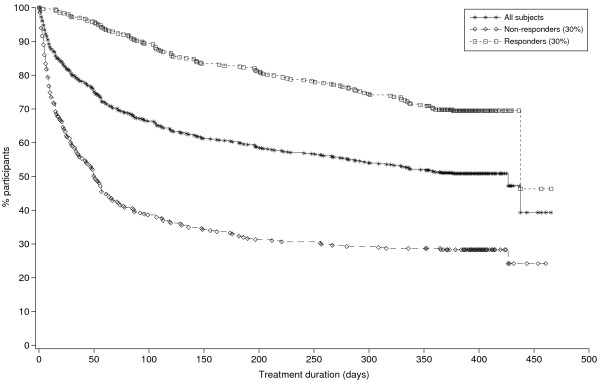
Results: Over half the patients in both groups (n = 370; 54% TDF, 55% SRM) were treatment responders. There were no differences between the TDF and SRM responders in terms of age, sex, type or duration of pain between responders and non-responders. The difference in response to treatment between responders and non-responders could be detected at 3 weeks. Lack of response after 1 month had a stronger negative predictive value (i.e., ability to detect non-responders) than the presence of response after 1 month. The most influential factors for predicting a response were employment status (chi2 = 11.06, p = 0.0259) and use of high doses of opioids (chi2 = 3.04, p = 0.0811).
Conclusion: No clear pattern of baseline pain (type or severity) or patient characteristics emerged that could be used to predict responders before the start of opioid treatment. However, a 1-month trial period appears sufficient to determine response and tolerability in most cases.
Figures
References
-
- Axen I, Jones JJ, Rosenbaum A, Lovgren PW, Halasz L, Larsen K, Leboeuf-Yde C. The Nordic Back Pain Subpopulation Program: validation and improvement of a predictive model for treatment outcome in patients with low back pain receiving chiropractic treatment. J Manip Physiol Ther. 2005;28:381–385. doi: 10.1016/j.jmpt.2005.06.008. - DOI - PubMed
Publication types
MeSH terms
Substances
LinkOut - more resources
Full Text Sources
