Review
. 2008 Mar 17;60(6):702-16.
doi: 10.1016/j.addr.2007.09.007. Epub 2007 Nov 7.

Lipid-based delivery systems and intestinal lymphatic drug transport: a mechanistic update

Affiliations
Review

Lipid-based delivery systems and intestinal lymphatic drug transport: a mechanistic update

Natalie L Trevaskis et al. Adv Drug Deliv Rev. .

Abstract

After oral administration, the majority of drug molecules are absorbed across the small intestine and enter the systemic circulation via the portal vein and the liver. For some highly lipophilic drugs (typically log P>5, lipid solubility>50 mg/g), however, association with lymph lipoproteins in the enterocyte leads to transport to the systemic circulation via the intestinal lymph. The attendant delivery benefits associated with lymphatic drug transport include a reduction in first-pass metabolism and lymphatic exposure to drug concentrations orders of magnitude higher than that attained in systemic blood. In the current review we briefly describe the mechanisms by which drug molecules access the lymph and the formulation strategies that may be utilised to enhance lymphatic drug transport. Specific focus is directed toward recent advances in understanding regarding the impact of lipid source (both endogenous and exogenous) and intracellular lipid trafficking pathways on lymphatic drug transport and enterocyte-based first-pass metabolism.


Figures

Fig. 1
Fig. 1
Drug absorption via the intestinal lymphatic system and portal vein. Both lymph and blood vessels are present in the lamina propria underlying the intestinal absorptive cells (enterocytes) of the intestine. The rate of flow of portal blood, however, is some 500-fold higher than that of the mesenteric lymph and as such, most drugs enter the portal blood more avidly than the mesenteric lymph. In contrast, following uptake into the enterocytes, fatty acid (FA) and monoglyceride (MG) digestion products are resynthesised to triglyceride (TG) and assembled into colloidal lipoproteins (LP) within the endoplasmic reticulum. These LP are exocytosed across the basolateral membrane of the enterocytes and preferentially access the mesenteric lymph vessels as their size precludes easy diffusion across the vascular endothelium. Highly lipophilic drugs (log P > 5 and long chain TG solubility > 50 mg/g) may therefore access the intestinal lymph via association with developing lipoproteins in the enterocyte, with the properties of the lipoprotein, rather than the drug, dictating lymphatic access.
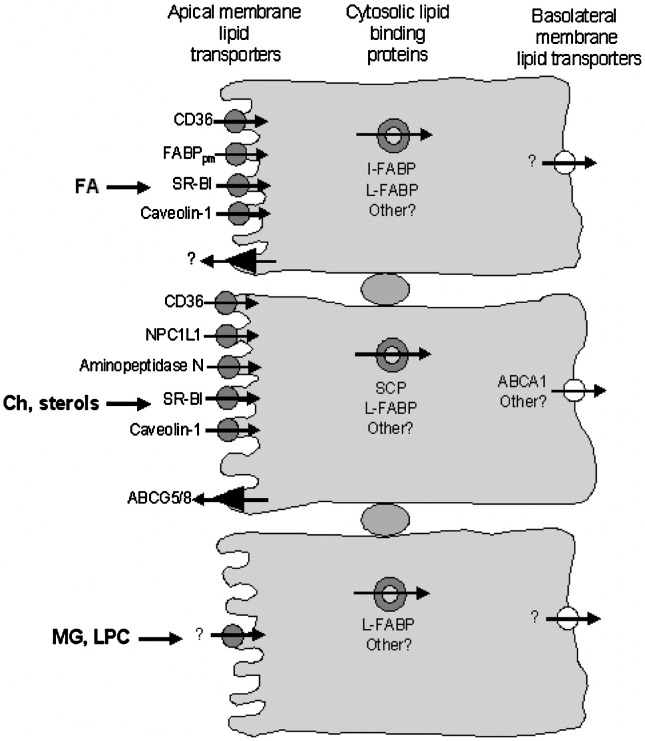
Fig. 2
Fig. 2
Lipid transporters and binding proteins involved in intestinal lipid absorption. A number of transporters and binding proteins have been implicated in lipid uptake into and transport across intestinal epithelial cells (enterocytes) although the relative contribution of each of these proteins and indeed the role of passive vs active uptake in the overall intestinal absorption of lipids is yet to be fully resolved. Apical membrane lipid transporters (including CD36/FAT (cluster determinant 36/fatty acid translocase), FABPpm (plasma membrane fatty acid binding protein), SR-BI (scavenger receptor BI), caveolin-1 (which may act in concert with annexin-2), aminopeptidase N, NPC1L1 (Niemann Pick C1-Like 1), (dark circles)) are believed to play a role in the uptake of lipid digestion products including fatty acid (FA), cholesterol (Ch) and other sterols, monoglycerides (MG) and lyso-phosphatidylcholine (LPC) from the intestinal lumen into the enterocytes. Lipid digestion products may also be effluxed from enterocytes back into the intestinal lumen by ABC (ATP-binding cassette) efflux transporters (black triangles). Transport across the enterocyte cytoplasm is thought to be facilitated by intracellular lipid binding proteins (including I-FABP (intestinal fatty acid binding protein), L-FABP (liver fatty acid binding protein), SCP (sterol carrier protein)) (dark rings). Ch exit from enterocytes across the basolateral membrane is facilitated by ABCA1 and a number of as yet unidentified transporters may facilitate exit of other lipids across the basolateral membrane (white circles).
Fig. 3
Fig. 3
Intracellular processing of lipids in the enterocyte. Following uptake across the apical membrane of the enterocyte, the products of gastrointestinal (GI) lumen lipid digestion (e.g. monoglyceride (MG) and fatty acid (FA)) may either diffuse across the enterocyte and enter the portal vein blood or be resynthesised to triglyceride via either the 2-monoglyceride (2-MG) pathway associated with the smooth endoplasmic reticulum (SER) or the glycerol-3 phosphate (G3P) pathway associated with the rough endoplasmic reticulum (RER) , . Triglyceride formed via these pathways may enter the endoplasmic reticular lumen where the triglyceride is assembled into lipoproteins (LP, represented by circles). LP are then transported to the Golgi, exocytosed from the enterocyte and taken up into the intestinal lymphatic system . Since lipid contained within the lipoprotein assembly pathways and the Golgi is destined for transport to the systemic circulation via the intestinal lymphatic system, this pool of lipids is referred to as the lymph lipid precursor pool (dashed blue line) , . A cytosolic pool of lipids is also located within the enterocytes , . This lipid pool comprises excess triglyceride formed via the G3P pathway and endogenous lipids taken up from the intestinal blood supply in the form of either FA or chylomicron remnants , . These cytosolic lipids are subject to hydrolysis by cytosolic lipase and the digestion products so formed may be re-circulated into TG assembly pathways . However, the majority of lipids from this pool exit the enterocyte in the form of TG or free FA and are taken up into portal vein blood , . The pool of lipids which is transported from the enterocyte via the portal vein is therefore referred to as the portal lipid precursor pool (dashed red line) , . This figure is modified from reference .
Fig. 4
Fig. 4
Schematic representation of the proposed mechanism by which different sources of endogenous lipids support lymphatic drug transport. Administration of exogenous fatty acid (FA) appears to lead to recruitment of endogenous FA into the intestinal lymph. These endogenous FA may enter the enterocyte across the apical (or luminal) membrane (e.g. FA derived from lipids secreted in bile) or the basolateral membrane (e.g. FA from the intestinal blood supply). However, apically- and basolaterally-sourced lipids are trafficked through the pools of lipid within the enterocyte and subsequently enter the lymph in a different manner. Thus, basolaterally-sourced endogenous lipids appear to largely enter the portal lipid precursor pool, from where the majority are transported from the enterocytes to the systemic circulation via the portal vein. A proportion of lipids in the portal lipid precursor pool are also redirected to the lymph lipid precursor pool from where they subsequently enter the lymph. These lipids do not, however, appear to support drug transport into the lymph. In contrast, apically-sourced lipids (either endogenous or exogenous) are trafficked directly into the lymph lipid precursor pool and support drug uptake into the lymph lipid precursor pool and transport into the lymph.

References

    1. Lipinski C.A. Drug-like properties and the causes of poor solubility and poor permeability. J. Pharmacol. Toxicol. Methods. 2000;44:235–249. - PubMed
    1. Charman W.N., Stella V.J. Estimating the maximum potential for intestinal lymphatic transport of lipophilic drug molecules. Int. J. Pharm. 1986;34:175–178.
    1. O'Driscoll C.M. Lipid-based formulations for intestinal lymphatic delivery. Eur. J. Pharm. Sci. 2002;15:405–415. - PubMed
    1. Porter C.J.H., Charman W.N. Intestinal lymphatic drug transport: an update. Adv. Drug Deliv. Rev. 2001;50:61–80. - PubMed
    1. Porter C.J.H., Trevaskis N.L., Charman W.N. Lipids and lipid-based formulations: optimizing the oral delivery of lipophilic drugs. Nat. Rev. Drug Discov. 2007;6:231–248. - PubMed