. 2007 Dec;19(12):3930-43.
doi: 10.1105/tpc.107.054288. Epub 2007 Dec 21.

P-glycoprotein4 displays auxin efflux transporter-like action in Arabidopsis root hair cells and tobacco cells

Affiliations

P-glycoprotein4 displays auxin efflux transporter-like action in Arabidopsis root hair cells and tobacco cells

Misuk Cho et al. Plant Cell. 2007 Dec.

Abstract

ATP binding cassette (ABC) transporters transport diverse substrates across membranes in various organisms. However, plant ABC transporters have only been scantily characterized. By taking advantage of the auxin-sensitive Arabidopsis thaliana root hair cell and tobacco (Nicotiana tabacum) suspension cell systems, we show here that Arabidopsis P-glycoprotein4 (PGP4) displays auxin efflux activity in plant cells. Root hair cell-specific overexpression of PGP4 (PGP4ox) and known auxin efflux transporters, such as PGP1, PGP19, and PIN-FORMEDs, decreased root hair elongation, whereas overexpression of the influx transporter AUXIN-RESISTANT1 enhanced root hair length. PGP4ox-mediated root hair shortening was rescued by the application of auxin or an auxin efflux inhibitor. These results indicate that the increased auxin efflux activity conferred by PGP4 reduces auxin levels in the root hair cell and consequently inhibits root hair elongation. PGP4ox in tobacco suspension cells also increased auxin efflux. PGP4 proteins were targeted to the plasma membrane of Arabidopsis root hair cells and tobacco cells without any clear subcellular polarity. Brefeldin A partially interfered with the trafficking of PGP4 reversibly, and this was rescued by pretreatment with auxin. These results suggest that PGP4 is an auxin efflux transporter in plants and that its trafficking to the plasma membrane involves both BFA-sensitive and -insensitive pathways.


Figures
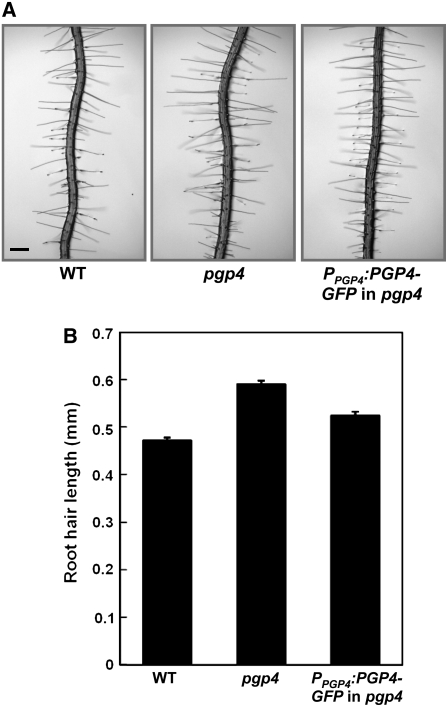
Figure 1.
Figure 1.
The Loss of PGP4 Enhances Root Hair Elongation. (A) Root hair phenotypes of the wild type, the pgp4 mutant, and the complemented transformant (PPGP4:PGP4-GFP in the pgp4 mutant background). Bar = 100 μm for all. (B) Root hair length of the wild type, pgp4, and PPGP4:PGP4-GFP roots. Error bars indicate se (n = 380). The averages are significantly different between the wild type and pgp4 and between pgp4 and PPGP4:PGP4-GFP at P < 0.0001 in Student's t test.
Figure 2.
Figure 2.
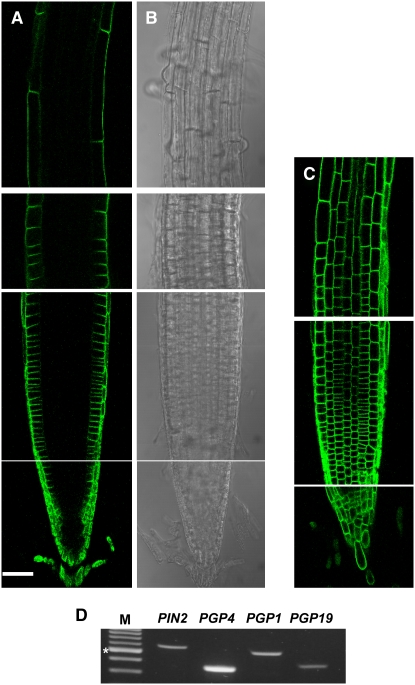
Expression Pattern of PGP4 in the Arabidopsis Root. (A) to (C) Confocal microscopy images of the pgp4 mutant root harboring PPGP4:PGP4-GFP. Bar = 50 μm for all. (A) and (B) Median sectional views of the root: (A) fluorescence; (B) bright field. (C) Optical sections of the root surface tissues (root cap and epidermis). (D) RT-PCR analysis of RNA from Arabidopsis root hair cells. M, 100-bp size maker (* 500 bp).
Figure 3.
Figure 3.
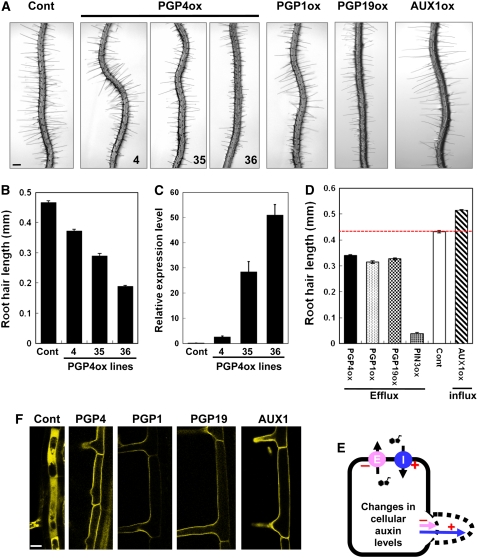
Overexpression of PGP4 in the Root Hair Cell Decreases Root Hair Elongation. (A) Roots of control (Cont; PE7:YFP), PGP4ox (PE7:PGP4-YFP), PGP1ox (PE7:PGP1-YFP), PGP19ox (PE7:PGP19-YFP), and AUX1ox (PE7:AUX1-YFP) transgenic Arabidopsis seedlings. Different numbers for PGP4ox indicate independent transgenic lines. Bar = 100 μm for all. (B) Root hair length of control (Cont) and PGP4ox lines. Error bars indicate se (n = 369 to 414; average = 396). (C) Relative expression levels of PGP4-YFP in terms of yellow fluorescence intensity from PGP4-YFP fusion proteins in the roots of independent transgenic lines. Error bars indicate se (n = 27). (D) Root hair length of control (Cont), PGPox, PIN3ox (PE7:PIN3-YFP), and AUX1ox lines. Error bars indicate se (n = 963 for Cont, 1782 for PGP4ox [from 10 independent lines], 1557 for PGP1ox [from 9 independent lines], 1152 for PGP19ox [from 7 independent lines], 430 for PIN3ox [from 2 independent lines], and 2187 for AUX1ox [from 11 independent lines]). The dashed line indicates the control level of root hair length. The averages for PGP4ox, PGP1ox, PGP19ox, PIN3ox, and AUX1ox are significantly different from that for Cont (at P < 0.0001 in Student's t test). (E) The root hair model illustrating the effects of efflux (E) and influx (I) activities of auxin transporters on root hair elongation. While efflux activity lowers the cellular auxin level and shortens (−) the root hair, influx activity elevates the auxin level inside the cell and stimulates (+) root hair elongation. (F) Confocal microscopy images of root hair cells of control (Cont), PGPox, and AUX1ox transformants. Bar = 10 μm for all.
Figure 4.
Figure 4.
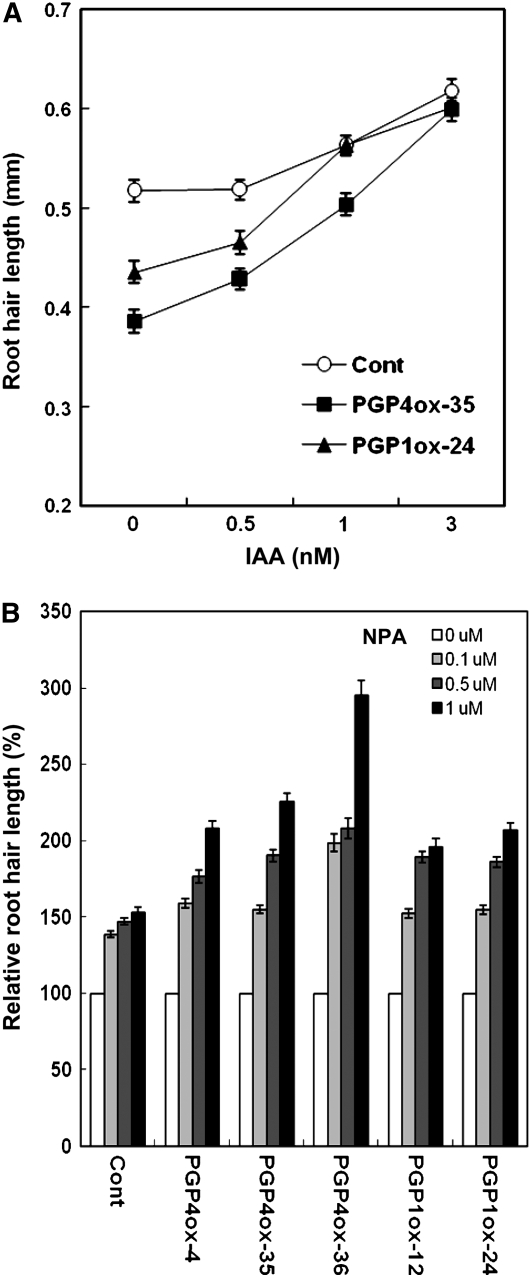
Exogenous IAA or NPA Restores Root Hair Elongation of PGP4ox and PGP1ox Lines. (A) Restoration of root hair elongation by IAA. Error bars indicate se (n = 81 to 126; average = 113). (B) Restoration of root hair elongation by NPA. The root hair length of untreated (0 μM NPA) seedlings was taken to be 100% for each transgenic line. Error bars indicate se (n = 126 to 252; average = 206).
Figure 5.
Figure 5.
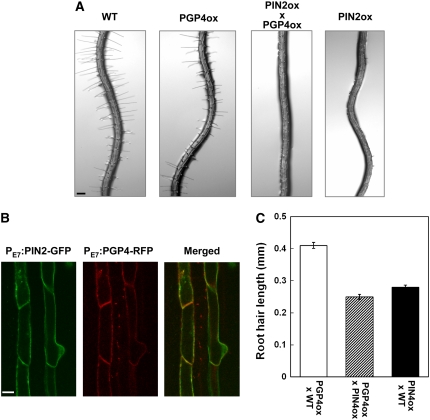
PGP4ox Does Not Rescue the PINox-Mediated Inhibition of Root Hair Elongation. (A) Root hair phenotypes of the wild type, PE7:PIN2-GFP (PIN2ox), PE7:PGP4-RFP (PGP4ox), and the cross line of both transformants (PE7:PIN2-GFP × PE7:PGP4-RFP). Bar = 100 μm for all. (B) Confocal microscopy images of the same root region of the double transgenic line (PE7:PIN2-GFP × PE7:PGP4-RFP). Bar = 10 μm for all. (C) Root hair growth of hemizygous transgenic lines of PE7:PGP4-RFP (PGP4ox), PE7:PIN4-GFP (PIN4ox), and a cross line (PGP4ox × PIN4ox) for both transformants. Error bars indicate se (n = 162 to 207; average = 196). The average for [PGP4ox × PIN4ox] is significantly different from that for [PIN4ox × the wild type] at P < 0.005 in Student's t test.
Figure 6.
Figure 6.
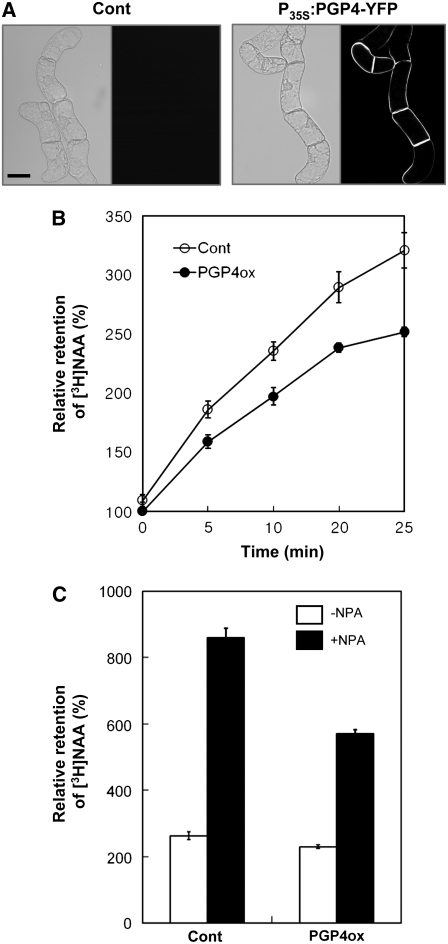
PGP4 Shows Auxin Efflux Activity in Tobacco Cells. (A) Confocal microscopy images of control (Cont) or P35S:PGP4-YFP (PGP4ox) transgenic tobacco BY-2 cells. PGP4-YFP is localized to the cell membrane (right panels). Bar = 30 μm for all. (B) The cellular accumulation of [3H]NAA is reduced by PGP4ox. Data points are percentages of PGP4ox at time 0 after the application of [3H]NAA. (C) Inhibition of cellular auxin efflux by 10 μM NPA. NAA retention was measured at 20 min after incubation. Data represent means ± se from five independent experiments (two replicates for each) for (B) and three independent experiments (two replicates for each) for (C).
Figure 7.
Figure 7.
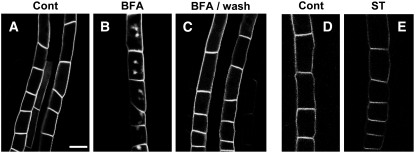
Effects of BFA and ST on the Subcellular Localization of PGP4-YFP. Confocal microscopy images of PE7:PGP4-YFP transformant roots. The transformant seedlings were treated with 0.5× Murashige and Skoog (MS) medium for 2 h ([A] and [D]), 10 μM BFA for 2 h (B), 10 μM BFA for 2 h followed by a washout with 0.5× MS medium for 2 h (C), and 10 μM ST for 2 h (E) before observation. Bar = 10 μm for all.
Figure 8.
Figure 8.
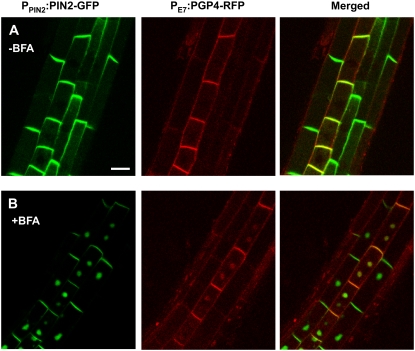
PGP4 and PIN2 Are Colabeled in the Same BFA-Induced Intracellular Compartments. Confocal microscopy images of the same root region of a double transgenic plant (PPIN2:PIN2-GFP × PE7:PGP4-RFP) treated with 0 μM (A) or 50 μM (B) BFA for 2 h. The green fluorescence was from whole epidermal cells expressing PIN2-GFP from the PIN2 promoter, and the red fluorescence was from the trichoblast cell files expressing PGP4-RFP from the EXPA7 promoter. The merged images with a yellowish tone are shown only in the trichoblast cell files. Bar = 10 μm for all.
Figure 9.
Figure 9.
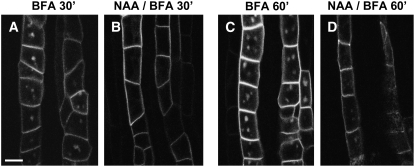
Auxin Inhibits the BFA-Induced Internal Accumulation of PGP4. Confocal microscopy images of PE7:PGP4-YFP transformant roots. Transformant seedlings were incubated with 10 μM BFA for 30 (A) and 60 (C) min or preincubated with 5 μM NAA for 30 min and then cotreated with 5 μM NAA and 10 μM BFA for 30 (B) and 60 (D) min. Bar = 10 μm for all.

References

    1. Bandyopadhyay, A., et al. (2007). Interactions of PIN and PGP auxin transport mechanisms. Biochem. Soc. Trans. 35 137–141. - PubMed
    1. Bassham, D.C., and Raikhel, N.V. (2000). Plant cells are not just green yeast. Plant Physiol. 122 999–1001. - PMC - PubMed
    1. Bechtold, N., and Pelletier, G. (1998). In planta Agrobacterium-mediated transformation of adult Arabidopsis thaliana plants by vacuum infiltration. In Arabidopsis Protocols, J.M. Martinez-Zapater and J. Salinas, eds (Totowa, NJ: Humana), pp. 259–266. - PubMed
    1. Blakeslee, J.J., et al. (2007). Interactions among PINFORMED (PIN) and P-glycoprotein (PGP) auxin transporters in Arabidopsis thaliana. Plant Cell 19 131–147. - PMC - PubMed
    1. Bouchard, R., Bailly, A., Blakeslee, J.J., Oehring, S.C., Vincenzetti, V., Lee, O.R., Paponov, I., Palme, K., Mancuso, S., Murphy, A.S., Schulz, B., and Geisler, M. (2006). Immunophilin-like TWISTED DWARF1 modulates auxin efflux activities of Arabidopsis P-glycoproteins. J. Biol. Chem. 281 30603–30612. - PubMed

Publication types

MeSH terms

LinkOut - more resources