. 2008 Feb;74(4):1064-75.
doi: 10.1128/AEM.02430-07. Epub 2007 Dec 21.

Genetic tools for select-agent-compliant manipulation of Burkholderia pseudomallei

Affiliations

Genetic tools for select-agent-compliant manipulation of Burkholderia pseudomallei

Kyoung-Hee Choi et al. Appl Environ Microbiol. 2008 Feb.

Erratum in

  • Appl Environ Microbiol. 2008 Aug;74(16):5265

Abstract

Because of Burkholderia pseudomallei's classification as a select agent in the United States, genetic manipulation of this bacterium is strictly regulated. Only a few antibiotic selection markers, including gentamicin, kanamycin, and zeocin, are currently approved for use with this bacterium, but wild-type strains are highly resistant to these antibiotics. To facilitate routine genetic manipulations of wild-type strains, several new tools were developed. A temperature-sensitive pRO1600 broad-host-range replicon was isolated and used to construct curable plasmids where the Flp and Cre recombinase genes are expressed from the rhamnose-regulated Escherichia coli P(BAD) promoter and kanamycin (nptI) and zeocin (ble) selection markers from the constitutive Burkholderia thailandensis ribosomal P(S12) or synthetic bacterial P(EM7) promoter. Flp and Cre site-specific recombination systems allow in vivo excision and recycling of nptII and ble selection markers contained on FRT or loxP cassettes. Finally, expression of Tn7 site-specific transposase from the constitutive P1 integron promoter allowed development of an efficient site-specific chromosomal integration system for B. pseudomallei. In conjunction with a natural transformation method, the utility of these new tools was demonstrated by isolating an unmarked delta(amrRAB-oprA) efflux pump mutant. Exploiting natural transformation, chromosomal DNA fragments carrying this mutation marked with zeocin resistance were transferred between the genomes of two different B. pseudomallei strains. Lastly, the deletion mutation was complemented by a chromosomally integrated mini-Tn7 element carrying the amrAB-oprA operon. The new tools allow routine select-agent-compliant genetic manipulations of B. pseudomallei and other Burkholderia species.


Figures
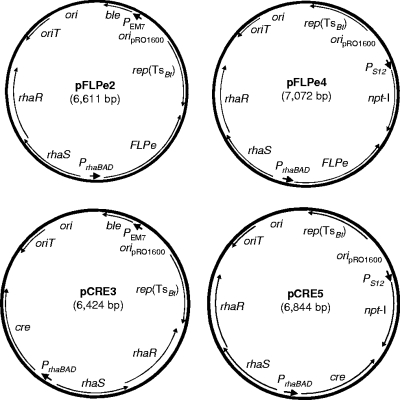
FIG. 1.
FIG. 1.
Curable Flp and Cre recombinase-expressing plasmids. The plasmids contain the following shared features: ori, the E. coli pMB9 origin of replication; ori1600, the pRO1600 origin of replication, requiring the rep(TsBt)-encoded replication protein, which confers a TS phenotype in Burkholderia spp. at temperatures above 37°C; oriT, an RK2-derived origin for conjugal plasmid transfer; and PrhaBAD, the rhamnose-inducible E. coli rhaBAD operon promoter controlled by the rhaR- and rhaS-encoded regulatory proteins. Features unique to individual plasmids include ble, the bleomycin resistance gene, which confers Zeo resistance; cre, the Cre recombinase structural gene; FLPe, a gene encoding an enhanced Flp recombinase which is active over a larger temperature range than the wild-type enzyme; nptI, the neomycin phosphotransferase I gene, which confers Km resistance; PEM7, a synthetic prokaryotic promoter; and PS12, the promoter for the B. thailandensis ribosomal S12 protein-encoding gene.
FIG. 2.
FIG. 2.
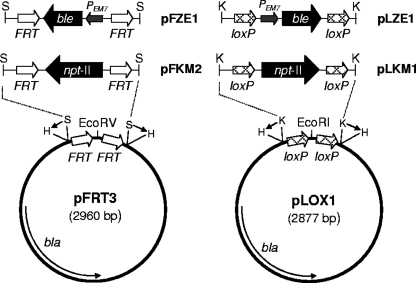
Maps of FRT and loxP cassette vectors. Plasmid pFRT3 was derived from pFRT2 by fill-in of the unique NdeI site in the plasmid backbone. pLOX1 is based on the pFRT3 backbone and contains the pACD4K-C-loxP (Sigma-Aldrich)-engineered 5′ (CTACTTCGTATAGCATACATTATACGAAGTTAT) loxP and 3′ (ATAACTTCGTATAGCATACATTATACGAAGTTAT) loxP sites, which show increased recombination efficiencies. The unique EcoRV and EcoRI sites are used for insertion of antibiotic resistance cassettes. Plasmids pFKM2 and pFZE1 were obtained by insertion of the neomycin phosphotransferase II (nptII) or Zeo binding protein (ble) gene into pFRT3 or pFRT2, respectively (see Table 1 for details). The same genes were inserted into the blunt-ended EcoRI site of pLOX1 to obtain pLKM1 and pLZE1. Abbreviations: bla, Ap resistance (β-lactamase) gene; PEM7, synthetic prokaryotic promoter; S→H, SacI-KpnI-SmaI-BamHI-XbaI-SalI-PstI-SphI-HindIII; K→H, KpnI-SmaI-BamHI-XbaI-SalI-PstI-SphI-HindIII.
FIG. 3.
FIG. 3.
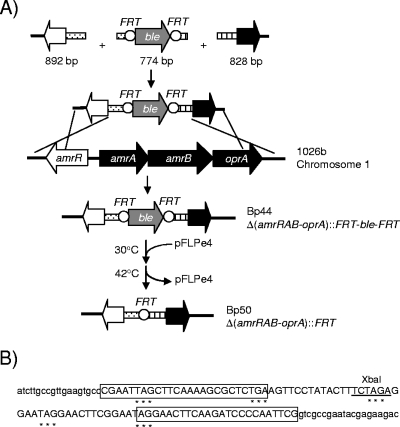
Construction of an unmarked Δ(amrRAB-oprA) B. pseudomallei mutant. (A) Three partially overlapping DNA fragments were PCR amplified in separate reactions and then used as DNA templates in a second PCR to obtain a recombinant DNA fragment containing a ble-encoded Zeo resistance marker flanked by FRT sites as well as amrR and oprA 3′ sequences. This ∼2.45-kb fragment was first cloned into pGEM-T Easy, excised from the plasmid, gel purified, and then introduced into strain 1026b by natural transformation, and Zeo-resistant transformants were selected. For excision of the Zeo resistance marker, the resulting strain, Bp44, was transformed with pFLPe4, followed by plating on rhamnose-containing media at 30°C to derive the unmarked strain Bp50. Plasmid pFLPe4 was then cured by culturing Zeo-susceptible cells at 42°C. (B) Sequence of the FRT scar region present in Bp50. Capital letters indicate the 86-bp FRT sequences. An XbaI site located within the FRT site is underlined, and GmFRT-UP and GmFRT-DN priming sites are boxed. The specific amrR and oprA priming sites are shown in lowercase letters. Asterisks mark potential translational stop codons carried by FRT sequences.
FIG. 4.
FIG. 4.
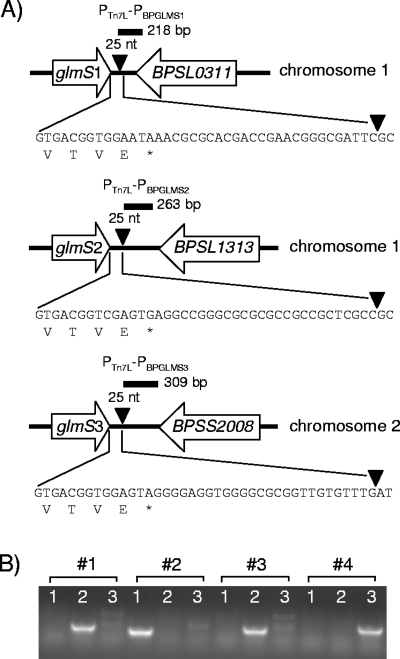
Site-specific Tn7 insertion in B. pseudomallei. (A) The insertion sites in K96243 were derived by PCR amplification of Tn7-chromosomal DNA junction sequences by using PTn7L and glmS1-, glmS2-, and glmS3-specific primers. Transposon-chromosomal junction DNA sequences were determined by sequencing of the PCR fragments (indicated by horizontal bars and labeled with the expected product sizes) amplified with the indicated primer pairs, taking into account the 5-bp duplication generated upon Tn7 transposition. BPSL0311, BPSL1313, and BPSS2008 are B. pseudomallei K96243 genes that encode proteins of unknown functions. Note that although these insertion sites are identical in other B. pseudomallei strains examined in this study, annotation numbers of the downstream genes are different (e.g., for strain 1026b) or not yet available at the time of these studies. Boxed arrows mark genes and their transcriptional orientations. The sequences shown encompass the last five codons of the respective glmS genes and their immediate downstream sequences, including the Tn7 insertion sites, which are marked by triangles. (B) PCR verification of mini-Tn7 insertion in strain 1026b at glmS1 (1), glmS2 (2), and glmS3 (3) by use of the primer pairs shown in panel A. In this particular example, insertion no. 2 is at glmS1, insertions no. 1 and no. 3 are at glmS2, and insertion no. 4 is at glmS3. nt, nucleotides.
FIG. 5.
FIG. 5.
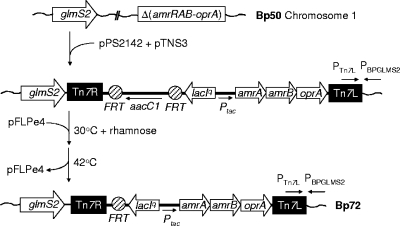
Single-copy gene complementation of a B. pseudomallei Δ(amrRAB-oprA) deletion mutant. The suicide mini-Tn7 delivery plasmid pPS2142 and helper plasmid pTNS3 were introduced into Δ(amrRAB-oprA)::FRT strain Bp50 by conjugation, followed by selection of transformants that were Gm resistant due to the aacC1 gene present on the mini-Tn7 element. In this strain, the 1026b amrAB-oprA operon is transcribed from the tac promoter (Ptac), which is under the control of the lacI-encoded E. coli Lac repressor. The Gm marker flanked by FRT sites was then excised using Flp recombinase, resulting in the unmarked amrAB-oprA-expressing strain Bp72. The negative-control strain Bp73 had the empty mini-Tn7T-LAC vector inserted at the same site on chromosome 1. Insertion at glmS2 on chromosome 1 was verified by PCR using the primer pair PTn7L and PBPGLMS2.

References

    1. Abremski, K., A. Wierzbicki, B. Frommer, and R. H. Hoess. 1986. Bacteriophage P1 Cre-loxP site-specific recombination. Site-specific DNA topoisomerase activity of the Cre recombination protein. J. Biol. Chem. 261:391-396. - PubMed
    1. Barekzi, N., K. Beinlich, T. T. Hoang, X. Q. Pham, R. R. Karkhoff-Schweizer, and H. P. Schweizer. 2000. High-frequency Flp recombinase-mediated inversions of the oriC-containing region of the Pseudomonas aeruginosa genome. J. Bacteriol. 182:7070-7074. - PMC - PubMed
    1. Brent, A. J., P. C. Matthews, T. L. Pitt, and R. Handy. 2007. Misdiagnosing melioidosis. Emerg. Infect. Dis. 13:349-351. - PMC - PubMed
    1. Brett, P. J., D. DeShazer, and D. E. Woods. 1998. Burkholderia thailandensis sp. nov., a Burkholderia pseudomallei-like species. Int. J. Syst. Bacteriol. 48:317-320. - PubMed
    1. Buchholz, F., P.-O. Angrand, and A. F. Stewart. 1998. Improved properties of FLP recombinase evolved by cycling mutagenesis. Nat. Biotechnol. 16:657-662. - PubMed

Publication types