Comparative Study
. 2008 Feb;74(4):1190-7.
doi: 10.1128/AEM.02448-07. Epub 2007 Dec 21.

Melanin-based high-throughput screen for L-tyrosine production in Escherichia coli

Affiliations
Comparative Study

Melanin-based high-throughput screen for L-tyrosine production in Escherichia coli

Christine Nicole S Santos et al. Appl Environ Microbiol. 2008 Feb.

Abstract

We present the development of a simple, high-throughput screen for identifying bacterial strains capable of L-tyrosine production. Through the introduction of a heterologous gene encoding a tyrosinase, we were able to link L-tyrosine production in Escherichia coli with the synthesis of the black and diffusible pigment melanin. Although melanin was initially produced only at low levels in morpholinepropanesulfonic acid (MOPS) minimal medium, phosphate supplementation was found to be sufficient for increasing both the rates of synthesis and the final titers of melanin. Furthermore, a strong linear correlation between extracellular L-tyrosine content and melanin formation was observed by use of this new medium formulation. A selection strategy that utilizes these findings has been developed and has been shown to be effective in screening large combinatorial libraries in the search for L-tyrosine-overproducing strains.


Figures

FIG. 1.
FIG. 1.
Growth and melanin production of K-12 ΔpheA ΔtyrR expressing two versions of the R. etli melA gene. Cultures were grown in M9 minimal medium with l-tyrosine supplementation at 500 mg/liter. Squares, pTrcmelA; triangles, pTrcmelAmut1; open symbols, growth (expressed as optical density at 600 nm [OD600]); solid symbols, melanin production (in milligrams per liter).
FIG. 2.
FIG. 2.
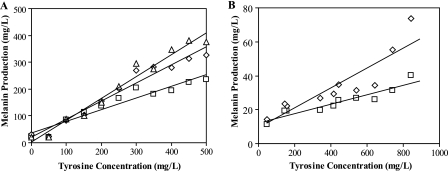
Correlation between melanin production and external l-tyrosine concentrations in different medium formulations. (A) M9 minimal medium. K-12 ΔpheA ΔtyrR/pTrcmelAmut1 was cultivated in 0 to 500 mg/liter l-tyrosine in 50-mg/liter increments. Melanin measurements were taken after 48 h (□), 72 h (⋄), and 96 h (▵) of cultivation. R2 values for the linear regressions were 0.922, 0.956, and 0.968, respectively. (B) MOPS minimal medium. Five l-tyrosine production strains (Table 1, strains A to E) were transformed with pTrcmelAmut1 and assayed for melanin production in medium without l-tyrosine supplementation. In order to probe a wider l-tyrosine concentration range, strain D was also cultivated in medium containing 100, 200, 300, 400, or 500 mg/liter l-tyrosine. For these data points, l-tyrosine concentration was calculated as the sum of strain D's l-tyrosine production level after 24 h (347 mg/liter) and the amount of l-tyrosine that was externally supplemented. Melanin measurements are shown after 313 h (□) and 410 h (⋄) of growth. R2 values for the linear regressions were 0.875 and 0.797, respectively.
FIG. 3.
FIG. 3.
Melanin production by K-12 ΔpheA ΔtyrR/pTrcmelAmut1 in MOPS minimal medium with different amounts of Na2HPO4 supplementation. All cultures were additionally supplemented with 500 mg/liter l-tyrosine. Melanin measurements were taken after 72 h (open bars) and 96 h (solid bars).
FIG. 4.
FIG. 4.
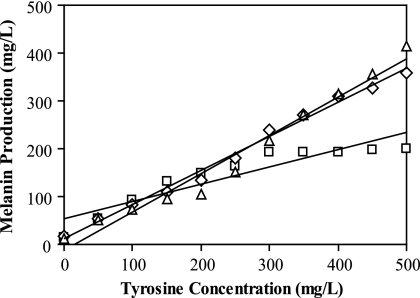
Correlation between melanin production and l-tyrosine supplementation in MOPS minimal medium with 20 mM Na2HPO4. K-12 ΔpheA ΔtyrR/pTrcmelAmut1 was cultivated in 0 to 500 mg/liter l-tyrosine in 50-mg/liter increments. Melanin measurements were taken after 72 h (□), 96 h (⋄), and 120 h (▵) of cultivation. R2 values for the linear regressions were 0.853, 0.992, and 0.970, respectively.
FIG. 5.
FIG. 5.
Melanin production on MOPS agar plates with 20 mM Na2HPO4. (A) Melanin production by K-12 ΔpheA ΔtyrR/pTrcmelAmut1 with l-tyrosine supplementation. (B) Melanin production by five l-tyrosine production strains, A to E, as listed in Table 1. Image brightness and contrast were adjusted with Adobe Photoshop CS2 (brightness, +25; contrast, +45).
FIG. 6.
FIG. 6.
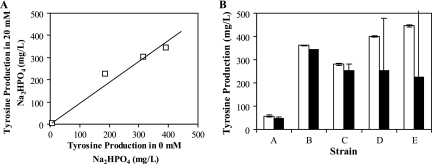
Effects of cellular and cultivation perturbations on l-tyrosine production. (A) l-Tyrosine production by strains A, C, D, and E (Table 1) in 0 and 20 mM Na2HPO4 after 24 h. Each data point represents one strain. (B) l-Tyrosine production of strains A to E (Table 1) with (solid bars) and without (open bars) pTrcmelAmut1 after 24 h.
FIG. 7.
FIG. 7.
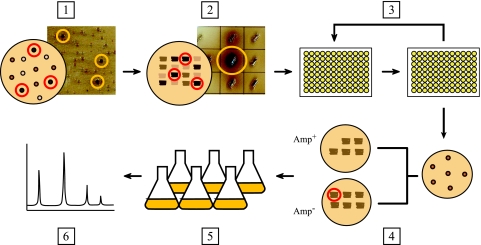
Strategy for screening libraries on solid media. (Step 1) Plate the library of mutants on MOPS agar and incubate strains at 30°C until clear differences in melanin pigmentation are observed (120 to 144 h). Select the darkest colonies from this first round of screening. (Step 2) Streak out the selected colonies on a fresh set of MOPS agar plates. Incubate the plates for an additional 120 to 144 h to allow for melanin synthesis. Select the darkest streaks from this round. (Step 3) Proceed to the plasmid-curing step. This is achieved by subculturing mutants in Amp medium at 37°C to facilitate the loss of pTrcmelAmut1. (Step 4) To verify the loss of the plasmid, isolate single colonies and check for growth on Amp and Amp+ plates. (Step 5) Strains that now exhibit ampicillin sensitivity are cultivated under conditions appropriate for l-tyrosine production (MOPS minimal medium, 37°C). (Step 6) The cell-free culture supernatant is collected and analyzed by HPLC to quantify the l-tyrosine content of the medium. Image brightness and contrast were adjusted with Adobe Photoshop CS2 (brightness, +30; contrast, +30).

References

    1. Alper, H., K. Miyaoku, and G. Stephanopoulos. 2005. Construction of lycopene-overproducing E. coli strains by combining systematic and combinatorial gene knockout targets. Nat. Biotechnol. 23:612-616. - PubMed
    1. Badarinarayana, V., P. W. Estep III, J. Shendure, J. Edwards, S. Tavazoie, F. Lam, and G. M. Church. 2001. Selection analyses of insertional mutants using subgenic-resolution arrays. Nat. Biotechnol. 19:1060-1065. - PubMed
    1. Bailey, J. E. 1991. Toward a science of metabolic engineering. Science 252:1668-1675. - PubMed
    1. Berry, A. 1996. Improving production of aromatic compounds in Escherichia coli by metabolic engineering. Trends Biotechnol. 14:250-256. - PubMed
    1. Bongaerts, J., M. Kramer, U. Muller, L. Raeven, and M. Wubbolts. 2001. Metabolic engineering for microbial production of aromatic amino acids and derived compounds. Metab. Eng. 3:289-300. - PubMed

Publication types

LinkOut - more resources